
Rupiah Closes Lower as US Dollar Advances to Rp18,030
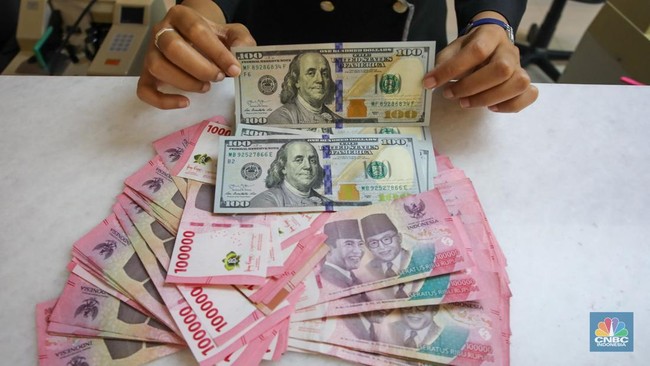
Jakarta, CNBC Indonesia – The rupiah has yet to move away from the Rp18,000-per-US-dollar level. It weakened again at the close of trading on Monday (19 October 2026), amid continued pressure on domestic financial markets.
According to Refinitiv data, the rupiah closed 0.17% lower at Rp18,030 per US dollar, compared with Friday’s (16 October 2026) close of Rp18,000.
Meanwhile, the US dollar index (DXY), which measures the greenback against six major global currencies, was up 0.10% at 101.936 at 3pm Western Indonesian Time (WIB).
The rupiah’s movement was still weighed down by concerns over domestic financial-market conditions following MSCI’s announcement that it may change the classification of Indonesia’s stock market from Emerging Market to Standalone Market.
The pressure continued during Monday’s trading. The Jakarta Composite Index (JCI) opened 4.31% lower at 4,961.88, with 602 shares declining. Several large-cap stocks, including BBCA, BBRI and TLKM, also hit the 7% lower auto-rejection limit.
The JCI’s decline deepened to 5.05%, taking it to 4,923.26 by the end of the first trading session, reflecting continued strong selling pressure in the domestic equity market.
Amid these conditions, the Indonesia Stock Exchange (IDX) was scheduled to meet MSCI online at 3.30pm WIB on Monday to seek clarification over the planned change to Indonesia’s market status.
“This afternoon, we will have an online meeting with MSCI,” IDX President Director Jeffrey Hendrik told reporters at the exchange’s headquarters.
Jeffrey said communications with global investors indicated that market participants had also been unaware of MSCI’s announcement beforehand. The uncertainty could prompt foreign investors to adjust their portfolios and add to pressure on the rupiah.
Even so, Bank Indonesia (BI) remains committed to maintaining the rupiah’s exchange-rate stability.
Erwin Gunawan Hutapea, head of BI’s Monetary and Securities Asset Management Department, said the central bank was committed to remaining present in the market to maintain the rupiah’s stability in line with its fundamentals, through ongoing intervention.
“We will also ensure that market mechanisms function properly. Interventions are continuing consistently through Non-Deliverable Forward (NDF) transactions in offshore markets, spot transactions and Domestic Non-Deliverable Forward (DNDF) transactions in the domestic market, as well as purchases of government bonds (SBN) in the secondary market,” Erwin said, as quoted on Monday (19 October 2026).
Erwin said the rupiah was under pressure amid rising global risk-off sentiment, which was strengthening the US dollar and weighing on domestic financial markets.
He said this meant outflows from domestic portfolio assets were expected to continue. “Outflows from domestic portfolio assets are expected to continue,” Erwin stressed.
Markets are also focused on BI’s Board of Governors Meeting on 20–21 October 2026, with the interest-rate decision due to be announced on Wednesday (21 October 2026).
At its meeting in September, BI kept its benchmark interest rate at 5.75%. With the rupiah and domestic financial markets under pressure, investors are watching this week’s decision, particularly for signals about the central bank’s measures to stabilise the exchange rate.