
Rupiah Closes Flat as US Dollar Holds at Rp17,630
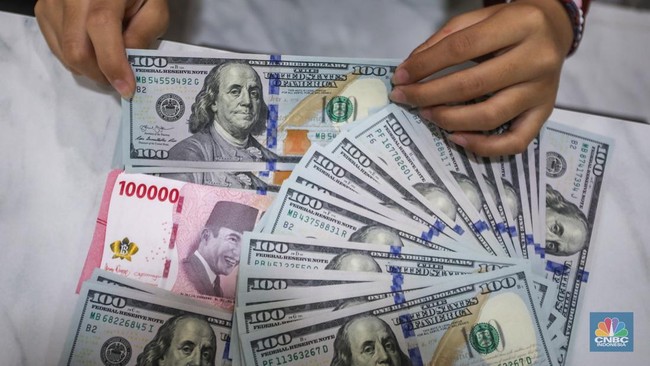
The rupiah closed flat against the US dollar at the start of the trading week.
According to Refinitiv data, at Monday’s close of trading (7/9/2026), the rupiah stood at Rp17,630 per US dollar, unchanged from its last close on Friday (4/9/2026).
The rupiah had in fact opened 0.11% higher at Rp17,610 per US dollar in the morning. However, the Garuda currency then reversed course and weakened to an intraday low of Rp17,665 before trimming its losses and ending trade at the same level as the previous close.
Meanwhile, the US dollar index (DXY), which measures the greenback’s strength against six major world currencies, was down 0.09% at 99.088 as of 15:00 WIB, after closing 0.27% higher in Friday’s trading.
The rupiah’s movement today took place against the backdrop of an announced increase in Indonesia’s foreign exchange reserves and a weakening US dollar in global markets.
Bank Indonesia (BI) reported that Indonesia’s foreign exchange reserves reached US$146.5 billion at the end of August 2026, an increase of US$1.2 billion from the end-of-July position of US$145.3 billion.
The rise in reserves was driven by tax and services receipts as well as the withdrawal of government foreign loans. The increase came despite government external debt payments and BI’s rupiah stabilisation policy.
“Amid government external debt payments and Bank Indonesia’s exchange rate stabilisation policy in response to persistently high global financial market uncertainty,” said BI Executive Director of the Communications Department Ramdan Denny Prakoso on Monday (7/9/2026).
The reserve position is equivalent to financing 5.4 months of imports, or 5.3 months of imports plus government external debt payments, remaining well above the international adequacy standard of around three months of imports.
BI considers the reserves sufficient to support the resilience of the external sector and to safeguard macroeconomic and financial system stability.
The increase in reserves provides a stronger cushion for BI in facing global market volatility and maintaining rupiah stability.
In global markets, the US dollar continued to struggle to sustain gains, even though the odds of a Federal Reserve rate hike rose again following the release of the US jobs report.
Market players are now pricing in roughly a 57% chance that the Fed will raise interest rates in September. Attention now turns to US inflation data scheduled for release on Friday this week.
The dollar remains overshadowed by concerns over the ever-growing US government debt and uncertainty over the direction of US policy.
Several major global central banks are also expected to raise interest rates. This limits the widening of the interest rate differential between the US and other countries, reducing the dollar’s appeal.
The DXY’s weakness gave the rupiah room to recover from its intraday low, though it was not enough to bring the Garuda currency to close in the green.
US inflation data will determine the dollar’s next direction. Inflation higher than expected could strengthen the odds of a Fed rate hike and lift the greenback once again. Conversely, lower inflation could weigh on the dollar and open the way for the rupiah to strengthen.