
Rupiah Closes 0.54% Weaker, US Dollar Settles at Rp17,825
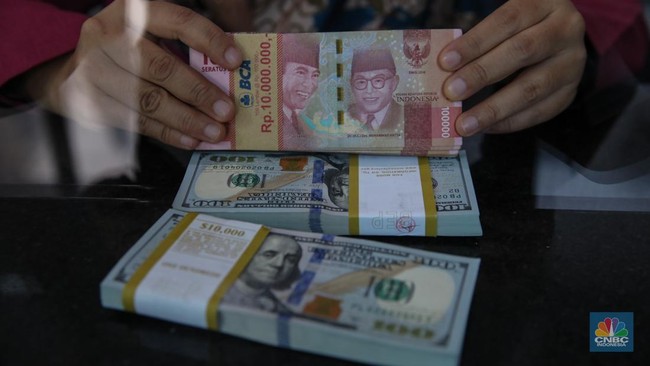
The rupiah exchange rate closed the start of the week with a decline against the US dollar.
According to Refinitiv data, the rupiah ended trading on Monday (21/09/2026) at the position of Rp17,825/US, representingadepreciationof0.54.
Throughout today’s trading, the ‘Garuda’ currency moved within a range of Rp17,740 to Rp17,840/US$. Meanwhile, the US Dollar Index (DXY), which measures the strength of the greenback against six major world currencies, was observed to have strengthened by 0.11% to 100.334 at 15:00 WIB.
The weakening of the rupiah occurred as the US dollar regained strength in the global market. The DXY remained above the 100 level after rising by more than 1% last week, following the Federal Reserve’s decision to raise interest rates and signal that further hikes remain on the table.
Markets are now increasing their expectations for a US interest rate hike in October. Based on the CME FedWatch tool, the probability of a hike at that meeting has reached 55%, up from 42.5% a week earlier.
Beyond Federal Reserve policy, market participants are also monitoring conflicts in the Middle East and the rise in global bond yields. Tensions escalated again after the Houthi group in Yemen stated they had attacked several locations in Riyadh, Saudi Arabia, over the weekend.
Bank Indonesia (BI) considers these tensions to be one of the causes of the pressure on the rupiah today. “The weakening of the rupiah exchange rate is still influenced by concerns over geopolitical tensions in the Middle East, which are driving oil prices to remain high above US$100 per barrel,” said Erwin Gunawan Hutapea, Head of the Monetary Management and Securities Assets Department at BI, in a written statement on Monday (21/09/2026).
According to Erwin, rising oil prices could add to the risks of global inflation and pressure on the fiscal outlook. Domestically, demand for dollars by importers and capital outflows from domestic asset portfolios have also weighed on the rupiah.
“Exchange rate pressure is also driven by the foreign exchange needs of importers as well as capital outflows from domestic asset portfolios,” Erwin added.
Bank Indonesia has ensured it will continue to be present in the market to maintain the stability of the rupiah. Its measures include interventions in the offshore foreign exchange market through Non-Deliverable Forwards (NDF), as well as spot transactions and Domestic Non-Deliverable Forwards (DNDF) in the domestic market. BI also mentioned the purchase of Government Securities (SBN) in the secondary market as part of its stabilisation efforts.