
Rupiah Closes 0.45% Weaker, US Dollar Sits at Rp18,020
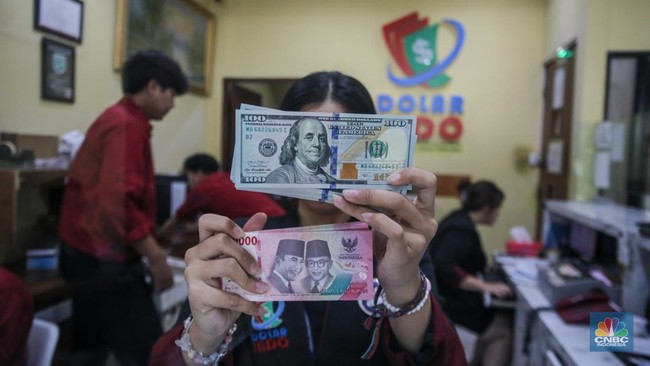
The Rupiah closed weaker against the US Dollar in trading on Thursday (4/6/2026), marking its worst level in history. According to Refinitiv data, the Rupiah depreciated by 0.45% to the level of Rp18,020/US, confirmingthatthecurrencyhasbrokenthroughthenewpsychologicallevelofRp18, 000/US.
Pressure on the Rupiah was evident from the start of trading. The currency opened 0.11% lower at Rp17,960/US.However, onlyminutesaftertheopening, theGarudacurrencyplummetedpasttheRp18, 000/US mark and remained above that level until the close of trading. Meanwhile, the US Dollar Index (DXY), which measures the strength of the greenback against six major world currencies, was observed to have weakened by 0.07% to the level of 99.463.
The deepening depreciation of the Rupiah has prompted a response from the government. Finance Minister Purbaya Yudhi Sadewa revealed that the government has injected more than Rp8 trillion to stabilise the bond market. This measure was implemented to assist Bank Indonesia (BI) in maintaining the stability of the Rupiah exchange rate by conducting buybacks of Government Securities (SUN) sold by foreign investors.
Through this strategy, the government aims to maintain the stability of yields for Government Securities (SBN) in the bond market. “Perhaps more than Rp8 trillion, in bonds,” said Purbaya in the DPR Building area, Jakarta, on Thursday (4/6/2026).
Purbaya emphasised that while the government does not plan to disclose the full progress of the bond market stabilisation policy, the move has already had a tangible impact on the stability of the 10-year benchmark SBN yield. Currently, the yield for the benchmark debt instrument is moving around the 6.7% range. “It is fine if you know I intervened slightly. Consequently, the 10-year yield remains relatively stable,” Purbaya added.
Meanwhile, Bank Indonesia explained that the Rupiah’s weakness is still being influenced by both external and domestic factors. “The exchange rate depreciation is still influenced by the escalating geopolitical tensions in the Middle East, which are hindering peace prospects, thereby driving oil prices higher and increasing global inflation risks and capital outflows from emerging markets,” said BI Senior Deputy Governor Destry Damayanti in a written statement.
“Furthermore, domestic demand remains quite high in line with dividend repatriation patterns and external debt payments,” she added. BI ensured it would increase interventions to curb the Rupiah’s depreciation and ensure market mechanisms function properly. Additionally, BI will continue to strengthen the interest rate structure of pro-market monetary instruments to attract capital inflows into domestic asset instruments. Interventions are being conducted through Non-Deliverable Forward (NDF) transactions in the offshore market, spot transactions, Domestic Non-Deliverable Forward (DNDF) in the domestic market, and the purchase of SBN in the secondary market.