
Rupiah at 17,600 is a Serious Alarm; Government Urged Not to Underestimate Impact on the People
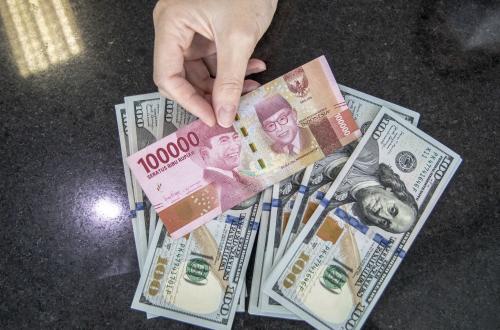
President Prabowo Subianto has once again made a controversial statement that has drawn sharp criticism from the public regarding the weakening of the Rupiah exchange rate. Prabowo suggested that the plummeting value of the Rupiah does not have a real impact on the lives of people in rural areas, as villagers do not use the US Dollar.
Bhima Yudhistuitra, an observer from the Centre of Economics and Law Studies (Celios), criticised the President’s statement, suggesting that Prabowo needs to study the basics of economics, specifically ‘Economics 101’.
Bhima stated that the weakening of the Rupiah clearly impacts the population, including those in rural areas. This is because the correction of the ‘Garuda’ currency will lead to an increase in the cost of living.
“Do not assume that the weakening of the Rupiah against the dollar, at Rp 17,600, will not spread to rising living costs at the village level. It is as if everything can currently be contained by fuel subsidies (BBM) and LPG subsidies,” Bhima said when confirmed by Republika on Sunday (17/05/2026).
The issue, according to Bhima, is that Indonesia is more integrated into the global economic system today than in 1998, when the Rupiah plummeted during the Asian financial crisis. He noted that in 1998, when kerosene prices rose sharply, people could switch to firewood. The situation today is different.
“But where would the firewood come from now? Therefore, the transmission from the global energy crisis and the weakening of the Rupiah exchange rate will have a deadly effect on LPG and the prices of basic necessities,” he explained.
Furthermore, Bhima revealed that rural communities will certainly be affected by the weakening Rupiah due to the use of imported goods. The influx of imported goods required by the community, amidst the correction of the Rupiah, will automatically impact the prices of essential needs.
“Do people in villages not use imported goods? From mobile phones and motor vehicles to electronic components and washing machines—all will be affected. Even fertiliser prices in agricultural centres will be impacted if the Rupiah continues to weaken. It is only a matter of time before these prices begin to pressure rural communities,” he explained.
Bhima also highlighted the broader impact of the Rupiah’s weakness, including widespread layoffs (PHK), which indicates a dangerous condition for the people’s economy.
“Make no mistake, if the Rupiah continues to weaken against the dollar, mass layoffs are a potential risk. Villages will be flooded by those who are victims of layoffs in urban areas. They will return to the villages, but in a position where they are unemployed and without income. This will become a burden on the villages,” he asserted.
Bhima emphasised that President Prabowo’s statements as the nation’s leader in response to the Rupiah’s weakness are highly regrettable. Prabowo is seen as needing to evaluate his communication style to avoid causing ‘turmoil’ in the public sphere.
“We deeply regret that Prabowo is taking the current situation too lightly. In many countries, leaders should be preparing for the worst-case scenario with stimulus and preparing the public. In Indonesia, it seems as though he is almost challenging the situation, but without any preparation. I believe such attitudes and communication methods are very dangerous,” he concluded.
Source: jawawa.id (https://jawawa.id/newsitem/rupiah-at-17-600-is-a-serious-alarm-government-urged-not-to-underestimate-impact-on-the-people-1780929289)
Originally published by Republika (https://ekonomi.republika.co.id/berita/tf7ixn423/rupiah-17600-alarm-serius-pemerintah-diminta-jangan-anggap-remeh-dampaknya-bagi-rakyat), translated from Indonesian