
Rupiah and Yen Strengthen Against US Dollar, While Ringgit and Baht Decline
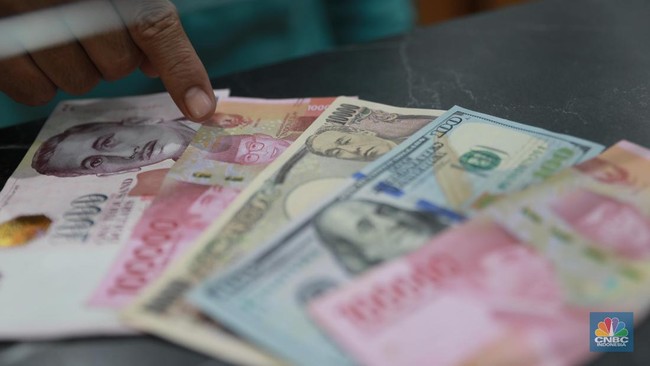
Most Asian currencies managed to strengthen against the US Dollar throughout this week, including the Rupiah. However, in the final trading session of the week, the Indonesian currency closed slightly weaker against the Greenback.
According to Refinitiv data, the Rupiah exchange rate closed down 0.23% at Rp17,585/US$ on Friday (11/09/2026). Despite this, the Rupiah still gained 0.26% over the course of the week, extending a positive trend of six consecutive weeks without depreciation. During the week’s trading, the Rupiah even reached a position of Rp17,500/US$ on Wednesday (09/09/2026), marking its strongest level in 17 weeks, since 15 May 2026.
Significant appreciation was also observed in several other Asian nations. The Japanese Yen was the Asian currency with the sharpest gain this week, appreciating by 1.73%. The Yen even touched its strongest position against the US Dollar in seven months at the start of the week.
This strengthening was driven by rising expectations of a Bank of Japan (BOJ) interest rate hike. Markets anticipate that the Japanese central bank will raise interest rates by 2_5 basis points to 1.25% at next week’s meeting. These expectations strengthened after Japan’s wholesale inflation remained high, providing room for the BOJ to further tighten its monetary policy.
The Yen’s strength was also supported by shifts in investor positioning. Market participants began reducing yen carry trade transactions—a strategy of borrowing yen at low costs to invest in higher-yielding assets in other countries. As Japanese interest rates are expected to rise and the yen strengthens, the cost of closing these loans increases, prompting investors to buy back yen to unwind positions, thereby driving the currency higher.
Furthermore, the Japanese and US governments continue to maintain communication regarding foreign exchange market stability following previous interventions to support the yen. Japanese Finance Minister Satsuki Katayama emphasised that the policy of both nations regarding the foreign exchange market remains unchanged.
Other Asian currencies that strengthened include the Vietnamese Dong by 0.51%, the Rupiah by 0.26%, the South Korean Won by 0.20%, the Chinese Yuan by 0.04%, and the Philippine Peso by 0.02%. Conversely, the Malaysian Ringgit recorded the deepest decline among Asian currencies this week, depreciating by 0.67%.
The diverse movement of Asian currencies this week was influenced by expectations regarding US interest rate policy, surging oil prices, the US-Iran conflict, and projections for a Bank of Japan interest rate hike. While the US Dollar Index (DXY) actually weakened slightly by 0.05% over the week, pressure from the Dollar resurged towards the weekend after US inflation data increased the likelihood of a Federal Reserve rate hike.
US consumer inflation rose by 0.4% month-on-month in August 2026, higher than the 0.1% increase in July. This data led market participants to price in an 86% probability that the Fed will raise interest rates by 25 basis points during its meeting on 15-16 September 2026, up from 72% before the inflation data was released.
In addition to Fed policy, surging oil prices also weighed on Asian currencies. Brent crude prices surged 8.65% during the week, remaining above US$100 per barrel due to supply disruptions in the Middle East. Rising oil prices can increase import burdens and heighten the demand for Dollars in Asian nations that rely on external energy supplies. This pressure helped restrain the appreciation of several regional currencies, even as the US Dollar weakened on a weekly basis.