
Rupiah and Won Strengthen in Tandem, Leading Asia Against the Dollar
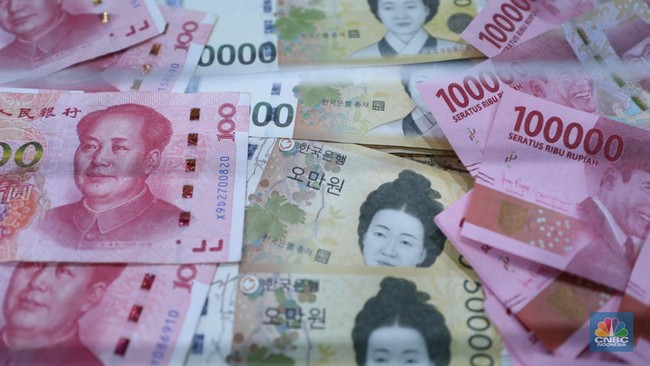
Asian currencies exhibited varied movements against the US dollar during Tuesday morning’s trading (21/4/2026). Markets continue to monitor dollar dynamics amid the latest developments on the potential US-Iran peace agreement, which could lower demand for safe-haven assets.
According to Refinitiv data, at 09:10 WIB, out of 11 monitored Asian currencies, five strengthened, five weakened, and one remained stagnant against the greenback.
Among the strengthening Asian currencies, the rupiah once again led the pack after rising 0.16% to Rp17,137 per dollar. The rupiah even briefly touched Rp17,100 per dollar.
South Korea’s won followed, strengthening to KRW 1,471 per dollar, or appreciating 0.06%. Vietnam’s dong and Malaysia’s ringgit both rose 0.03%, to VND 26,300 per dollar and MYR 3.949 per dollar, respectively.
China’s yuan also joined the list of strengthening currencies, with a slight appreciation of 0.02% to CNY 6.81 per dollar.
Meanwhile, India’s rupee remained stagnant at INR 93.11 per dollar.
On the other side, the deepest weakening occurred in the Philippine peso, which fell 0.26% to PHP 59.95 per dollar. Thailand’s baht weakened 0.22% to THB 32.07 per dollar. Japan’s yen dropped 0.11% to JPY 158.97 per dollar, while Taiwan’s dollar weakened 0.08% to TWD 31.44 per dollar. Singapore’s dollar also fell 0.04% to SGD 1.27 per dollar.
This movement aligns with the US dollar index (DXY), which remained largely stable. At the same time, the DXY rose slightly by 0.02% to 98.118, following a weakening in the previous session.
The stability of the US dollar comes as markets assess the chances of a long-term peace agreement between the US and Iran, which could reduce the need for safe-haven assets.
Markets are also watching the ongoing negotiation agenda. US Vice President JD Vance is scheduled to lead the US delegation back to Pakistan, while Iran is reportedly sending representatives after previously signalling reluctance to join the next round.
On the other hand, US President Donald Trump stated that it is unlikely to extend the current ceasefire if no agreement is reached before its expiration this weekend. Trump also affirmed that the Strait of Hormuz will remain blockaded until an agreement is reached.
The correction in oil prices has also eased inflation pressures and tempered expectations for more aggressive monetary policy. The Federal Reserve is generally expected to hold interest rates this month and is likely to maintain a policy pause throughout 2026.
Market participants are also awaiting developments from the Senate confirmation hearing for Kevin Warsh, Trump’s nominee to lead the Fed.
This agenda is noteworthy as it could influence market expectations for the direction of US interest rates, ultimately affecting the room for manoeuvre of Asian currencies.