
Rupiah and Ringgit Shine Amid Broad Asian Currency Weakness Against the US Dollar
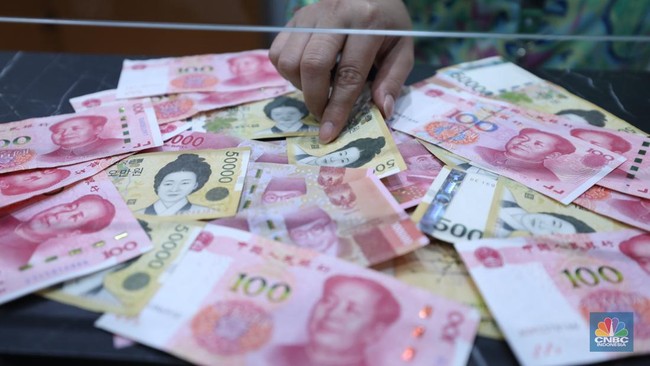
Most Asian currencies weakened against the US Dollar in early trading on Monday (29/6/2026). Pressure remains evident even though the US Dollar Index (DXY) moved slightly lower this morning.
According to Refinitiv data as of 09:10 WIB, out of ten Asian currencies, eight were observed to weaken against the greenback, while two others strengthened. The Malaysian Ringgit recorded the sharpest gain in Asia this morning, rising 0.42% to a position of MYR 4.068/US$.
The Indonesian Rupiah also moved into the green zone. The ‘Garuda’ currency strengthened by 0.20% to a position of Rp17,870/US, pushingtheRupiahslightlyawayfromthepsychologicallevelofRp17, 900/US.
On the other hand, the deepest pressure was experienced by the South Korean Won, which weakened 0.49% to KRW 1,542.4/US.TheThaiBahtalsocorrectedsignificantly, dropping0.42.
The Vietnamese Dong weakened to VND 26,305/US, experiencing0.22. The Chinese Yuan corrected 0.07% to CNY 6.802/US, whiletheTaiwanDollardropped0.05.
A shallower decline was seen in the Philippine Peso, which corrected 0.02% to PHP 61.266/US.TheJapaneseYenalsoweakenedslightlyby0.01.
Meanwhile, the US Dollar Index (DXY) was observed to weaken slightly by 0.01% to 101.347 at the same time. Despite the slight correction, the US Dollar remains at a high level.
The US Dollar is under pressure this Monday morning but remains in its largest monthly upward trend in almost a year. This condition is closely linked to tensions in the Gulf region and market attention towards US labour data, which could influence the direction of US central bank (The Federal Reserve/The Fed) interest rates.
The US and Iran exchanged harsh statements again over the weekend before eventually agreeing to halt mutual attacks and meet in Qatar on Tuesday. However, the fragile ceasefire condition still makes investors cautious.
Oil prices also rose again on Monday after recent attacks slowed energy shipments in the Strait of Hormuz. The rise in oil prices has helped support demand for the US Dollar as a safe-haven asset.
The conflict with Iran also continues to trigger inflation concerns. At the same time, the debut of Kevin Warsh as Fed Chair, which sounded more hawkish earlier this month, has reversed market expectations regarding US interest rate cuts this year.
Based on the CME FedWatch Tool, market participants are now pricing in a 29.90% probability that the Fed will raise interest rates by 25 basis points at the July 28-29 meeting. Meanwhile, the probability of rates being held steady stands at 70.10%.
Beyond geopolitical factors, global equity sell-offs led by the technology sector have also driven capital flows into the US Dollar. Investors are returning to safe havens amidst increasing pressure on risky assets.
Market participants are now awaiting the release of US non-farm payrolls and unemployment rate data this week. This data will serve as a new indicator regarding the strength of the labour market and the future direction of Fed policy.
Joseph Capurso, head of foreign exchange at Commonwealth Bank of Australia, predicts that the US Dollar still has the potential to strengthen in the coming weeks.
“We expect the US Dollar to move higher in the coming weeks due to the narrative of US economic outperformance,” Capurso stated in his notes, as quoted by Reuters.
He added that a strong and improving labour market could be the cause of higher US interest rates and a stronger US Dollar.