
Running Away from North Jakarta
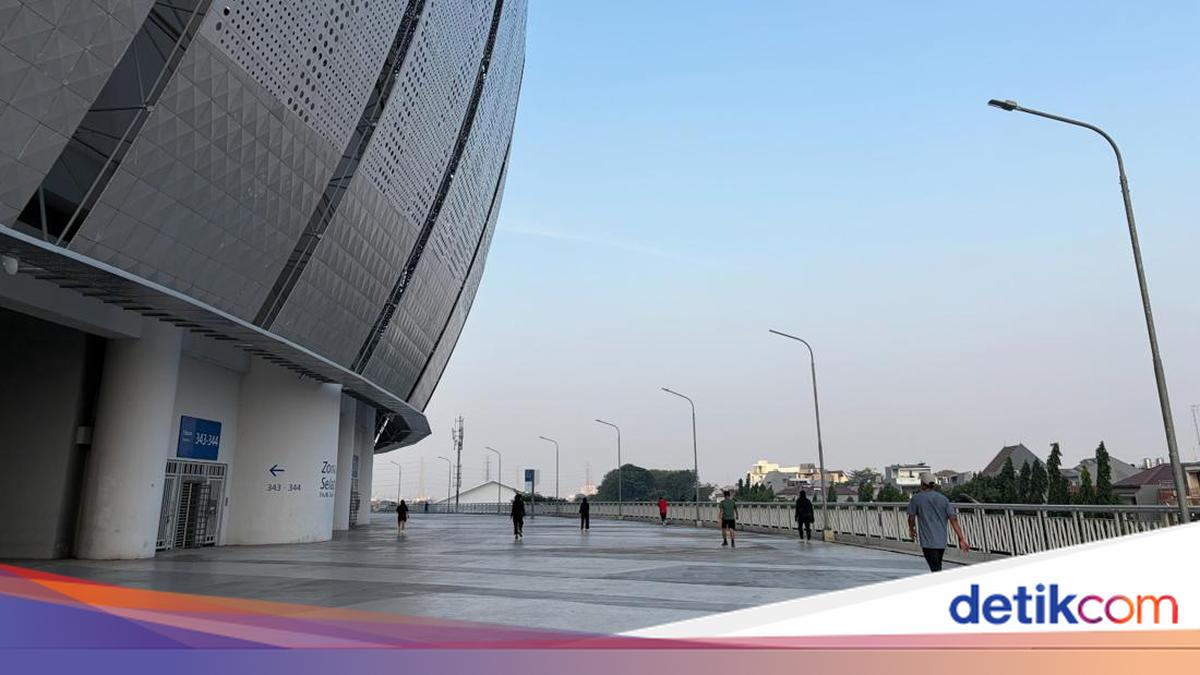
The sky over North Jakarta still held a hint of orange when Gloria Virginta Limbong turned off her motorcycle engine in the parking area of Jakarta International Stadium (JIS). The clock on her phone showed 5:00 PM WIB, that awkward time between the end of work and nightfall. Beside her, Sintia had already removed her helmet, tidying her wind-blown hair after the journey from Tanjung Priok. As part of a slowly forming new habit, their afternoons no longer end at home or a trendy café, but on the jogging track circling the magnificent stadium. “In the past, if you wanted to run, you’d automatically think of GBK (Gelora Bung Karno). I’ve exercised there a few times too,” said Gloria, 28. “But getting there from home was a bit of a hassle. You have to take this and that, not to mention the traffic. Now it’s just more realistic, somewhere close to home, somewhere you can go without overthinking it.”
For years, Gelora Bung Karno was the gravitational centre for Jakarta’s sporting citizens. However, since the Jakarta International Stadium, or JIS, was completed and opened in 2022, that map of habits has slowly begun to change. Not entirely shifting, but at least offering more choices. The main jogging track at JIS is located on the concourse, a vast open area on the upper level that encircles the main building. Connected directly to the west and east ramps, this area, which also serves as a spectator circulation route with around 53 access doors to the stands, has been repurposed daily into a favourite running track. One lap here is roughly one kilometre, depending on the chosen path along the outer, middle, or inner edge. Besides the concourse, JIS also features a running track on the Sky View Deck on the stadium’s top floor. Unlike the concourse, which is the main artery of daily activity, the Sky View Deck offers a running experience from a height with views of the city and the North Jakarta sea. This route is more of an alternative or a complement, as most visitors still prefer the concourse for its easier access, wider space, and direct connection to the stadium’s main entrances. In the distance, the coastline of North Jakarta is faintly visible. Gloria and Sintia usually spend about an hour to an hour and a half on the concourse, jogging slowly, sometimes stopping, sometimes just walking and chatting.
“The nice thing here is it’s not too crowded; you can run without worrying about bumping into people,” said Sintia, 25, who works in the same division as Gloria at Pegadaian. “We can run without having to zig-zag to avoid others. At GBK, especially at this hour, it’s really packed. Sometimes you get more tired from managing your steps than from the running itself.” She added that the atmosphere at JIS feels more relaxed, not too noisy, not too crowded with large communities. There is enough distance between people, a space that makes the activity feel more personal. Still, not everything at JIS is perfect. Gloria pointed to the open area around the stadium, which looks spacious but lacks trees. The afternoon sun, which felt warm earlier, slowly becomes scorching before it finally sets. “It’s still barren. If you come a bit earlier in the afternoon, the heat is really intense. Also, there aren’t many places to eat or drink inside yet. So we usually buy something outside first, or just eat out after exercising.”
Gloria and Sintia’s journey to JIS is relatively simple. From Tanjung Priok, they take a motorbike, a 15-20 minute trip outside peak hours. The ample parking is one reason they feel comfortable coming back repeatedly. But for residents living further away, JIS no longer feels remote. Public transport integration over the last two years has changed things significantly. TransJakarta routes like corridor 14 (Senen–JIS) and 14A (Juanda–JIS) provide direct access to the stadium area. Meanwhile, the presence of the Jakarta International Stadium KRL Station, inaugurated in June 2026, marks a major turning point. From the station, visitors only need to walk about ten minutes to the stadium. The route is connected by a covered corridor, stairs, and a pedestrian bridge (JPO) that leads directly to the JIS area. In fact, passengers do not even need to tap out from the platform before continuing their journey. The flow is designed to be seamless, as if the journey isn’t truly over until one’s feet step onto the stadium grounds. This integration is not just about convenience, but also about unravelling the classic problem of traffic congestion whenever a major event is held at JIS.
A few hundred metres from where Gloria and Sintia were running, Muhammad Yusuf had just finished his third lap. His breathing was still steady, though sweat had soaked his shirt. He is 18 years old, a final-year student at SMAN 40, and lives close enough to walk to the stadium in five to ten minutes. For him, JIS is not just a place to exercise, but a new space to fill his time after school. “I used to run at the sports hall near my house, but the route was really short,” Yusuf said, sitting on the edge of the track. “Here, it’s longer, so it feels more satisfying. I can also manage my pace without having to stop all the time.” He comes about three to four times a week, sometimes alone, sometimes with his girlfriend. The time he spends is not much different from Gloria and Sintia, around an hour or more, depending on his physical condition and the weather. There is a certain pride in the way Yusuf views JIS. For him, the stadium is no longer a distant place or just for major events, but a part of daily life. “It’s like having your own personal space, a spot to sit and relax while enjoying the sunset,” he said. “Especially at night, when the lights are on and the breeze is nice. It makes you want to come back.”