
Rubber Supply Chain Under Pressure, Tyre Industry Strengthens Interventions at Farmer Level
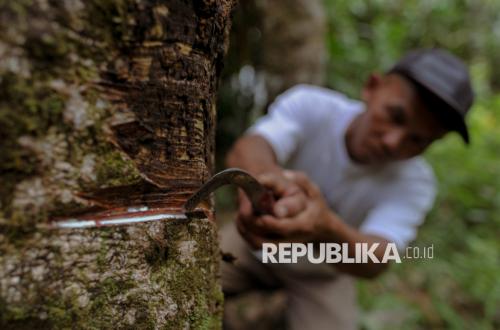
The national rubber industry is facing pressure due to land shrinkage and declining raw material quality, which could disrupt supply stability. Industry players are beginning to strengthen interventions in the upstream sector to maintain production sustainability while improving natural rubber processing standards.
Indonesia remains the world’s second-largest rubber producer, with output of around 2.65 million tonnes in 2023 according to the Central Statistics Agency. However, rubber plantation area has shrunk by an average of 5.7 per cent annually, directly impacting the consistency of supply and raw material quality throughout the production chain.
In response to the situation, PT Hankook Tire Indonesia has distributed rubber processing aid to farmers in Marga Mulia Village, South Sumatra. The programme includes the distribution of 2,500 kilograms of formic acid, 1,000 kilograms of NPK fertiliser, and 200 tapping knives to improve rubber production quality at the farmer level.
President Director of PT Hankook Tire Indonesia, Jung Jinkyun, explained that challenges in the upstream sector are increasing alongside rising production costs and the continued use of coagulants that pose risks to health and the environment. “Through this programme, we aim to address challenges in the upstream rubber industry, especially amid increasing production costs,” he said in a press release on Wednesday (6/5/2026).
Jung added that the use of formic acid is considered safer while helping to standardise the rubber coagulation process, thereby maintaining raw material quality. “We are introducing environmentally friendly and health-safe thickening agents for farmers, as well as ensuring more standardised and efficient processing,” said Jung.
In addition to distributing materials and production tools, the company also provided technical training and demonstrations on formic acid use to around 200 farmers. This education aims to enhance understanding of proper coagulant use, maintain latex quality, and reduce environmental pollution potential from non-standard chemical use.
Director of PT Sri Trang Lingga Indonesia, Chaikrit Rattana, assessed that consistency in processing from the initial stage is a key factor in maintaining natural rubber quality. “We understand that maintaining rubber quality requires a consistent process from the start.”
Chaikrit added that the activity is expected to strengthen ties between farmers and industry players while improving local rubber processing quality. “Today’s activity is expected to have a positive impact, not only in enhancing rubber processing quality but also in strengthening relationships between farmers and industry players,” said Chaikrit.
Head of the Regional Technical Implementation Unit for Rambang Sub-District, Muara Enim, South Sumatra, Malvin, stated that the programme has the potential to encourage more environmentally friendly rubber processing practices while increasing farmer productivity. “This initiative is expected not only to help improve better rubber processing practices but also to have a broader impact on farmer productivity.”
This aid programme was previously implemented in Kalimantan since 2022 and expanded to South Sumatra this year. The effort is part of the industry’s strategy to strengthen more responsible natural rubber procurement practices, including the implementation of sustainable rubber policies, supply chain transparency, and prevention of deforestation and peatland protection.
Strengthening farmer capacity is seen as a crucial factor in maintaining the competitiveness of the rubber-based industry amid production cost pressures and land use changes. Collaboration between industry and farmers is considered increasingly vital for the stability of automotive sector raw material supply in the coming years.