
RPN intensifies control of leaf fall disease in rubber trees
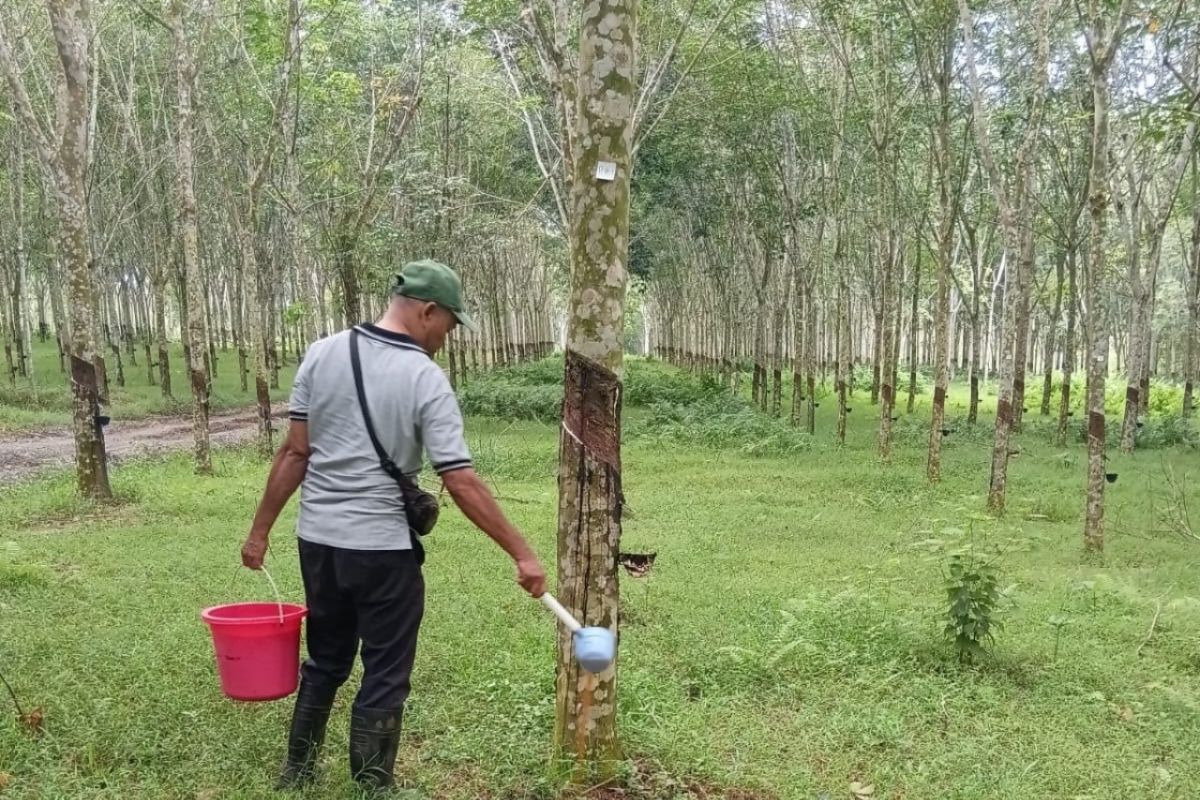
PT Riset Perkebunan Nusantara (RPN) is intensively carrying out prevention and control of pestalotiopsis leaf fall disease on rubber trees at the Sungei Putih experimental plantation in Deli Serdang, North Sumatra.
Dr Tri Rapani Febbiyanti, a researcher at RPN’s Sungei Putih Research Unit, said the strategic measures and rapid action were taken as a form of commitment to curbing the spread of the parasitic fungus that threatens the productivity of the national rubber commodity.
The disease, caused by infection with the fungus Pestalotiopsis sp., is known to be highly aggressive in damaging the leaf canopy of rubber plants, disrupting the photosynthesis process and triggering a significant decline in latex production if not handled quickly and systematically.
“Responding to this threat, a joint team consisting of researchers and field technical staff is implementing an Integrated Pest Management (IPM) strategy,” she said.
Operational measures are focused on spraying fungicide evenly onto the canopies of tall trees using mist blower equipment, carrying out weed sanitation in the tree disc areas, and monitoring attack intensity periodically at sample locations in the experimental plantation.
In addition to curative actions, supplementary nutrient fertilisation is also being optimised to accelerate the formation of new, healthier leaves that are more resistant to secondary attacks.
She said the field technical intervention was designed in a measured way to safeguard the economic threshold of rubber plant production.
“This integrated control focuses on reducing the severity of the disease directly in the plant canopy. Through periodic monitoring and appropriate nutrient supplementation, we are accelerating the recovery and formation of healthy new leaves so that daily latex production capacity remains optimally maintained,” she said.
She said the technical intervention was designed to maintain the economic threshold of rubber production at the experimental plantation.
Currently, pestalotiopsis attacks in the North Sumatra region show fluctuating intensity levels, but have the potential to trigger massive leaf fall and suppress latex productivity if the wet climate cycle supports spore development.
The implementation of the IPM strategy at the experimental plantation is not only aimed at biologically suppressing the rate of pathogen infection, but also serves as a strategic measure in maintaining the economic threshold of rubber production.
By calculating the ratio of operational control costs to the potential magnitude of latex yield loss, plantation management can ensure that every intervention action carried out, such as spraying frequency and fertiliser dosage, remains efficient, rational and provides an optimal profit margin for the sustainability of the rubber commodity.
“This integrated control focuses on reducing the severity of the disease directly in the canopy. Through periodic monitoring and appropriate nutrient application, we are accelerating the formation of healthy new leaves so that latex production capacity is maintained,” she said.
Head of the Rubber Research Centre Dr Suroso Rahutomo said that through the implementation of Integrated Pest Management standards, the Rubber Research Centre of PT Riset Perkebunan Nusantara is not only committed to securing plant assets at the Sungei Putih Experimental Plantation.
It is also preparing technical recommendations that can be replicated by farmers and rubber plantation managers in North Sumatra and, of course, throughout Indonesia.