
Rp 300 Trillion Successfully Saved, Prabowo: Thanks to Cuts in Unproductive Spending
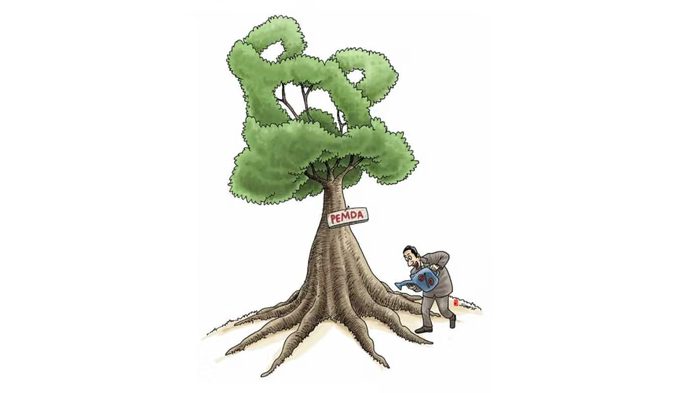
President Prabowo Subianto has stated that the government has managed to save up to Rp308 trillion in the budget after implementing efficiency policies by cutting unproductive spending items.
In a discussion session with several journalists and economists at President Prabowo’s private residence in Hambalang, Bogor Regency, West Java, this week, President Prabowo explained that the massive efficiency of the state revenue and expenditure budget (APBN) aims to save the people’s money from potential criminal acts of corruption.
“When we first carried out efficiency, we saved Rp308 trillion from the central government. Where did that come from? From all the unreasonable expenditures. My conviction is that all this Rp308 trillion, if not cut, would lead to corruption,” said President Prabowo when discussing efficiency issues in an event titled “President Prabowo Answers”, as quoted from the official broadcast of the Indonesian Government Communication Agency confirmed in Jakarta, Thursday (19/3).
The President explained the need for efficiency by looking at Indonesia’s ICOR score, which tends to be higher than that of neighbouring countries.
ICOR or Incremental Capital Output Ratio is an indicator that shows the level of efficiency in using a country’s budget. The lower the ICOR score, the more efficient the country is in using its budget.
Indonesia, said President Prabowo, has a score of 6.5, while neighbouring countries such as Thailand and Malaysia each have 4, and Vietnam 3.6.
Reflecting on the APBN approaching Rp3,700 trillion (about US$230 billion), President Prabowo estimated that budget inefficiency reaches approximately 30% or about US$75 billion.
“So, this figure means 30%, much less efficient than Thailand, Malaysia, the Philippines, or Vietnam. If I use this as a basis, it approaches our GDP of Rp3,700 trillion or US$230 billion. Around 30% of that is US$75 billion. This is inefficient,” he said.
On the same occasion, the President then outlined the unproductive spending items that have been cut, including the purchase of office stationery, expenditures for meetings and seminars outside the office, and the habit of procuring goods such as computers and office equipment almost every year.
Not only that, the President also found studies that do not address main issues, such as poverty and employment.
Therefore, the President emphasised that the efficiency policy will continue to be maintained given the threat of crisis that many countries, including Indonesia, will face.
Several countries, the President stated, have anticipated the potential crisis by issuing policies to reduce working days and implement a work-from-home (WFH) system.
“I see other countries, for example, working days from five to four days, the Philippines, Pakistan. Then work from home. During COVID, we did it quite successfully. I think we can do that too. Maybe 75% of employees or staff can work from home,” said the President. (Ant/P-3)
He emphasised that the government will continue to prioritise more productive and targeted spending.
He stressed that the public needs concrete examples from leaders regarding efforts to efficiency the state budget.