
Rosan Targets Indonesia's Investment to Reach Rp13,033 Trillion by 2029
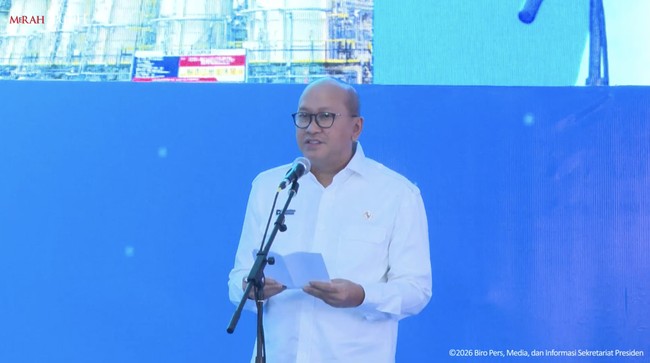
The Ministry of Investment and Downstreaming/Investment Coordinating Board (BKPM) requires an investment achievement of up to Rp13,032.8 trillion by 2029. Minister of Investment and Downstreaming Rosan Roeslani stated that this is intended to support the 8% growth target of President Prabowo Subianto’s administration.
According to the Minister, the target of Rp13,032.8 trillion represents a 143% increase from the realised investment over the last 10 years. “The increase is indeed quite significant. However, our investment strategy is not solely about chasing dominance or nominal amounts, but also aims to ensure that the incoming investment is high-quality,” he said at the DPR RI building in Jakarta on Monday (15/06/2026).
Investment realisation in the first quarter of 2026 reached Rp498.8 trillion. Amid global geopolitical and geo-economic dynamics, this achievement grew by approximately 7.2% year-on-year, representing 24.4% of the total target for 2026. This investment has also absorbed approximately 700,000 direct workers, an increase of 18.9%, which does not include indirect labour from supporting investment activities.
Rosan detailed that Domestic Direct Investment (PMDN) contributed approximately 49.9%, or Rp248.8 trillion, growing by about 6% year-on-year. Meanwhile, Foreign Direct Investment (PMA) contributed a nearly equal share of 50.1%, amounting to Rp250 trillion.
The distribution of investment realisation this year is split between Java and regions outside Java. The proportions are almost equal, with Java contributing 50.4% (Rp251.3 trillion), slightly exceeding investments outside Java at approximately 49.6%. The four main investment locations in Java are Jakarta, West Java, Banten, and East Java. However, five provinces outside Java also ranked in the top 10 investment locations: Central Sulawesi (6.4% of national total), North Maluku (5%), Riau Islands (4.8%), West Nusa Tenggara (3.6%), and East Kalimantan (3.2%).
Rosan noted that the primary sectors for investment realisation include the metal industry, services, mining, housing, industrial estates, offices, logistics, and telecommunications.
Regarding the source of foreign investment, there have been no significant changes; Singapore remains the leader at position one, followed by Hong Kong as a global business hub with US$4.6 billion and US$2.7 billion respectively. This is followed by China at US$2.2 billion, the United States at US$1.3 billion, and Japan at US$1 billion. Outside of Asian investment, the UK, the Netherlands, and Australia also featured in the top 10. Overall, Europe and North America each contributed 10%, indicating that investment sources remain well-diversified globally.
Rosan mentioned that the downstreaming of natural resources has increased its contribution to 30% of the total investment realisation entering Indonesia. In the first quarter of 2026, this amounted to Rp147.5 trillion, growing by 8.2% year-on-year. The mineral sector continues to dominate at approximately 67% (Rp98.3 trillion), followed by plantations and forestry (Rp29.8 trillion), oil and gas (Rp17.7 trillion), and fisheries and marine sectors (Rp1.7 trillion).
Rosan added that the ministry continues to encourage contributions from other strategic downstreaming communities that produce high-value-added products, such as semiconductors, bioethanol, coconut derivatives, and seaweed. Downstreaming also contributes significantly to investment sources outside Java; in the first quarter of 2026, 70% of downstreaming activities were located outside Java, particularly in Central Sulawesi and North Maluku, supported by nickel downstreaming and the electric vehicle battery ecosystem.
Source: jawawa.id (https://jawawa.id/newsitem/rosan-targets-indonesias-investment-to-reach-rp13-033-trillion-by-2029-1781506251)
Originally published by CNBC Indonesia (https://www.cnbcindonesia.com/news/20260615115210-4-742889/rosan-targetkan-investasi-ri-tembus-rp13033-t-di-2029), translated from Indonesian