
Rosan: Government Cuts Regulations and Strengthens Danantara to Chase US$790 Billion Investment
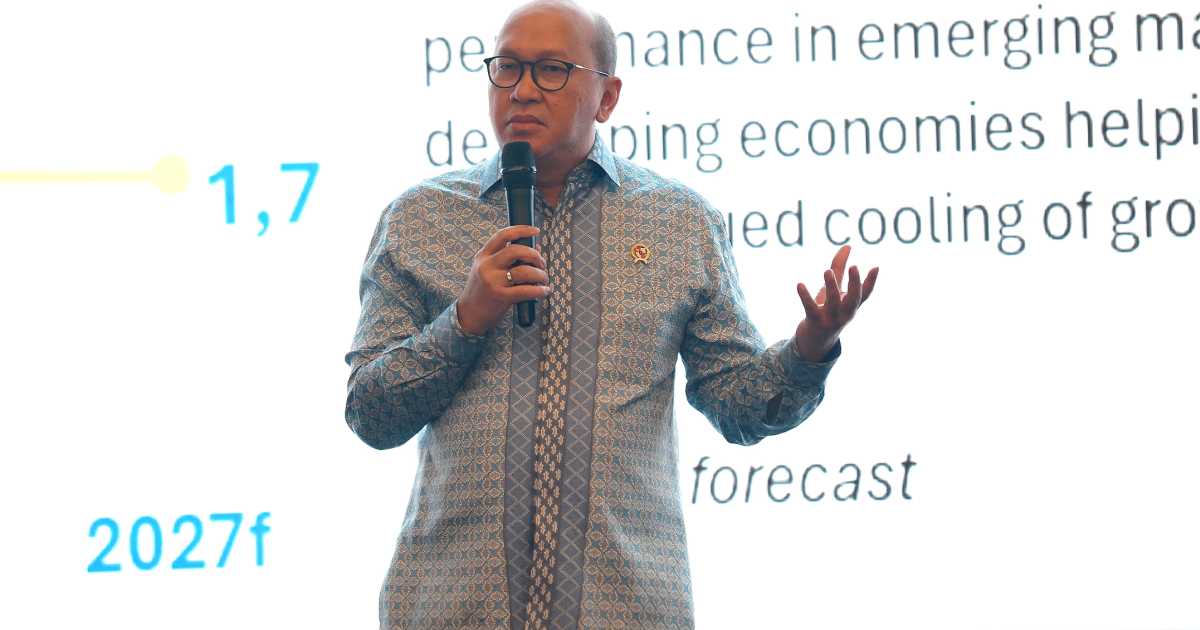
Indonesia’s Minister of Investment and Downstreaming/Chief of BKPM RI, as well as CEO of Danantara Indonesia, Rosan P. Roeslani, emphasised that the government is continuously improving the national investment climate through regulatory simplification, bureaucracy reduction, enhanced legal certainty, and strengthened governance of state-owned enterprises (SOEs) to attract major investments and pursue an 8% economic growth target.
Rosan conveyed this during the Kadin Indonesia Monthly Diplomatic Economic Breakfast at the Auditorium on the 3rd Floor of Wisma Danantara Indonesia, Jakarta, on Friday (08/05/2026). The event, initiated by Kadin Indonesia, was attended by Kadin Indonesia General Chairman Anindya Novyan Bakrie, Vice Chairman Coordinator for Foreign Affairs James T. Riady, dozens of ambassadors and diplomatic corps members, regional Kadin leaders, national and international business actors, and government officials.
In his speech, Rosan stated that the world is currently facing severe challenges due to geopolitical tensions, geo-economic conflicts, supply chain disruptions, protectionism, and slowing global economic growth. However, amid this situation, Indonesia is still able to maintain its economic growth momentum. “Indonesia, despite all these challenges, geopolitical tension, geo-economic tension, Indonesia still managed to have economic growth this quarter at 5.61%,” said Rosan.
According to him, investment is now one of the main engines of Indonesia’s economic growth. Previously, domestic consumption was the largest contributor to gross domestic product (GDP), but the contribution of investment has significantly increased.
Rosan explained that the contribution of investment to national economic growth now reaches around 1.79 percentage points out of the total economic growth of 5.61%, or about 31%-32%. “Previously, the investment contribution was around 27%-28%, then rose to 30%, and now reaches almost 32%. That’s why we can achieve 5.61% growth,” he said.
Nevertheless, the government does not want to stop at 5% growth. According to Rosan, President Prabowo Subianto has a big ambition to bring Indonesia to 8% economic growth.
To achieve this target, the government estimates that Indonesia needs around US$789.9 billion in investment over the next five years. “In the last 10 years, investment realisation reached around US$515.6 billion. But for the next five years, we need almost US$790 billion to achieve 8% economic growth,” he said.
Specifically for 2026, Indonesia’s investment target is set at US$123.7 billion. Rosan is optimistic that this target can be achieved if the government, business world, and international partners strengthen collaboration and synergy. “Is this achievable? Yes, achievable if the government, private sector, and international partners work together,” he said.
Although acknowledging that the target is not easy amid global uncertainties, Rosan emphasised that Indonesia still has very strong investment appeal. In the first quarter of 2026, Indonesia’s investment realisation reached around US$30.2 billion and successfully created around 700,000 new jobs. Singapore remains Indonesia’s largest foreign investor over the past decade, followed by Hong Kong, China, the United States, Japan, South Korea, and the Netherlands.
To accelerate investment flows, the government continues to improve the national investment climate through regulatory and bureaucratic reforms. “Indonesia is open for business,” Rosan asserted.
According to him, the government continues to strive to cut unnecessary rules, reduce cross-sectoral and cross-level bureaucratic barriers, and increase legal certainty for domestic and foreign investors.
“The government continues to endeavour to reduce unnecessary regulations, improve legal certainty, and refine investment policies,” he said. Rosan stated that regulatory reform is very important because long-term investment requires certainty, efficiency, and stability.
In addition to improving regulations, the government is also strengthening downstream strategies as the main driver of national investment. Currently, around 30% of Indonesia’s investment comes from the downstream sector, particularly minerals. However, the government is not only focusing on mining downstream like nickel, bauxite, and copper, but also expanding downstream to plantation, forestry, oil and gas, fisheries, and maritime sectors.
Rosan explained that Indonesia has a very strategic position in the global supply chain because it controls around 42% of the world’s nickel reserves. Indonesia is also one of the world’s major producers of various important commodities such as seaweed, shrimp, and coconut. “If talking about tropical seaweed, Indonesia is number one in the world,” he said.
The government, continued Rosan, is starting to seriously promote coconut downstream as a high value-added industry. One coconut downstream investment worth US$100 million can even create around 10,000 jobs.
Danantara
On that occasion, Rosan also explained the development of Danantara Indonesia as Indonesia’s national sovereign wealth fund. According to him, Danantara has a different structure from other sovereign wealth funds because it consolidates all Indonesian SOEs under one national investment entity.
Initially, the government estimated that only around 700 state companies would be consolidated. However, after conducting an inventory, the number turned out to reach around 1,044 companies. “Most of them turned out not to be running well, ba
Source: jawawa.id (https://jawawa.id/newsitem/rosan-government-cuts-regulations-and-strengthens-danantara-to-chase-us-790-billion-investment-1778248456)
Originally published by investortrust.id (https://investortrust.id/business/102752/rosan-pemerintah-pangkas-regulasi-dan-perkuat-danantara-untuk-mengejar-investasi-us790-miliar), translated from Indonesian