
Rogue Cypriot Bank Unit’s Depositors Still in Limbo
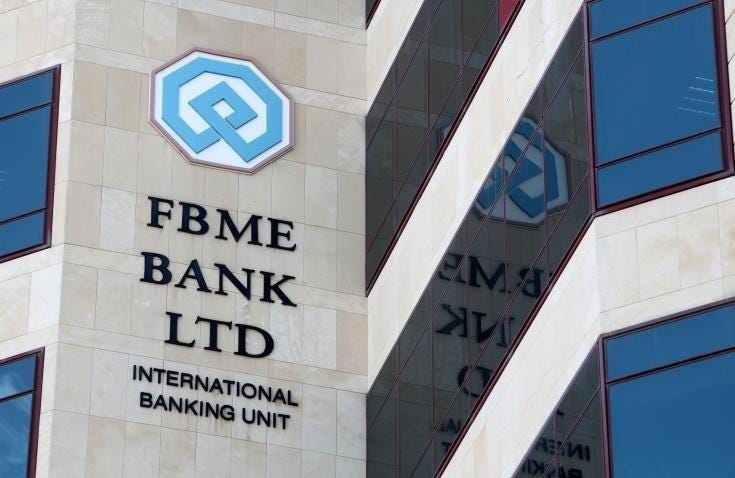
Rogue Cypriot Bank Unit’s Depositors Still in Limbo
Depositors say liquidator slow-walks zombie FBME’s dissolution
Twelve years after the US Treasury’s Financial Crimes Enforcement Network (FinCEN) designated the notorious FBME Bank Ltd as a “financial institution of primary money‑laundering concern” and the Central Bank of Cyprus put the Cyprus branch out of business, not a single prosecution for money laundering or any other crime has resulted, and creditors in the UK reportedly have taken their own lives out of frustration, jilted depositors say.
“More than 90 percent of FBME depositors were legitimate businesses, most of whom are still waiting for their money back,” said James Sutherland, chairman of Zetland Fiduciary Group, a Hong Kong-based global corporate services provider, which has US$100 million tied up out of the €1.3 billion still frozen in foreign banks abroad, with client funds tied up that could run up to US$300 million. “The Cyprus authorities have grossly mishandled the bank which was perfectly solvent and could have been sold. The depositors are now being milked by the liquidator and lawyers. In short, Cyprus, a member of the EU, is worse than a third world country.”
In a 2022 letter to the Sunday Mail, a group of UK-based depositors who said they wished to remain anonymous, urged the Cyprus central bank to take control of the funds in FBME, owned by Lebanese brothers Ayoub-Farid Saab and Fadi Saab, and return them to their rightful owners, blaming Cyprus for the deaths of several savers who committed suicide.
Instead, Sutherland charged, the Cyprus administrative court has appointed as liquidator Petros Ioannides of BDO Cyprus, a professional services firm, who allegedly has been throwing roadblocks in front of the creditors for the better part of four years, ignoring provisions of the agreement including deducting 1 percent of distributions as an additional fee despite remuneration totalling €1.35 million stipulated in the agreement for the first three years of the liquidation process, potentially producing as much as €13 million in additional fees, and delaying an initial dividend of 45 percent of claims with little allegedly disbursed to date.
Lawyer says charges are false
“Our client strongly denies these allegations,” said Maria Macridou, Ioannides’s lawyer in a broadly-based reply to Sutherland’s charges. “Our client was appointed at a time when the bank had been inactive for approximately 10 years. Upon assuming this role, he was required to undertake the complex task of re-establishing operational systems and gathering the necessary information and records. These were inherently time-consuming and technically demanding processes. At no point did our client delay the procedure, whether intentionally or otherwise. Any time taken was solely attributable to the complexity and circumstances of the matter. This was identified objectively by the court, and relevant extensions have been provided by the Nicosia District Court to the deadlines contained within the LFA, as this was not anticipated at the time of establishing the liquidation plan 10 years ago, when the bank ceased its operations.”
The liquidator hasn’t improperly deducted 1 percent on distributions, Macridou said, including in acceptance letters the specific provision of the 1 percent deduction to accommodate increased costs of the liquidation, “in light of the challenges faced that have not been foreseen in the original plan submitted 10 years ago. The subject provision has been approved by the Inspection Committee and is communicated to every single creditor who has the right to object within a period of 21 days directly to the Liquidator or via the Court, as per the applicable legislation.”
Although Sutherland said many banks have the same kind of dodgy depositors that FBME did, the bank was actually one of the world’s most corrupt. In the middle of the past decade, the Cyprus branch of the bank was the subject of a series of stories by Asia Sentinel that described the alleged laundering of hundreds of millions of US dollars out of the Indonesia-based Bank Mutiara, formerly known as Bank Century, which was looted by its owner, Robert Tantular, during the global financial crisis of 2009. The Cyprus unit of the Tanzania-based bank was described as one of the most infamous money-laundering operations in the world, with depositors allegedly including Russian Mafia suspects, central African satraps, pornographers, internet scam artists and a long list of other outlaws.
Hundreds of millions of dollars, alleged to have been siphoned out of Hermitage Capital, the Moscow-based investment concern headed by William Browder, were said to have been directed into FBME, making it a player in one of the world’s most infamous financial scandals. Sergei Magnitsky, an associate of Browder’s, was said to have been beaten to death in a Moscow jail when he tried to investigate the theft of Browder’s funds. Browder was forced to leave Russia. Eventually, the US Congress passed the Magnitsky Act banning a list of Russian individuals believed complicit in the killing from using the US financial system to move funds around the world, in effect freezing them.
FinCEN bar
In 2017, US district court granted a motion by FinCEN to bar FBME Bank from US operations, effectively barring it from access to the global financial system, sending the decision to the Central Bank of Cyprus and the Central Bank of Tanzania, which were supposed to begin disposing of US$2.6 billion in depositors’ funds. Depositors were given 90 days to file claims for the return of their money although sources told Asia Sentinel at the time that hundreds of millions were likely to go unclaimed because coming forward to do so would identify them.
However, Tanzania and Cyprus became embroiled in a contest for jurisdiction over the dissolution of the bank, with the Cyprus central bank refusing to talk to the authorities in Tanzania, where FBME was headquartered, unt