
Robots Replace Human Police for 3 Days, Recording 12,000 Traffic Violations
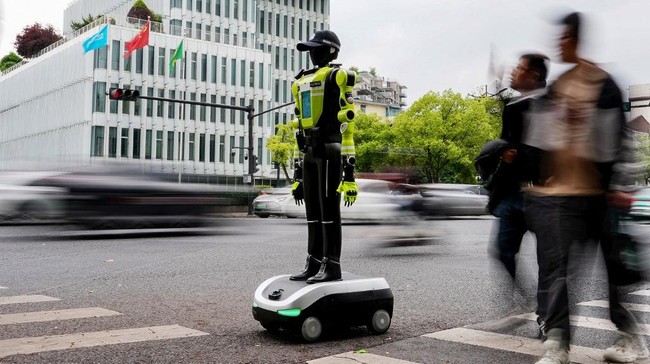
On 1 May 2026, an unusual sight appeared on the streets of Hangzhou, Zhejiang province, as several robots were deployed as traffic police. A total of 15 robots were operating, working in collaboration with human officers to manage traffic flow, according to reports from the Global Times.
The Hangzhou Traffic Police Bureau explained that the robots were deployed at major intersections across several districts, covering vital areas such as the West Lake tourist attraction, lakeside commercial zones, and main urban thoroughfares. These robots are tasked with directing both vehicles and pedestrians, including managing traffic flow and assisting tourists with navigation. Tourists needing assistance can use a voice button to ask questions; the robots then analyse the request and provide walking or transport routes via visual guidance on their screens.
Equipped with high-performance visual recognition algorithms, the robots can detect various traffic violations. They are also integrated with signal control systems to execute eight different types of traffic commands. These robotic officers can operate continuously for 8 to 9 hours. Local officials stated that the use of robots aims to free up human police officers from repetitive tasks, such as blowing whistles or providing manual directions.
China has been operating robots in real-world scenarios well before May, such as providing traffic support during marathons to gain operational experience. During the Labour Day holiday, the deployment shifted from event-based use to managing high-volume traffic, moving from a pilot phase to large-scale operations.
The role of these robotic officers extends beyond mere traffic regulation. Their advanced visual recognition systems can automatically detect various offences, including motorcyclists not wearing helmets, vehicles stopping over the stop line, exceeding passenger limits on motorcycles, and pedestrians crossing motor vehicle lanes. Upon detecting a violation, the robots issue an immediate verbal warning via built-in loudspeakers. If a violator ignores the warning three consecutive times, the system automatically records the incident and transmits the data to the police control centre for further processing.
According to the Hangzhou Traffic Police Bureau, during the first three days of their operational trial, the robot fleet successfully intervened in nearly 12,000 traffic violations. On average, each robot performed a corrective action every 1 minute and 43 seconds.