
Roblox, A World Without Fences
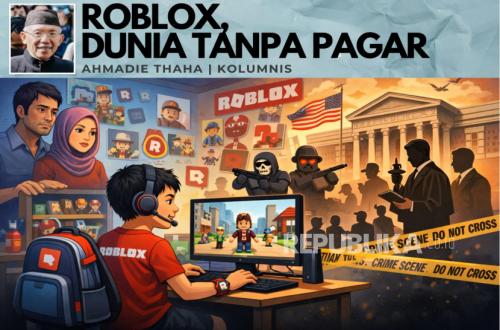
Raka is nine years old. For him, the world is simple: wake up, go to school, come home, then immerse himself in a small universe called Roblox. His T-shirt is Roblox, his watch is Roblox, even his bag is Roblox. The walls of his room have turned into a colourful gallery full of boxy characters that are more familiar to him than the faces of historical figures in his textbooks. That is the logo and characters from the favourite game of children nowadays, called Roblox.
Raka does not just play. He “enters” that world. He chooses an avatar, walks, jumps, talks with other players, and even creates his own “game” using the tools provided by the platform.
Roblox is not a single game, but thousands or even millions of games created by its users themselves. It is like a giant playground, where every child can be both a player and a creator of worlds.
The platform was created by Roblox Corporation, a technology company from the United States, and launched in 2006. However, its popularity has surged in the last decade, especially among children and teenagers.
To this day, tens of millions of people around the world log in every day to explore virtual worlds created by fellow users. That is where its strength lies: boundless creativity.
However, like all boundless spaces, it also harbours boundless problems. This brings us to the side that is starting to make adults anxious. Because anyone can create a “game”, not all games are safe.
There are Roblox games that are just car races, building houses, or light adventures. But there are also those that feature brutal fights, simulations of violence, and even scenarios that are too close to the dark side of the real world.
In Indonesia, Roblox was initially fine. But lately, games on Roblox causing concern are not new stories. Reports of violent content, hate speech, and inappropriate interactions have emerged in recent years.
The government has reacted. The tone of appeals has turned into warnings. There was even a temporary access restriction for certain age groups, as a form of caution in facing increasingly evident risks.
The concern is simple but fundamental: children do not yet have the full ability to distinguish between play and reality. When violence is presented as entertainment, it has the potential to be imitated without understanding.
But this story does not stop in Indonesia. In the United States, the Roblox issue has gone further: it has entered the courtroom.
A lawsuit has been filed by a family of a teenager against Roblox Corporation and its major investor, Andreessen Horowitz. The lawsuit accuses the platform of failing to protect young users from exposure to extreme content and communities that glorify violence.
This case is not just an ordinary legal matter. It touches on a big question: to what extent is a platform responsible for the world built by its users? And further, do the investors funding the platform also bear moral and legal responsibility?
In the lawsuit, it is stated that the Roblox ecosystem allows the emergence of communities that glorify mass shootings, complete with simulations and conversations that normalise violence.
The existing moderation is considered inadequate. Age verification is deemed weak. Supervision is said to lag far behind the platform’s growth rate. At this point, Roblox transforms from just a game into a mirror of the times.
It shows how modern technology works: open, participatory, creative, but also vulnerable. What used to be creatable only by big companies can now be made by anyone. The problem is, not everyone comes with good intentions.