
Ritual Nyobeng: When the Village Awakens in Ancestral Devotion
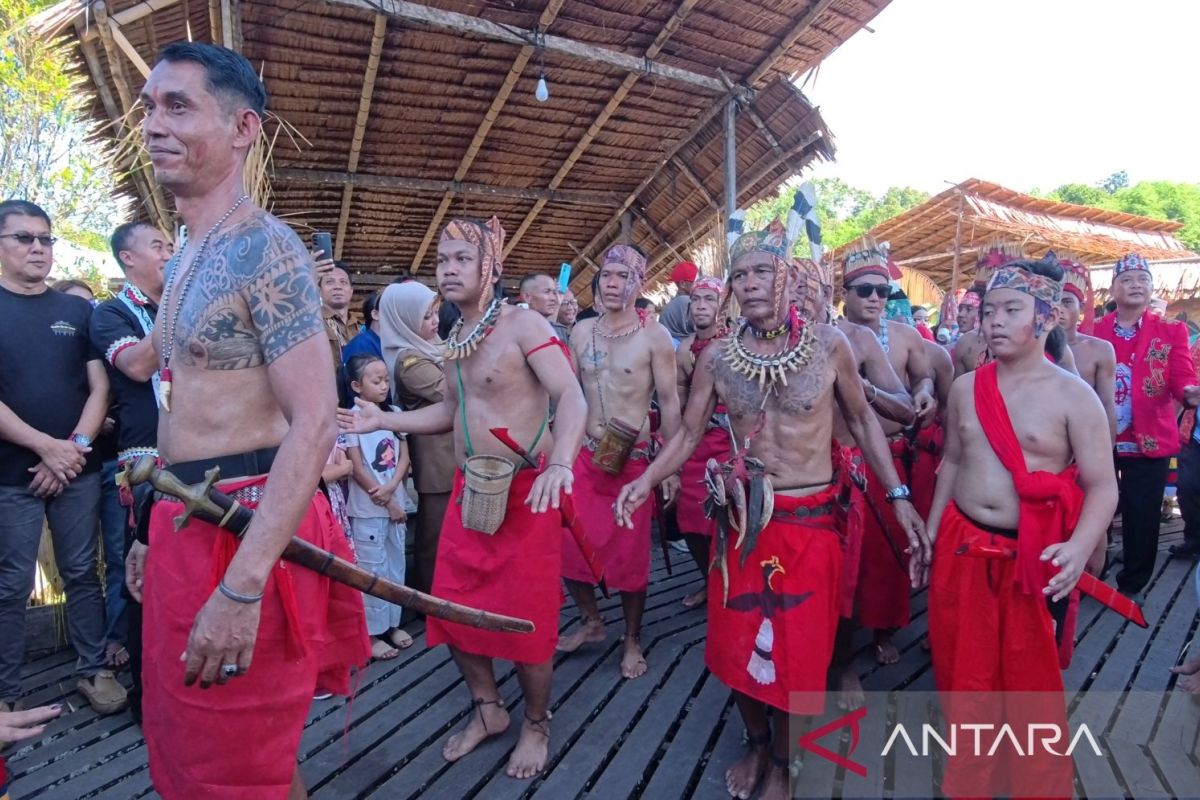
The day was still very dark and silent in Hlibuei Village, Siding District, Bengkayang Regency, West Kalimantan, when life began to move in a different manner. It was not driven by ordinary daily activities, but by the pulse of a ritual that has lived for hundreds of years within the Dayak Bidayuh community.
The silence was slowly broken by the footsteps of a traditional elder walking through the village paths, still damp with morning dew. Emerging from a simple house, the figure was Pak Amin, the Customary Chief of Sebujit Baru Hamlet, who began moving towards the Rumah Baluk.
The destination is a circular traditional house on high stilts that serves as the sacred centre for the Nyobber (Gawia Nibakng) ritual, one of the most respected traditions in the lives of the Dayak Bidayuh people in the Indonesia–Malaysia border region.
“The Rumah Baluk is not merely a traditional building for us. It is a spiritual space, a place where customary prayers are offered, where ancestors are ‘present’, and where the relationship between humans, nature, and the unseen world is kept in balance,” said the Chairman of the 2026 Nyobeng Committee, Gregorius Gunawan, in Bengkayang, recently.
It is in that place that the entire series of Nyobeng will begin, a ritual which, according to ancient traditional records, is related to the veneration of ancestors and an expression of gratitude for the continuation of life.
Although his steps are no longer as strong as they once were, and his health is not entirely optimal, Pak Amin’s spirit remains alight amidst the morning chill. With his body occasionally supported by his son, Gubawan, he continues to walk slowly but steadily.
Every step towards the Rumah Baluk seems to be part of an inner journey, a devotion that is not only ceremonial but also spiritual, connecting him with the long footsteps of the ancestors who preceded him in guarding this custom.
In the silence of that morning, there were no excessive words. There was only the sound of footsteps, the rustle of the wind sweeping through the trees, and the faint light of dawn creeping from behind the hills of Siding.
The villagers, waking from their respective homes, realised that today was no ordinary day. It was a day when the village came alive again through a traditional rite that unites all residents in a single cultural consciousness.
Since the previous night, the village had transformed into a large space of preparation carried out through mutual cooperation (gotong royong). In every house, residents arranged various ceremonial implements with great care and respect.
Offerings were prepared not merely as food, but as symbols of communication with the ancestors: traditional rice wine (tuak) brewed in bamboo containers or bottles, sweet rice representing good hopes, chicken eggs as a symbol of life, as well as traditional supplies such as betel lime, tobacco, gambier leaves, and betel leaves, all of which hold philosophical meaning in the Dayak Bidayuh tradition.
Outside the houses, the village atmosphere increasingly showed signs of traditional celebration. Yellow coconut leaves were hung in front of the Rumah Baluk, swaying gently in the morning breeze as a sign that the village was in a sacred state. These simple decorations are not merely ornaments, but markers of the boundary between everyday life and ritual space, between the profane world and the spiritually meaningful customary world.