
Rising from the Grave! Furniture and Footwear Businesses Post Double-Digit Growth
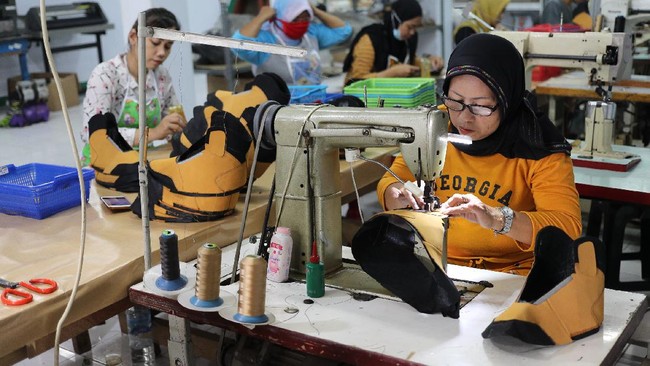
Amid a slowdown in the overall manufacturing industry, the non-oil and gas manufacturing sector recorded an increase in the second quarter of 2026. Its annual growth rate rose compared to the previous quarter.
Manufacturing as a whole grew 4.52% year-on-year (yoy) in the second quarter of 2026. According to data from Statistics Indonesia (BPS), this figure slowed from 5.04% in the first quarter of 2026 and 5.68% in the second quarter of 2025.
Despite the slowdown, manufacturing remained the largest business field in Indonesia’s gross domestic product (GDP) structure. Its contribution reached 18.50% of GDP and contributed 0.90 percentage points to national economic growth in the second quarter of 2026.
The slowdown in manufacturing mainly came from the coal industry and oil and gas refining.
This sub-sector contracted 3.97% yoy in the second quarter of 2026, after still growing 3.88% in the previous quarter.
A different situation was seen in the non-oil and gas manufacturing industry.
Its growth rate increased from 5.14% yoy in the first quarter of 2026 to 5.32% in the second quarter of 2026. Its growth was also higher than the overall manufacturing industry at 4.52%.
Within the non-oil and gas manufacturing industry, three sub-sectors even recorded double-digit growth. Other manufacturing and repair and installation services of machinery grew 12.22% yoy, the furniture industry grew 11.82%, while the leather, leather goods and footwear industry grew 11.30%.
The three not only grew strongly on an annual basis, but also accelerated compared to the previous quarter.
Other Manufacturing Soars 12.22%
The highest growth occurred in other manufacturing and repair and installation services of machinery. Its growth rate jumped from 6.39% yoy in the first quarter of 2026 to 12.22% in the second quarter of 2026.
The increase reached 5.83 percentage points in just one quarter. Compared to the second quarter of 2025, which grew 7.13%, there was an acceleration of 5.09 percentage points.
Growth in the second quarter of 2026 was also the highest in the last three quarters. A higher figure was last recorded in the third quarter of 2025 at 13.90%.
However, this sub-sector is a combined category with a broad scope.
Other manufacturing includes, among others, jewellery, musical instruments, sports equipment, toys, and medical and dental equipment. BPS then combines it with repair and installation services of machinery.
Furniture Rebounds After Being Under Pressure
The furniture industry experienced the sharpest change. After growing 4.32% yoy in the first quarter of 2026, its pace jumped to 11.82% in the following quarter. This growth was also the highest in the last 7 years, or since the first quarter of 2019, when it grew by 12.89%.
The growth increased by 7.50 percentage points compared to the previous quarter. The increase was much larger compared to the second quarter of 2025, when the furniture industry contracted by 0.05%.
The low base effect is one explanation for the high growth of the furniture industry in the second quarter of 2026. The contraction in the same period the previous year occurred when the United States trade war created uncertainty for Indonesian furniture exporters.
In April 2025, the United States announced reciprocal tariffs against many countries. Indonesian products at that time were threatened with an additional tariff of 32%, although its implementation was later postponed during the negotiation process.
The policy greatly affected the furniture industry because the United States absorbs around 54% of Indonesia’s furniture and craft exports. The Indonesian Furniture and Craft Industry Association (HIMKI) at that time recorded shipment delays and buyer concerns due to tariff uncertainty.
Thus, when production improved in 2026, the low comparison base made the annual growth percentage appear very high.
Despite receiving a boost from the low base effect, Bank Indonesia data shows that furniture industry activity did improve. In the Second Quarter 2026 Business Activity Survey, the Weighted Net Balance (SBT) of furniture business activity increased from minus 0.01% in the first quarter of 2026 to 0.01%.
Production capacity utilisation in the furniture industry also rose from 65.46% to 66.13%. The increase in both indicators shows an increase in production activity, although the change was not as large as the jump seen in the annual growth data.
Footwear Grows Alongside Export Recovery
The leather, leather goods and footwear industry grew 11.30% in the second quarter of 2026, up from 8.31% in the same quarter the previous year.
This growth was the highest in 15 quarters, or since the third quarter of 2022, which grew by 13.44%.
The double-digit growth shows that the leather and footwear industry was able to accelerate production above last year’s performance.
The increase in production took place alongside strengthening export performance. Based on the Ministry of Trade’s Single Trade Data, footwear exports under HS code 64 reached US$3.29 billion during January-May 2026, growing 5.59% compared to the same period the previous year.
The United States remained the largest market with an export value of US$1.18 billion, or around 35.8% of Indonesia’s total footwear exports. Its value increased 8.77% year-on-year.
Exports to the Netherlands jumped 52.42% to US$413 million. Exports to Japan increased 1.47% to US$186 million, while shipments to Australia and Italy grew 13.06% and 10.73% respectively.
The data shows that the double-digit growth of the leather and footwear industry in the second quarter of 2026 took place alongside increased demand from a number of countries that are indeed export destinations.
Source: jawawa.id (https://jawawa.id/newsitem/rising-from-the-grave-furniture-and-footwear-businesses-post-double-digit-growth-1785999113)
Originally published by CNBC Indonesia (https://www.cnbcindonesia.com/research/20260806104647-128-757065/bangkit-dari-kubur-bisnis-furniture-alas-kaki-tumbuh-double-digit), translated from Indonesian