
Rising from Semeru's Ashes, Supiturang Residents Develop Lightweight Bricks and Processed Salak
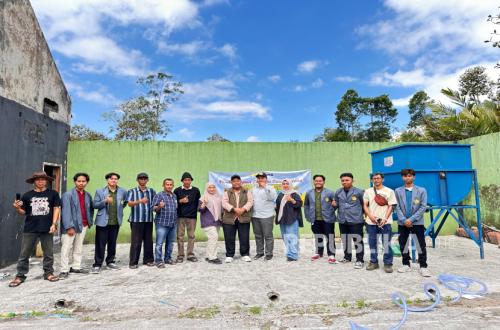
Post-eruption recovery for residents of Supiturang village, Pronojiwo district, Lumajang regency, East Java, is not merely about restoring the environment and rebuilding physical infrastructure. More than that, the community needs to rediscover sources of livelihood and build economic activities that can endure after the disaster.
The effort is being carried out through the Assisted Village Empowerment Programme (PDB), which combines appropriate technology with local resource potential. The programme involves the Wana Semeru Lestari Farmers Group and the Supiturang village PKK as target partners.
Through the programme, volcanic material in the affected area is being directed into raw material for a non-structural lightweight brick business based on Cellular Lightweight Concrete (CLC). Meanwhile, salak commodities are being developed into value-added processed products to open business opportunities for PKK members.
The programme is implemented by a team of lecturers from Universitas Panca Marga (UPM) together with Institut Teknologi Sepuluh Nopember (ITS), partners, and the Supiturang village government. The implementing team consists of Dr Judi Suharsono as chair, together with Prof Ridho Bayuaji, Linda Kurnia Supraptiningsih, and Triyan Bayu Pratama. This programme is the first year of a three-year implementation plan.
The eruption of Mount Semeru has affected various aspects of community life. In Supiturang village, some residents who depend on agriculture for their livelihoods face land conditions that cannot yet be fully utilised optimally.
This situation has created a need for alternative economic activities. The potential available around the village then became the basis for designing empowerment activities. Volcanic material and salak commodities are seen as having opportunities to be developed into productive activities.
For the Wana Semeru Lestari Farmers Group, developing lightweight bricks has become a non-agricultural business alternative. Before the programme began, the group still faced technological and skills limitations in utilising volcanic material into economically valuable products. Business administration, financial recording, and marketing capabilities also needed strengthening.
Mentoring was then carried out using a learning-by-doing approach. Group members not only received explanations but were also directly involved in the production process and operation of the technology.
CLC lightweight brick production technology became one of the main parts of joint activities with the farmers group. The equipment prepared supports the process from raw material preparation, mixing, moulding, cutting, to curing.
Group members also received training on equipment use and maintenance as well as the application of occupational health and safety. The designed technology capacity is in the range of 300–500 lightweight brick units per day with dimensions of approximately 60 × 20 × 10 centimetres. In the initial stage, the business unit is targeted to involve around 8–10 farmer group members.
However, the programme does not stop at the ability to produce goods. The group is also directed to understand how a business unit is managed. Mentoring covers the preparation of SOPs, division of tasks, recording of income and expenditure, calculation of production costs, and evaluation of business results.
The division of tasks is being directed more clearly, including in production, raw material procurement, equipment maintenance, financial recording, and marketing. Thus, the technology provided is expected to become part of a business system that the group can manage independently.
In addition to production, marketing is an important concern. Before the programme began, the Wana Semeru Lestari Farmers Group did not have a marketing strategy and distribution network for lightweight brick products.
Mentoring is carried out by introducing potential customers, determining prices based on production costs and market conditions, building business identity, and developing networks with potential users. The local market and building material needs are the initial targets, with opportunities to develop networks through the village government, construction business actors, and potential users in the surrounding area.
The use of social media and business partnerships is also directed to expand marketing reach. This approach places production technology as part of a business ecosystem that includes governance, production costs, product identity, and market access.
Meanwhile, the Supiturang village PKK received mentoring to develop salak potential. Until now, salak processing at the group level has been carried out simply. Production capacity, quality consistency, processing technology, packaging, branding, and marketing still require strengthening.
Through the empowerment programme, PKK members received training in salak processing using vacuum frying technology. The process includes selection and sorting of raw materials, preparation, frying, draining, and packaging.
The technology is directed to help the group produce processed products with better quality, longer shelf life, and higher selling value. Product development is also accompanied by packaging and brand identity mentoring so that products are more attractive and easily recognisable. The development target is directed at establishing at least two types of processed salak products as well as increasing the group’s production capacity.
PKK empowerment does not only touch on production aspects. Business management is also an important part of the mentoring. Group members are directed to record capital, raw material costs, production costs, packaging, sales results, and profits.
The group is also encouraged to prepare business administration and SOPs as guidelines for production activities. In the marketing aspect, mentoring includes developing business identity, packaging, and pricing.