
Rising Food Prices Squeeze Traders and Small Businesses in Yogyakarta
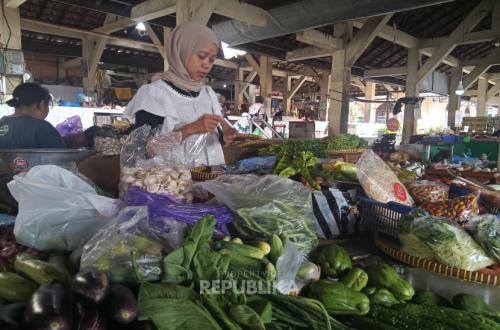
YOGYAKARTA — Rising prices for several foodstuffs, particularly flour and vegetables, are being felt by traders at Godean Market in Sleman Regency and Ngasem Market in Yogyakarta City, Special Region of Yogyakarta. The increases are affecting not only buying and selling at the markets, but also raising production costs for micro, small and medium-sized enterprises (MSMEs) and forcing residents to reconsider household spending.
Observations by Republika at the two markets found that prices had risen for several commodities, although not all food prices had changed. At Godean Market, some vegetables, including broccoli and cucumber, had become more expensive. Traders at Ngasem Market said tomato and cabbage prices had also risen in recent weeks. Chilli prices, meanwhile, have fluctuated frequently.
Ngaji, 70, a staple-goods trader who has been working at Godean Market since 1971, said food price increases had become quite pronounced recently. Flour was among the commodities to have risen most sharply. Higher wholesale costs mean traders have to adjust their selling prices to maintain a profit.
“When you work it out, you feel bad for the customers. So I take a slightly smaller profit, but that’s all right as long as they keep coming back,” he said at Godean Market on Wednesday (28 October 2026).
The increases have also been felt by Budiem, 47, a vegetable seller at the same market. She said the prices of some vegetables had changed, while others remained stable or had even fallen. Broccoli and cucumber were among the vegetables that had risen in price. Red and white onion prices, by contrast, had generally remained stable recently.
A similar situation was reported at Ngasem Market. Tri, 42, a vegetable seller who has been trading there for about four years, said tomato and cabbage prices had risen over the past week or two. Chilli prices, unlike those of the two vegetables, tend to fluctuate, making their direction difficult to predict.
Food price rises are not only a problem for market traders; they also affect MSMEs that rely on these ingredients. Cecep, 46, who sells maklor (a tapioca-and-egg snack) outside Ma’arif Gamping Junior High School in Sleman Regency, said the price of tapioca flour, his main ingredient, had risen sharply. It previously cost between Rp 10,000 and Rp 12,500 per kilogram, but now costs between Rp 18,500 and Rp 20,000.
The increase has affected his daily earnings. Cecep said his usual net income of about Rp 150,000 had fallen to around Rp 100,000. Even so, he has chosen to keep the portions and taste of his food unchanged so that customers do not go elsewhere.
“The important thing is to bring plenty; hopefully it will sell well and things will go smoothly,” he said on Friday (30 October 2026).
Consumers have also felt the impact of higher food prices. Trias, 44, a resident shopping for vegetables near Jalan Pundung in Nogotirto, Gamping, on Sunday (1 November 2026), said she had to manage her household budget more carefully. Whereas she used to buy enough supplies for a week, she now shops according to daily needs.
“So I have to be a bit cleverer about managing money,” she said.
She has also reduced the quantities of some food items she buys to ensure her spending covers her family’s needs. In her view, vegetable prices rose most noticeably during October, forcing her to adjust the amount she buys to the money available.
Food prices do not rise without cause. Dr Y. Sri Susilo, a lecturer in Development Economics at Atma Jaya Yogyakarta University (UAJY) and secretary of ISEI Yogyakarta, said several factors influence food price increases in Indonesia. One is changing environmental, weather and seasonal conditions, which can reduce crop yields.
Natural disasters such as floods can also cause crop failures. When harvests fall, food supplies in markets are disrupted, pushing prices up. Flooding can also obstruct the distribution of food production and increase transport costs.
“Flooding can also disrupt the distribution of food production, which in turn affects supply. This raises distribution costs and ultimately leads to higher food prices,” Sri Susilo said in an interview on Monday (2 November 2026).
Another factor is the rupiah’s exchange rate against the US dollar. Sri Susilo said a weaker rupiah could make imported food more expensive. Indonesia still imports several commodities, including soya beans and maize. Higher ingredient costs can then affect products made from them, such as tofu and tempeh, as well as animal feed, which influences the prices of eggs and broiler chickens.
In addition to supply constraints, rising demand can also affect food prices. This usually occurs at particular times, such as during Ramadan and in the run-up to Eid al-Fitr, when people’s needs increase.
Nevertheless, Sri Susilo said food price rises in Indonesia were driven more by supply factors than by demand. Volatile food prices are also one of the main causes of inflation in Indonesia.
To manage the situation, Bank Indonesia and the government, through Regional Inflation Control Teams (TPID), are implementing a four-pronged strategy known as 4K: affordable prices, sufficient supply, smooth distribution and effective communication. These measures are intended to maintain price stability while ensuring that people’s food needs are met.
Source: jawawa.id (https://jawawa.id/newsitem/rising-food-prices-squeeze-traders-and-small-businesses-in-yogyakarta-1794203484)
Originally published by Republika (https://rejogja.republika.co.id/berita/to7yvw291/kenaikan-harga-pangan-tekan-pedagang-dan-pelaku-umkm-di-yogyakarta), translated from Indonesian