
Ringgit, Peso, Dong, and Baht Slump; Only Yen and Won Survive
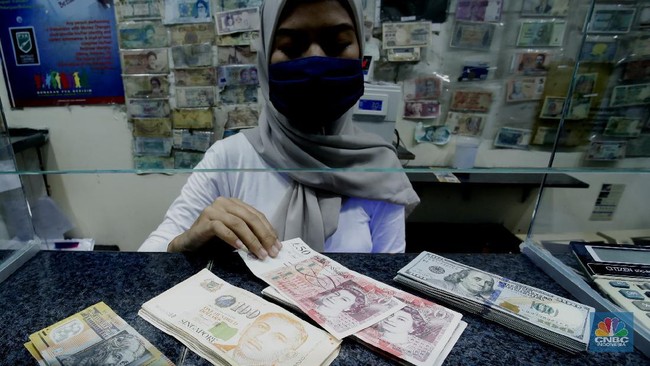
Jakarta, CNBC Indonesia - Most Asian currencies weakened against the United States (US) dollar in trading on Tuesday, pressured by a rebound in the US dollar index after it had weakened in the previous session.
According to Refinitiv data as of 11:55 Western Indonesia Time, seven out of nine monitored Asian currencies depreciated against the US dollar, while two strengthened.
The Malaysian ringgit experienced the deepest decline, falling 0.30% to MYR 4,060 per US dollar. The Philippine peso followed, weakening 0.25% to PHP 60.353 per US dollar.
The Vietnamese dong also fell 0.24% against the US dollar. The Taiwan dollar corrected 0.10% to TWD 31.568 per US dollar, while the Thai baht slipped 0.06% to THB 32.56 per US dollar.
The Singapore dollar and the Chinese yuan both weakened by 0.05%. The Singapore dollar stood at SGD 1.283 per US dollar, while the Chinese yuan was at CNY 6.76 per US dollar.
On the other hand, the Japanese yen managed to strengthen slightly by 0.04% to JPY 160.24 per US dollar. The yen’s appreciation came after the Bank of Japan (BOJ) raised its benchmark interest rate by 25 basis points from 0.75% to 1%. The increase brought Japan’s interest rate to its highest level since 1995. The BOJ took this step in response to inflationary pressures, including the impact of rising energy prices due to the conflict in the Middle East.
The South Korean won also managed to strengthen slightly by 0.03% to KRW 1,512.7 per US dollar.
Meanwhile, the US dollar index (DXY) was observed strengthening 0.14% to 99.765 at the same time. The DXY returned to stability around the 99.7 level after previously weakening due to sentiment surrounding the US-Iran peace agreement.
Market attention is now shifting from the US-Iran peace news to the agenda of the US central bank (The Federal Reserve/The Fed). The Fed is expected to hold interest rates steady in its first policy meeting under new leadership.
However, the Fed’s room for manoeuvre is not easy. The latest US inflation data remains hotter than expected, particularly because the previous conflict with Iran had temporarily driven energy prices higher.
Investors are also awaiting decisions from several other major central banks this week, including those in Japan, Australia, the United Kingdom, and several other large economies. This condition is causing the currency market to move cautiously.
On Monday, the US dollar had come under pressure after US President Donald Trump announced that the United States had reached a peace agreement with Iran. The deal was said to restore access through the Strait of Hormuz. However, ahead of final confirmation, market participants still tend to be cautious and are once again scrutinising the direction of The Fed’s interest rates.
This condition caused the US dollar to regain a foothold in today’s trading. As a result, the majority of Asian currencies moved weaker.