
Ringgit Leads Asia: Rupiah Strengthens as Yen and Won Enter Red Zone
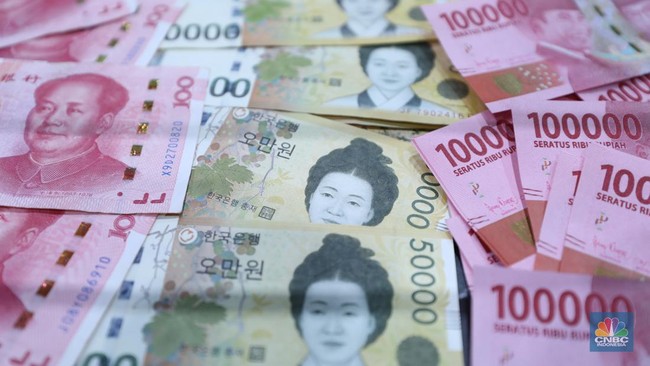
The majority of Asian currencies strengthened against the US Dollar in the final trading session of the week on Friday (18/09/2026). According to Refinitiv data, six out of ten monitored Asian currencies managed to gain against the greenback, while four others remained in the red.
The Malaysian Ringgit emerged as the top performer in Asia this morning, strengthening by 0.45% to a position of MYR 4.076/US.TheTaiwanDollarfollowedwitha0.26 and PHP 62.589/US$ respectively, followed by the Vietnamese Dong with a 0.08% rise. The Indonesian Rupiah also entered the green zone, appreciating by 0.06% to a position of Rp17,725/US$.
Conversely, the South Korean Won experienced the deepest pressure, weakening by 0.35%. The Japanese Yen also corrected by 0.21% to JPY 156.3/US$, followed by the Thai Baht, which fell by 0.12%, and the Singapore Dollar, which weakened slightly by 0.02%.
The Chinese Yuan reached its strongest level since July 2022, supported by solid Chinese export performance and signals of support from the central bank. The People’s Bank of China (PBoC) has raised the daily yuan reference rate for eight consecutive sessions up to Friday, the longest streak since 2023. This strengthening also occurs ahead of the planned meeting between US President Donald Trump and Chinese President Xi Jinping at the end of September. Serena Zhou, a strategist at Mizuho Securities, noted that the Renminbi is likely to continue receiving support from the upcoming Trump-Xi meeting.
Asian currency movements remain heavily influenced by US Dollar dynamics. The US Dollar Index (DXY) was observed to have weakened slightly by 0.02% to 100.231. Despite the slight dip, the DXY remains above the 100 level, indicating that the US Dollar has not yet lost its momentum following the Federal Reserve’s recent decision to raise interest rates.
The Fed raised its benchmark interest rate by 25 basis points to a range of 3.75%-4.00% on Wednesday US time, signalling that there is still room for further hikes. While the US Dollar initially surged following this decision, it began to correct slightly during Thursday’s trading as US Treasury yields declined and oil prices stabilised. Marc Chandler, chief market strategist at Bannockburn Forex, suggested that the Dollar is currently moving in line with US interest rates.
Market attention is now shifting towards the Bank of Japan (BOJ). The Japanese central bank is expected to raise interest rates on Friday and signal its readiness to increase borrowing costs further in the future. Investors will closely scrutinise statements from BOJ Governor Kazuo Ueda, particularly regarding the timing and pace of subsequent rate hikes. While the Yen saw sharp gains in early September due to rate hike expectations and Japan-US interventions, it has faced renewed pressure recently alongside the strengthening US Dollar.