
Ringgit Leads Asia Against Dollar, Won and Rupiah Weaken
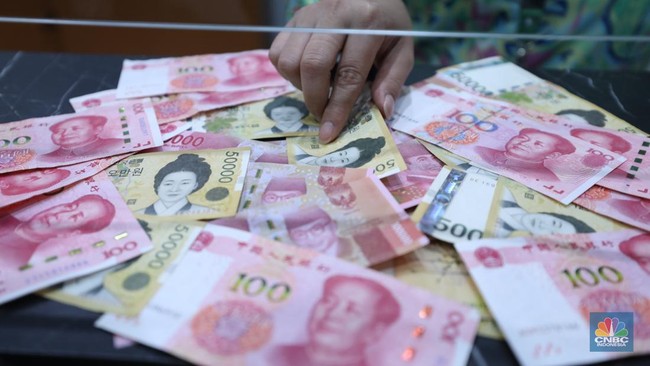
Asian currencies moved in mixed directions against the United States dollar on Thursday. The US dollar index remained at elevated levels, despite edging slightly lower this morning. Based on Refinitiv data as of 09:35 Western Indonesia Time, five out of ten monitored Asian currencies weakened against the dollar, while five strengthened. The Philippine peso was the worst performer in Asia this morning, falling 0.60% to PHP 61.238 per US dollar. The South Korean won also came under significant pressure, dropping 0.34% to KRW 1,547.5 per US dollar. The Taiwan dollar followed with a correction of 0.27% to TWD 31.823 per US dollar. The Indonesian rupiah also remained in negative territory, weakening 0.08% to IDR 17,940 per US dollar. The Thai baht and Singapore dollar saw marginal declines, slipping 0.03% to THB 33.41 per US dollar and 0.01% to SGD 1.296 per US dollar, respectively. On the other hand, the Malaysian ringgit posted the sharpest gains in Asia, rising 0.60% to MYR 4.110 per US dollar. The Vietnamese dong strengthened 0.19% to VND 26,280 per US dollar, while the Japanese yen and Chinese yuan both edged up 0.05%, reaching JPY 161.69 per US dollar and CNY 6.807 per US dollar, respectively. Meanwhile, the US dollar index weakened 0.09% to 101.552. Despite the slight dip, the index remained near a 13-month high, having touched 101.8 during the previous day’s trading. The dollar’s strength continues to be supported by expectations of a Federal Reserve interest rate hike this year. Fed Chair Kevin Warsh recently reaffirmed the commitment to restoring price stability. These expectations have overshadowed the positive impact of progress in US-Iran peace negotiations, which had previously eased energy inflation concerns by pushing oil prices lower. However, the market assesses that US inflationary pressures have not fully subsided. Investors are now awaiting the release of the Personal Consumption Expenditures (PCE) index, the Fed’s preferred inflation gauge, for further clues on the policy direction. Market participants are also monitoring other key US data, including the final estimate for first-quarter 2026 economic growth, May personal income figures, preliminary durable goods orders, and weekly jobless claims for the period ending 20 June. Steve Englander, head of global G10 currency research at Standard Chartered in New York, noted that the movement in interest rates and the dollar reflects expectations that the US economy will continue to outperform its peers. ‘We believe the moves in rates and the dollar reflect expectations of US cyclical and structural outperformance,’ Englander said, adding that strong productivity growth, partly driven by artificial intelligence, could support higher incomes and drive positive capital inflows for the dollar.