
Ringgit and Rupiah Lead Asia in Pushing Back Against the US Dollar
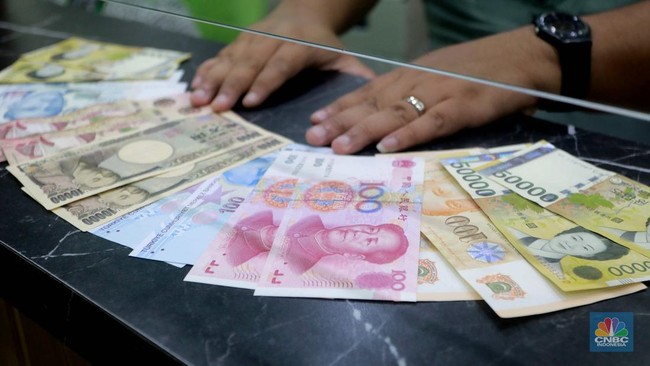
Most Asian currencies moved stronger against the US dollar in trading on Wednesday (26/8/2026). The US dollar, which remains under pressure, gave room for the majority of Asian currencies to strengthen, although the gains were not uniform.
According to Refinitiv data as of 09.17 WIB, seven out of ten currencies managed to strengthen against the US dollar, while two weakened and one remained stagnant.
The Malaysian ringgit emerged as the currency with the sharpest gain in Asia this morning. The ringgit jumped as much as 0.54% to MYR 4.022 per US dollar.
The rupiah also performed quite strongly this morning. The Garuda currency strengthened 0.14% to Rp17,680 per US dollar, placing it second after the Malaysian ringgit as the currency with the largest gain in Asia.
The rupiah’s strengthening occurred as the market observed the fit-and-proper test agenda for Bank Indonesia governor candidate Destry Damayanti, which was deemed in line with market expectations.
The Japanese yen also strengthened 0.13% to JPY 158.95 per US dollar, followed by the Vietnamese dong, which rose 0.10% to VND 26,084 per US dollar.
The Philippine peso also appreciated 0.08% to PHP 61.519 per US dollar, while the South Korean won edged up 0.05% to KRW 1,381.2 per US dollar.
The Taiwan dollar also moved positively with a 0.02% increase to TWD 31.824 per US dollar. The Chinese yuan was observed stagnant at CNY 6.72 per US dollar.
On the other hand, the Thai baht was the currency under the deepest pressure in Asia this morning. The baht weakened 0.03% to THB 32.68 per US dollar.
The Singapore dollar also corrected slightly by 0.01% to SGD 1.269 per US dollar.
Asian currency movements this morning were still influenced by US dollar dynamics. The US dollar index (DXY) at the same time was observed weakening slightly by 0.01% to 98.907.
The US dollar remained in a weak area after the market observed the direction of US fiscal and monetary policy. The greenback had previously come under pressure after US Treasury Secretary Scott Bessent stated that the Treasury Department would double its buybacks of long-dated bonds.
The move was initially aimed at dampening the rise in US borrowing costs. However, the market instead viewed the policy as a signal that the government was beginning to use a more direct approach to curb the surge in bond yields.
Concerns about the US dollar also emerged because its fundamentals were still considered not very strong. Besides the bond market issue, expectations of an interest rate hike by the US central bank (The Federal Reserve/The Fed) in September also declined.
Based on CME FedWatch, the probability of a Fed rate hike of at least 25 basis points in September fell to 40.1%, from around 55% in the previous month.
Marc Chandler, chief market strategist at Bannockburn Capital Markets, assessed that the US dollar is caught between two major forces: fundamental pressure and technical conditions that are already too weak.
“Fundamentals seem to be moving against the dollar, whether because of Bessent, or because other central banks are expected to raise rates more than the Fed. So the fundamentals are negative. However, the dollar has been pushed too far, its momentum indicators are already oversold,” Chandler said, as quoted by Reuters.
“In my view, that is the tension at play: the dollar’s oversold technicals and bearish fundamentals,” he added.
At the same time, the market was also observing the expansion of US sanctions against Iran. Washington warned countries to cut business ties with Tehran or risk being excluded from the US dollar-based financial system.
However, the sanctions were considered to lack detail because they did not specifically name Iran’s major trading partners such as China. This condition meant the market’s response to the US dollar did not move too aggressively.