
Rice Stocks Abundant, but Prices Remain High; Amran Calls for Rice Mafia to Be Arrested
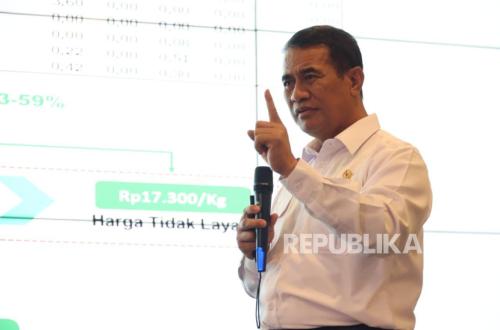
JAKARTA — Agriculture Minister Andi Amran Sulaiman has cited alleged rice-mafia practices as one reason for rising rice prices, despite abundant national supplies. The government says stocks have reached 4.5 million tonnes, but rice prices remain above the highest retail price (HET) in several regions.
According to data from the Trade Ministry’s Market and Basic Necessities Monitoring System (SP2KP) on Wednesday (11 November 2026), the national average price of premium rice was Rp 15,713 per kilogram, while medium-grade rice cost Rp 14,023 per kilogram. Asked why prices were still rising despite a supply surplus, Amran said alleged rice-mafia practices were one of the causes.
“One of the causes is the rice mafia, and they must be arrested,” the agriculture minister said after a coordination meeting at the Coordinating Ministry for Food Affairs in Jakarta on Wednesday (11 November 2026).
Amran said the government had uncovered several forms of misconduct in the rice trade. One involved fortified rice being sold at a price far above its proper level.
He also highlighted the repackaging and adulteration of rice distributed under the Food Supply and Price Stabilisation (SPHP) programme. Rice intended to be sold to the public at an affordable price was instead repackaged and marketed as premium rice.
“Fortified rice that should cost Rp 13,000 is being sold for Rp 50,000. Then there is adulteration: SPHP rice is unpacked and sold as premium rice. Thirteen suspects have been arrested,” Amran said.
The Agriculture Ministry previously said 13 people had been named as suspects in eight rice-trade violation cases involving 15 brands. The findings included suspected adulteration, quality manipulation and other forms of misconduct in the rice trade.
The government has also identified several methods used to misuse SPHP rice. Suspects allegedly took the rice to mills for reprocessing, replaced its packaging with different sacks, or unloaded it at concealed locations to change the product’s identity.
Amran said the government would not tolerate businesses manipulating rice prices or quality. He said oversight was necessary to protect consumers as well as farmers.
“Rice is subsidised by the government. There is an HET to protect consumers and a government purchase price (HPP) to protect farmers. We protect both. No one should make excessive profits. We will track them down and take action,” said Amran, who is from South Sulawesi.
Despite the enforcement efforts, consumer rice prices remain relatively high. Data from Bank Indonesia’s Strategic Food Price Information Centre (PIHPS) on Wednesday (11 November 2026) showed that the national average price of grade I super rice in traditional markets was Rp 18,050 per kilogram, while grade II super rice cost Rp 17,500.
Grade I medium rice was priced at Rp 16,750 per kilogram and grade II medium rice at Rp 16,550. Grade I lower-quality rice cost Rp 15,000 per kilogram, while grade II lower-quality rice was Rp 14,800.
Under National Food Agency Circular Letter No. 456 of 2026, the HET for premium rice is Rp 14,900 per kilogram in Zone 1, Rp 15,400 in Zone 2 and Rp 15,800 in Zone 3. The respective ceilings for medium rice are Rp 13,500, Rp 14,000 and Rp 15,500 per kilogram.
For SPHP rice, the government has set HETs of Rp 12,500 per kilogram in Zone 1, Rp 13,100 in Zone 2 and Rp 13,500 in Zone 3. The SP2KP national averages for premium and medium rice are therefore above the ceilings for Zones 1 and 2, although below the Zone 3 limits.
To strengthen oversight, the Agriculture Ministry has also received 340 public complaints through the Lapor Pak Amran channel over roughly two weeks. The complaints concern suspected irregularities involving rice, fertiliser, agricultural machinery and equipment, as well as the implementation of land-clearing programmes for new rice fields.
Amran said all reports would be reviewed and verified before being referred to law-enforcement authorities. The government may also announce further cases, although it has not yet provided details to the public.
“Pray for us, but I cannot say anything yet,” the minister said when asked about the latest developments in the rice-case investigations.
On supply, Amran said national rice availability remained secure ahead of Christmas and New Year 2026/2027. With stocks at 4.5 million tonnes in November, the government expects rice reserves at the end of 2026 could be the highest in Indonesia’s history.
The situation shows that the government’s challenge is not only to maintain rice availability, but also to ensure distribution and trade comply with the rules. Action against trading irregularities is part of efforts to keep rice affordable for the public.
Source: jawawa.id (https://jawawa.id/newsitem/rice-stocks-abundant-but-prices-remain-high-amran-calls-for-rice-mafia-to-be-arrested-1794397915)
Originally published by Republika (https://ekonomi.republika.co.id/berita/toc3ry416/stok-beras-melimpah-harga-masih-mahal-amran-tangkap-mafia-beras), translated from Indonesian