
Rice Production Grows from January to April, Harvest Area and Paddy Production Increase
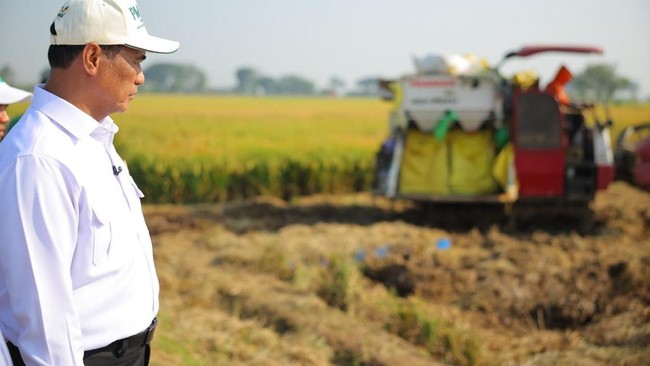
The Indonesian Central Statistics Agency (BPS) recorded national rice production from January to April 2026 at 14.03 million tonnes. According to BPS fixed figures, this amount increased by 16,810 tonnes, or 0.12%, compared to the same period in the previous year, which stood at 14.01 million tonnes.
This growth in rice production is in line with the increase in paddy production. During the same period, paddy production reached 24.36 million tonnes of Dry Milled Grain (GKG), up by 28,765 tonnes or 0.12% compared to January-April 2025, which was 24.33 million tonnes GKG.
An increase was also observed in the paddy harvest area. BPS noted that the harvest area for January-April 2026 reached 4.51 million hectares, an increase of 19,182 hectares or 0.43 per cent compared to the same period last year, which was 4.49 million hectares. These BPS figures indicate that the growth in rice production at the start of 2026 was supported by strengthened production at the upstream level.
The expansion of the harvest area has also driven the rise in paddy production, subsequently strengthening the availability of national rice raw materials. The Minister of Agriculture, Andi Amran Sulaiman, emphasised that the government will continue to maintain this production momentum by ensuring farmers receive the necessary support, particularly in facing the dry season and the potential impact of El Niño.
“We are going down, installing pumps; we must not give up. We must not let farmers struggle on their own; we must intervene,” Amran stated in an official statement on Friday (4/9/2026).
According to BPS records, rice production in January 2026 reached 1.73 million tonnes, then increased to 2.88 million tonnes in February. Production reached 5.02 million tonnes in March and 4.40 million tonnes in April.
Cumulatively, rice production during the first four months of 2026 reached 14.03 million tonnes, remaining higher than the same period in the previous year. This movement aligns with the production of paddy as the raw material for rice. Paddy production was recorded at 3.01 million tonnes GKG in January, 5.01 million tonnes GKG in February, 8.71 million tonnes GKG in March, and 7.63 million tonnes GKG in April. Thus, paddy production for January-April 2026 reached 24.36 million tonnes GKG, an increase of 28,765 tonnes compared to the same period in 2025.
This achievement serves as vital capital to maintain production in the following periods, especially as the agricultural sector enters the dry season and faces potential El Niño risks. The Ministry of Agriculture (Kementan) has strengthened various mitigation steps to ensure that water shortages do not hinder the planting season or suppress farmer productivity.
One of the primary steps taken is pumpisation. In the previous period, the utilisation of approximately 100,000 pump units was able to drive an additional production of about 2.8 million tonnes of paddy on the island of Java.
This year, the Ministry of Agriculture is preparing another 56,000 water pump units as part of drought mitigation. These efforts are accompanied by the strengthening of irrigation networks, the optimisation of small dams (embung) and piping, accelerated planting, and the use of rice varieties that are adaptive and drought-resistant.
The optimisation of water sources is also directed towards increasing the planting index, so that land that could previously only be planted twice a year can be increased to three planting cycles. Amran stated that the experience of facing El Niño in 2015 and 2023 serves as important capital for the Ministry to prepare anticipatory measures earlier. Interventions are being carried out comprehensively through pumpisation, irrigation improvement, productivity enhancement, and the use of seeds more adaptive to drought conditions.
“Now, for the impact of El Niño, God willing, we will mitigate it because we have prepared far in advance. First, pumpisation. Second, irrigation. Third, we increase production. Additionally, there are drought-resistant seeds,” said Amran.
Through the strengthening of production and the mitigation of climate change impacts, Amran emphasised that the Ministry of Agriculture is striving to maintain the positive momentum reflected in the BPS fixed figures for January-April 2026. The growth in rice production, paddy production, and harvest area serves as a vital foundation for maintaining national food security while ensuring that production activities and farmer incomes remain protected.