
Rice Prices Rise and Spread Across Regions, What Can the Government Do?
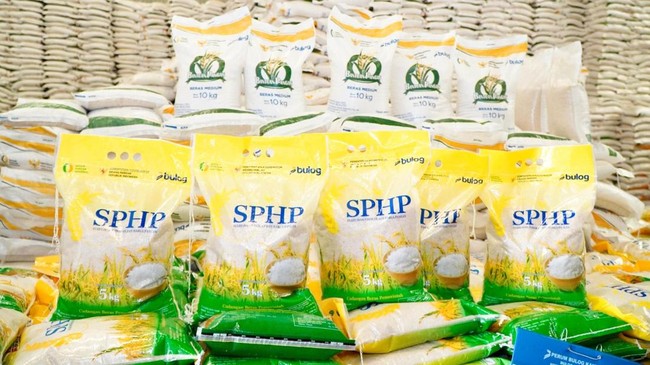
The government has asked Perum Bulog to accelerate intervention in rice prices through the distribution of Stabilisation of Food Supply and Prices (SPHP) rice to various regions. In fact, the government has assured that all distribution costs will be reimbursed, including if rice must be sent by aeroplane.
Deputy for Food Availability and Stabilisation at the National Food Agency (Bapanas), I Gusti Ketut Astawa, said there is no reason for Bulog to delay SPHP distribution when rice prices in a region begin to rise. According to him, the government is ready to bear the transportation costs of SPHP distribution, from land to air modes.
“Wherever Bulog distributes SPHP rice, it will be reimbursed by the government, whether by train, public transport, rental, ferry, container, or even aeroplane. So there is no excuse not to intervene, except for security conditions,” said Ketut during the Regional Inflation Control Coordination Meeting at the Ministry of Home Affairs on Tuesday (18/8/2026).
Ketut assessed that Bulog’s large rice stock holdings should serve as an intervention instrument when price increases occur in the regions. Therefore, SPHP distribution is requested not only to focus on certain points but to be expanded directly in markets.
Bapanas also asked Bulog to change its SPHP rice distribution strategy to more effectively curb the increase in the Price Development Index (IPH). “So if most of you distribute SPHP at RPK (Rumah Pangan Kita), while the market share is small, the IPH will certainly rise. Therefore, please use a strategy to massively distribute SPHP in markets in August, September, and October, and beyond,” he said.
Based on Bapanas data, the SPHP rice distribution target for 2026 is 828 thousand tonnes. As of 16 August 2026, realisation has only reached 652.6 thousand tonnes or 78.83% of the target. The largest distribution was recorded in several regions, including Southeast Sulawesi, South Sulawesi, and East Java.
In addition to SPHP, the government is also relying on food assistance to maintain rice price stability. For the July-September 2026 allocation, the number of food assistance recipients reached 33,244,408 beneficiary families (KPM). Each recipient receives an allocation of 10 kilogrammes of rice per month for three months.
Ketut said accelerating these two instruments, namely SPHP and food assistance, is important to ease rice price pressures. “Because if both are carried out on time, the IPH would actually be under control. Therefore, we ask Bulog colleagues, with the assignment already given, to please carry it out quickly, with certainty, and on time, with the right allocation. Our hope is that with these two interventions, the IPH for rice can be well controlled,” he said.
He also asked regional governments to monitor rice price developments daily and coordinate with Bulog when price increases occur. Ketut emphasised that the government has provided distribution cost support so that Bulog can distribute rice to areas in need, including regions with geographical constraints.
“So once again, please, because if every week we see the rice IPH continuing to rise, we should be somewhat embarrassed, because we hold a lot of rice, and certainly we should be able to intervene as soon as possible, anywhere in Indonesia. Because once again, everything you do in SPHP distribution will be reimbursed by the government,” Ketut stressed.
With this scheme, the government wants to ensure that limited distribution access does not become an excuse for Bulog not to intervene in prices. Distribution can be adjusted to the conditions of each region, while distribution costs are borne by the government.
This is in line with rice price developments showing widening pressure in the second week of August 2026. Based on BPS data, the number of provinces experiencing an increase in the rice Price Development Index (IPH) rose from 106 provinces in the first week of August to 120 provinces in the second week. This means there were an additional 14 provinces experiencing an increase in the rice IPH within a week.
In detail, as of the second week of August, the highest rice IPH increase was recorded in Gorontalo at 8.06%, with a cumulative average price of rice of all qualities at Rp15,432 per kg. Following that, rice IPH increases were recorded in Bengkulu at 1.59%, West Papua 0.91%, Jambi 0.84%, North Sumatra 0.80%, and North Kalimantan and West Kalimantan each at 0.69%.
Rice IPH increases also occurred in several other provinces, including East Java at 0.53%, West Nusa Tenggara 0.47%, Papua Pegunungan 0.46%, Central Kalimantan 0.44%, Bali 0.43%, Central Sulawesi 0.39%, Maluku 0.35%, Lampung 0.30%, and West Sulawesi 0.24%. Meanwhile, the lowest increase was recorded in the Bangka Belitung Islands at 0.01%.
Source: jawawa.id (https://jawawa.id/newsitem/rice-prices-rise-and-spread-across-regions-what-can-the-government-do-1787036027)
Originally published by CNBC Indonesia (https://www.cnbcindonesia.com/news/20260818120724-4-760254/harga-beras-naik-makin-menular-di-daerah-pemerintah-bisa-apa), translated from Indonesian