
Rice Harvests in Two Villages Show Blora’s Role as Central Java’s Food Basket
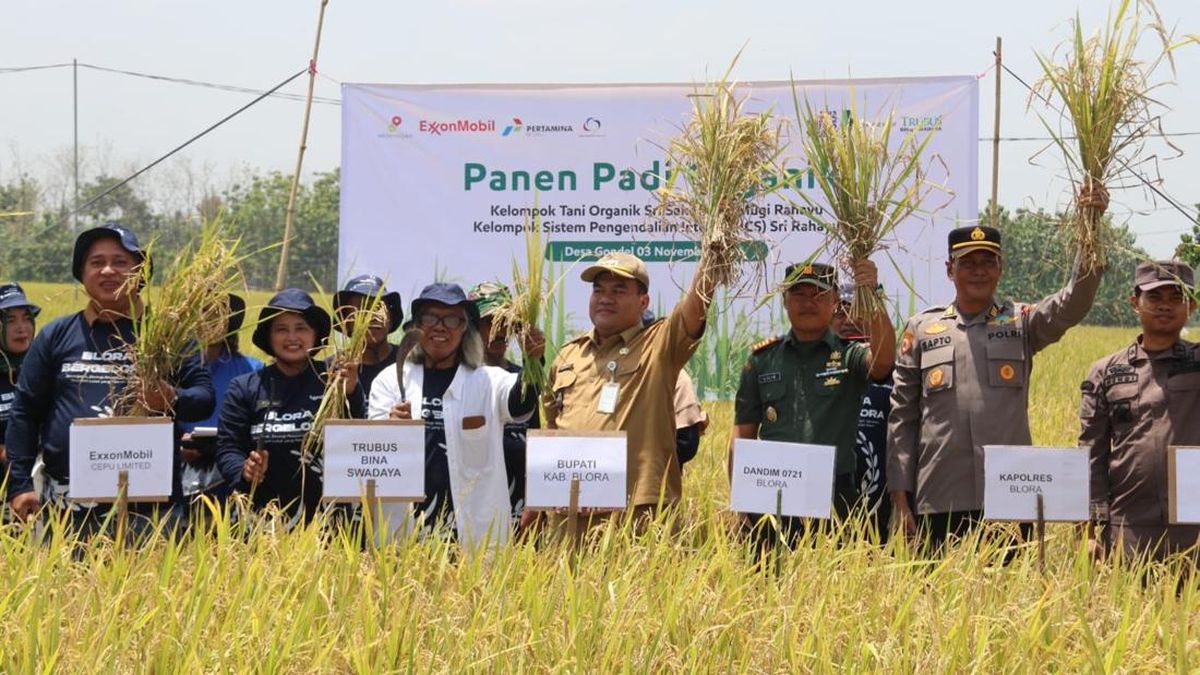
Blora Regency is maintaining its position as a major food-producing centre in Central Java through the development of organic farming and the adoption of modern agricultural technology to boost harvests.
The effort was highlighted when Blora Regent Arief Rohman inspected rice harvests at two locations on Tuesday (3 November). The first harvest took place in Gondel Village, Kedungtuban Sub-district, where farmers use organic rice-growing methods developed with guidance from Trubus and Exxon.
The main harvest then continued in Sumber Village, Kradenan Sub-district. There, farmers have adopted Gemburin soil-improver fertiliser technology produced by PT Chemstar Agro Indonesia.
The successful harvest amid the dry season demonstrates the resilience of Blora’s agricultural sector. The local government hopes the innovations can be developed further to strengthen Blora’s role in supporting food security in Central Java and nationally.
Harvest in Gondel Village
At the organic rice harvest in Gondel Village, Kedungtuban Sub-district, Regent Arief praised farmers’ commitment to developing environmentally friendly agriculture with support from Trubus and Exxon.
Organic farming has the potential to improve farmers’ welfare, he said. However, successful production needs to be matched by assured market access so that harvests generate better returns.
About 108 farmers are currently part of the organic farming development group in Gondel, covering 6.6 hectares of land.
The organic rice produced is sold under the Bestiw brand. Blora Regency Government has pledged to connect the farmers’ group with various parties to expand its access to markets.
“While ordinary rice sells for around Rp 13,000 per kilogram, we hope this organic rice can be marketed for at least Rp 20,000 per kilogram. That would give it added value and distinguish it from conventional rice,” Arief said.
He acknowledged that there were still several obstacles, particularly limited funding and a lack of processing equipment, such as rice milling, oven and vacuum machines.
Arief called for stronger support from field agricultural extension officers and other relevant parties. The government, meanwhile, will encourage quality testing of the rice, including assessments of flavour, texture and how well it keeps after cooking.
Quality and packaging are important to building consumer confidence and strengthening organic rice’s position in the market, the regent said.
“Our ambition is to make Blora an organic regency. Development will begin in villages with potential, one of which is Gondel. Several other villages have also begun developing organic farming,” he said.
Arief also praised Exxon and Trubus, particularly the support teams who had stayed for months to provide farmers with guidance and knowledge.
Unsiatun Noor, representing the women farmers’ group in Gondel, said participants had practised growing various organic vegetables, including water spinach, spinach, mustard greens and tomatoes.
They had previously received about six months of assistance and gained new skills, including vegetable cultivation and making organic fertiliser independently, as well as local microorganisms (MOL) from rice as an input for organic farming.
“We previously did not know how to make MOL from rice. Through this programme’s support, we were taught to make it ourselves, and thankfully we succeeded,” Unsiatun said.
She hoped the support programme would continue, saying the women’s group still needed to improve its knowledge and skills.
“We hope this programme can continue. Although we have gained a lot of experience, our knowledge and skills in organic farming are only about 50 per cent developed, and we have not yet fully mastered the techniques,” she said.
Harvest in Sumber Village
Regent Arief Rohman subsequently attended the main rice harvest in Sumber Village, Kradenan Sub-district, following the use of Gemburin soil-improver fertiliser technology developed by PT Chemstar Agro Indonesia.
Arief welcomed the results from the demonstration plot and said he hoped the soil-improver technology could provide an alternative for raising agricultural productivity in Blora Regency.
He said the good harvest needed to be followed up with further study and support to establish the technology’s measurable benefits, including its effects on production, soil quality and farming costs.
“These good demonstration-plot results need to be followed up with further study and support, so that we can understand their real benefits for production, soil quality and the efficiency of farming costs,” he said.
Arief urged the head of the DP4 Agriculture, Food and Fisheries Office, agricultural extension officers and the Kradenan sub-district head to follow up on the results together.
He also asked that information about Gemburin technology be shared with other farmer groups and farmers. Farmers should be given the opportunity to see its results first-hand, learn how to use it and try it under the conditions of their own land, he said.
Arief said he hoped PT Chemstar Agro Indonesia would do more than introduce its product, and would continue providing farmers with education and guidance.
“We hope PT Chemstar Agro Indonesia will continue to support farmers, provide education and develop sustainable cooperation with the Blora Regency Government,” Regent Arief concluded.
Source: jawawa.id (https://jawawa.id/newsitem/rice-harvests-in-two-villages-show-bloras-role-as-central-javas-food-basket-1793771623)
Originally published by CNN Indonesia (https://www.cnnindonesia.com/nasional/20261104112603-25-1423115/panen-raya-padi-di-dua-desa-blora-buktikan-jadi-lumbung-pangan-jateng), translated from Indonesian