
Rice Grain Dryer Helps Oransbari Farmers Reduce Dependence on the Weather
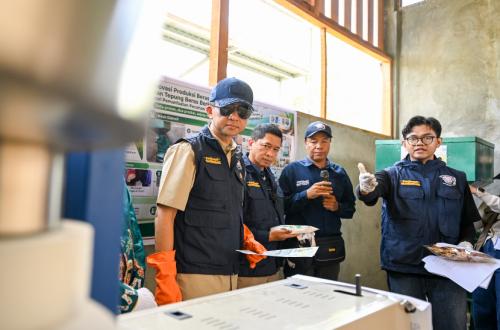
JAKARTA – Farmers in Oransbari District, South Manokwari Regency, West Papua, now have an alternative way to dry paddy without relying on sunny weather. A grain-drying technology developed by the Sepuluh Nopember Institute of Technology (ITS) can reduce the drying process from three to seven days to just several hours.
The two-tonne-capacity machine was developed by the ITS Patriot Expedition Team (TEP) to help farmers in the Momiwaren Transmigration Area process their harvests. The technology also reduces the need to dry paddy manually on roads, which can disrupt traffic.
The dryer is supported by a solar power plant to address limited electricity supplies in the area. Solar energy gives farmers a post-harvest processing option that does not depend entirely on the availability of local electricity.
Transmigration Minister M. Iftitah Sulaiman Suryanagara inspected the technology’s use alongside local residents on Friday (30 October 2026). Iftitah stressed that innovations developed by universities should meet people’s needs while creating opportunities to raise incomes.
“I want to encourage and see at first hand the tangible work delivered by members of the Patriot Expedition Team through the Patriot Transmigration movement. Today, transmigration is no longer simply about relocating people, but about developing an economic area,” Iftitah said in a press release on Saturday (31 October 2026).
Post-harvest technology development also includes sorting rice by quality. This gives farmers the opportunity to secure higher prices than they would by selling an unsorted harvest.
According to Iftitah, whole premium-quality rice produced through sorting sells for around Rp15,000 to Rp17,000 per kilogram, up from about Rp12,000 previously.
The team is also developing ways to increase the economic value of milling by-products. Rice grits, previously sold as animal feed for Rp8,000 to Rp9,000 per kilogram, can now be processed into rice flour selling for around Rp18,000 per kilogram.
However, the price difference does not take into account the costs of processing the grits into flour. The product development offers farmers and village businesses an opportunity to add value to their harvests.
Rice flour processing is managed by the local village-owned enterprise (BUMDes), which already holds a Business Identification Number (NIB). The product is expected to supply micro, small and medium-sized enterprises (MSMEs), including producers of peyek crackers and cakes.
Iftitah hopes that innovations in agricultural processing will expand business and employment opportunities for transmigrant communities. Adding value to agricultural products is also expected to help improve farmers’ incomes.
Alongside the grain dryer, the ITS Patriot Expedition Team has developed several innovations to support economic activity and meet basic needs. One is a biogas reactor whose by-product is liquid organic fertiliser, with reported production of up to 50 litres a day.
In the fisheries sector, the team has introduced fish-smoking technology that cuts processing time from two days to no more than two hours. The innovation offers fishing businesses a way to speed up production.
The ITS team has also built a clean-water pump installation and storage tank tower serving 35 families. It has also developed a promotional website and a BUMDes administration application to support product marketing and business record-keeping.
ITS Rector Bambang Pramujati said the university’s involvement in the Patriot Expedition gives students and lecturers the opportunity to apply their knowledge directly in the community. The programme involves 100 students and 20 lecturers, organised into 20 teams across three districts.
“There are 100 students, 20 teams in three districts and 20 lecturers involved. They have the opportunity to make a greater contribution to the community through the knowledge they possess,” Bambang said.
Bambang also said ITS was ready to continue its community service through a thematic Community Service Programme (KKN). Continued support is expected to help residents make use of the technologies developed.
South Manokwari Deputy Regent Mesak Inyomusi praised the innovations for addressing local needs, from agricultural processing to clean-water provision. He hopes the programme’s benefits will be sustained for residents of the transmigration area.
“These excellent innovations by our younger colleagues, the students from Patriot, truly touch us, the people of South Manokwari. They are extraordinary; I hope they will be a blessing to us and to all the transmigrant communities here,” Mesak said.
Source: jawawa.id (https://jawawa.id/newsitem/rice-grain-dryer-helps-oransbari-farmers-reduce-dependence-on-the-weather-1793447474)
Originally published by Republika (https://ekonomi.republika.co.id/berita/tnrl5g416/mesin-pengering-gabah-bantu-petani-oransbari-kurangi-ketergantungan-cuaca), translated from Indonesian