
Rice Fields Found in the Heart of Yogyakarta City
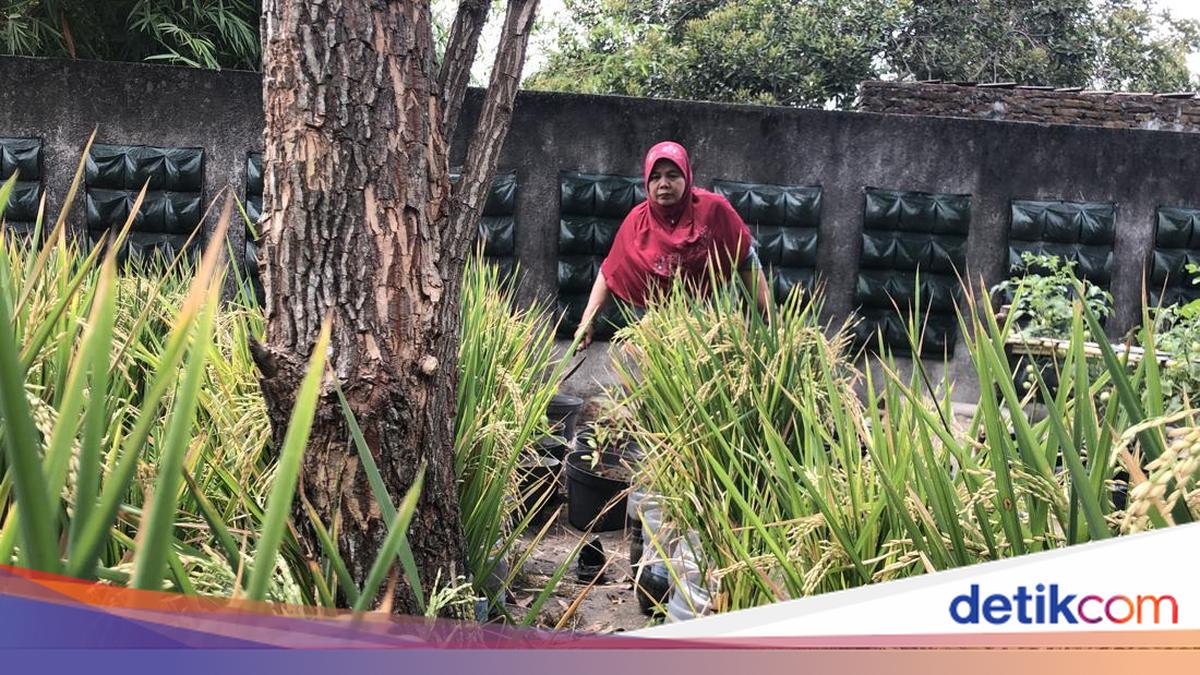
In the heart of Yogyakarta City, ‘rice fields’ still exist. Of course, these ‘fields’ are not literally plots of land, but rather rice being cultivated using plastic gallons.
This method is being pioneered by the Swa Katon Asri Farmers Group in the Wirobrajan neighbourhood. Developing agriculture via used gallons is considered practical and produces plump rice grains.
A Challenge from UMY
The Head of Wirobrajan Village, Budi Sutrisno, revealed that the farming group initially focused on growing vegetables. A few months ago, an agriculture lecturer from Universitas Muhammadiyah Yogyakarta (UMY) presented them with a challenge accompanied by financial assistance.
“The inspiration for rice farming actually came from UMY, to be fair. It was from Mr Agus, an agriculture lecturer. The initial inspiration from UMY was to suggest, ‘do something different, perhaps plant rice using gallons’,” said Budi at the Swa Katon Asri Farmers Group site in Wirobrajan on Friday (4/9/2026).
“UMY provided not only seeds but also funds, if I recall correctly, around Rp 6 million, because their needs back then included irrigation hoses and pipes. This was part of UMY’s community service programme for the region,” he added.
Budi stated that they began taking the cultivation of rice in used gallons seriously about three months ago. Their efforts have also been supported by the Yogyakarta City Agriculture and Food Office (DPP).
An extension officer from the Yogyakarta DPP, Sugio, explained that his role is to provide information on rice planting techniques to the Swa Katan Asri Farmers Group.
“This is the first planting; it is 90 days old, so about 3 months. We use the ‘tabela’ method, which is direct seeding. The medium we prepare consists of soil and organic manure. We soak a single grain for two nights before placing it in the medium,” he explained.
Easy Maintenance
Sugio explained that the rice variety being planted is Hybrid 32, which has a harvest period of 110 days. He detailed the process of planting in used gallon containers.
“Maintenance is very easy. Once planted, the important thing is to keep the water shallow—just enough to moisten the soil. It does not need to be deep or full of water,” Sugio explained.
“From planting until 30 to 40 days of age, the water should be kept at a low level. Since we only plant one seedling per gallon, it will develop tillers. After about 40 days, we then introduce standing water, allowing it to be slightly submerged,” he added.
No Need for Chemical Fertiliser or Pesticides
Sugio continued, noting that a single seedling will develop into dozens of stalks after 40 days. By the time it reaches maturity, a single gallon will contain 30 to 60 stalks.
He stated that this planting process does not require the use of chemical fertilisers or pesticides.
“We use organic manure, supplemented with catfish water—which comes from our own livestock. We take the murky water left over from cleaning the catfish and use it for irrigation. This way, nothing goes to waste,” he said.
“Using gallons is very practical; water and fertiliser levels can be precisely controlled. Unlike in traditional fields where fertiliser might wash away during rain or irrigation, here, the nutrients are maximised and fully absorbed by the rice,” he continued.
After 90 days of growth in the gallons, Sugio admitted he has yet to find any drawbacks. In fact, he noted that the resulting rice grains are plump. This was even validated by a visitor who compared the results to his own traditional rice field.
“To be honest, I haven’t seen any weaknesses yet. A visitor even said, ‘Why doesn’t my rice look like this?’, because the rice in the gallons is not inferior to that grown in a field,” said Sugio.
“He proved it himself, saying, ‘My rice isn’t like this, mine is like that’. He plants one hectare of the same variety, but this is better,” he added.
There are currently hundreds of gallons containing rice nearing harvest at the Swa Katon Asri site. However, Sugio admitted he cannot yet predict the total rice yield from this inaugural planting.
“The harvest period is 110 days. We don’t know the exact amount of rice that will be produced yet. The harvest should be in about 10 days,” Sugio explained.
Source: jawawa.id (https://jawawa.id/newsitem/rice-fields-found-in-the-heart-of-yogyakarta-city-1788659505)
Originally published by detikJogja (https://www.detik.com/jogja/berita/d-8650311/ternyata-masih-ada-sawah-di-tengah-kota-jogja), translated from Indonesian