
Riau Youth Group Says B50 Opens Opportunities to Strengthen Regional Economy
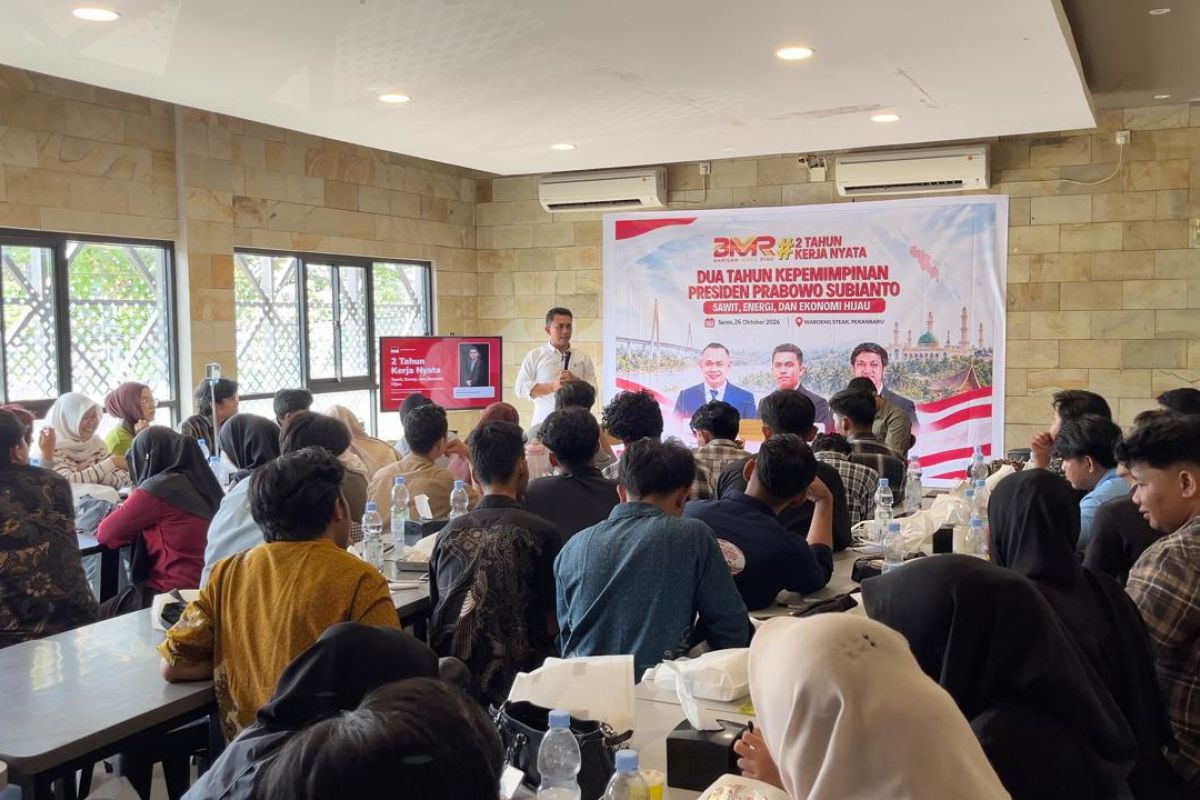
Barisan Muda Riau (BMR) says the B50 biodiesel programme offers an opportunity to strengthen the regional economy by increasing the use of palm oil as an energy feedstock, while potentially improving farmers’ welfare.
“We hope the policy will not only strengthen national energy security, but also increase added value and improve the welfare of oil-palm farmers in Riau,” BMR activist Jimmy Saputra Nasution said in a statement received in Jakarta on Tuesday.
Jimmy made the remarks at a BMR public discussion in Pekanbaru on Monday (26 October), entitled “Two Years of President Prabowo Subianto’s Leadership: Palm Oil, Energy and the Green Economy”.
He said greater use of palm oil as an energy feedstock could expand the domestic market for the plantation commodity and create economic opportunities for producing regions.
He described this prospect as important for Riau, which has substantial oil-palm plantation potential and contributes to supplying feedstock for national industry.
“Oil palm is one of Indonesia’s economic strengths. We appreciate the government’s efforts to optimise this commodity in support of energy independence,” he said.
Data from Statistics Indonesia (BPS) in Riau show that smallholder oil-palm plantations in the province covered about 2.30 million hectares in 2025, with production of approximately 5.72 million tonnes.
The mandatory B50 biodiesel programme began on 1 July 2026. It involves blending 50 per cent palm-oil-based biodiesel with 50 per cent diesel fuel to reduce dependence on fossil energy.
The Ministry of Energy and Mineral Resources (ESDM) said that by mid-September 2026, B50 distribution had reached 6,050 of 6,412 fuel stations, or about 94 per cent.
Meanwhile, the price of fresh fruit bunches (FFB) from independent smallholders in Riau for nine-year-old oil-palm trees rose by Rp75.48 to Rp3,679.40 per kilogram during 21–27 October.
Over the same period, the FFB price for nine-year-old trees cultivated by partner-plasma farmers fell by Rp37.97 to Rp3,745.42 per kilogram.
In addition to developing biofuels, Jimmy said stronger plantation governance through Indonesian Sustainable Palm Oil (ISPO) certification was important to support the sustainability and competitiveness of the palm-oil industry.
The discussion also covered the regulation of forest areas through the Forest Area Regulation Task Force (Satgas PKH), as part of efforts to strengthen natural-resource governance.
Jimmy welcomed the enforcement policy but stressed that it should be implemented fairly, taking into account the circumstances of communities that have long lived in certain areas.
“Regulating forest areas is an important step towards strengthening natural-resource governance. We hope its implementation will provide greater legal certainty, protect the environment, and continue to take account of the rights and circumstances of ordinary people,” he said.
The BMR discussion also featured political observer and Lancang Kuning University lecturer Dody Sukma, and was attended by students, young people and local residents.