
Riau Police Monitor Forest Fires Digitally via Green Policing Dashboard
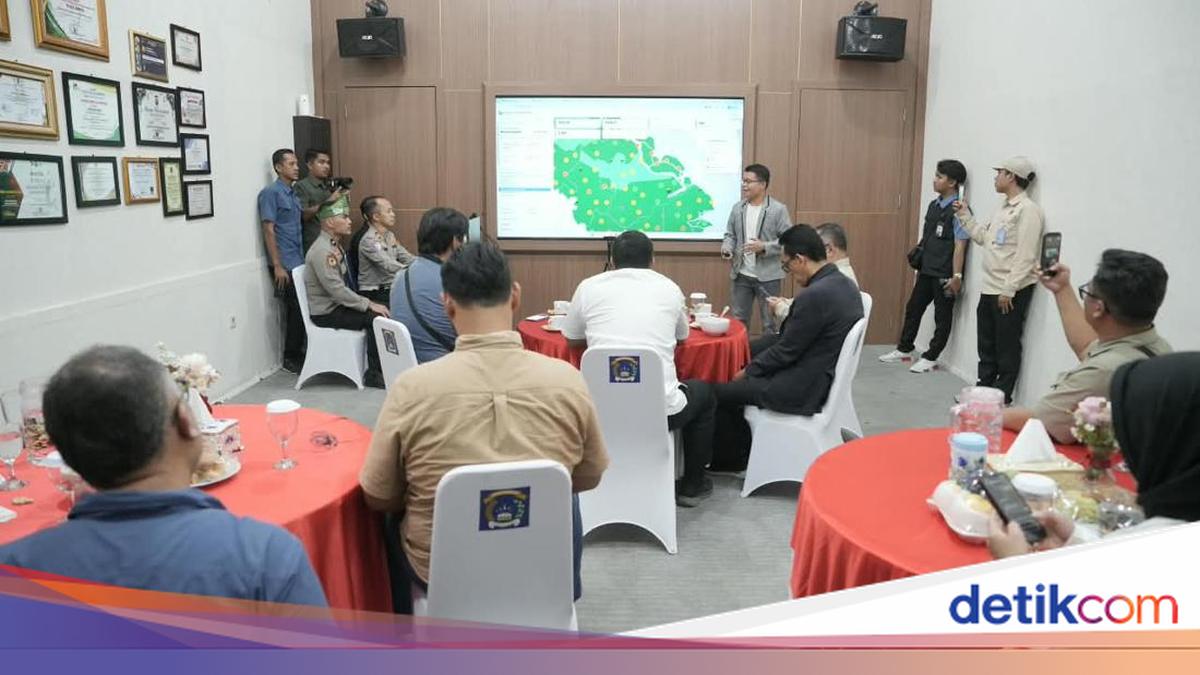
The Riau Regional Police are optimising digital-based monitoring of forest and land fires through the Green Policing Dashboard. This integrated system not only detects potential hotspots with precision but also maps environmental recovery achievements and calculates carbon absorption in real time.
The Green Policing Dashboard was officially introduced by Riau Police Chief Inspector General Herry Heryawan in the presence of Environment Minister Jumhur Hidayat and IPB University professor and forest and land fire expert Bambang Hero Saharjo. The Riau Police Chief explained that the dashboard was developed to make environmental protection efforts more measurable.
“This system can be used not only to view vulnerability and forest and land fire incidents, but also to record various Green Policing achievements carried out on an ongoing basis,” said Inspector General Herry Heryawan in Kampar on Saturday (22/8/2026).
The Green Policing Dashboard has recorded 7,349 data points spread across various regions. In addition to environmental data, the system also integrates 110 Precision Bridges as part of mapping programmes implemented by the Riau Police and its ranks.
Meanwhile, based on Green Policing Dashboard data as of 22 August 2026, 226,301 trees have been recorded in the system. This number has an estimated carbon absorption capacity of 4,978.6 tonnes of CO₂ per year.
“We are pushing everything to be data-based. How many trees have been planted, where they are located, how they are distributed, and how much carbon can be absorbed. The same goes for forest and land fires. We want a system that helps us read problems earlier so that intervention can be carried out more quickly,” said Inspector General Herry.
According to the Police Chief, the use of this technology is part of developing Green Policing as a policing paradigm that is not solely oriented towards law enforcement after environmental damage occurs.
This approach places prevention, education, collaboration, law enforcement, and environmental recovery in one interconnected series.
“Our measure of success is not only how many cases are handled or how many perpetrators are arrested. We must also be able to measure what has been returned to nature. How many trees are growing, how much carbon can be absorbed, and how damaged areas can be restored,” he said.
The Police Chief added that the complexity of environmental issues in Riau means that solutions cannot be achieved by a single institution. Government, the military and police, academics, businesses, communities, and the public must be part of the same working ecosystem.
“Forest and land fires are not only a problem when fire appears. What we must build is how to ensure that fire does not reappear. That is where the importance of data, science, law enforcement, and collaboration lies,” concluded the Police Chief.