
Riau Police Chief: Future Polri Leaders Must Be Able to Anticipate Change and Risk
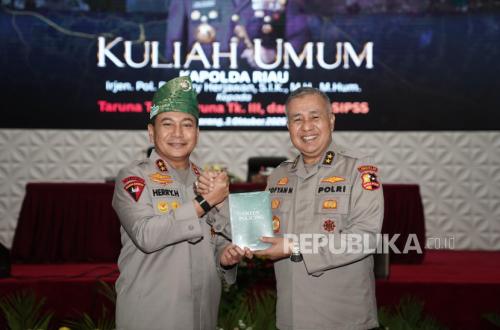
Technological shifts, evolving crime patterns, information flows, and environmental issues are making security challenges increasingly complex. These conditions demand that leaders within the Indonesian National Police (Polri) are not only capable of responding to existing problems but also able to anticipate changes and risks before they escalate into crises.
Riau Regional Police Chief, Inspector General Herry Heryawan, stated that these capabilities must be prepared from the very beginning of officer training. He shared these insights during a public lecture delivered to cadets of the Police Academy (Akpol) in Semarang on Saturday (3/10/2026).
According to Herry, while the primary mandate of the police remains unchanged, the environment in which that mandate is executed is constantly shifting. Consequently, police officers are required to be closer to the community, responsive to regional issues, fair in law enforcement, transparent in service, and adaptive to developments in technology, data, and criminal methods.
He noted that future Polri officers must possess more than just ‘command’ capabilities to move an organisation; they also need ‘design’ capabilities—the ability to plan how an organisation can work more effectively against changing problems. An officer must be able to translate issues into policy, policy into programmes, and programmes into tangible change.
Herry highlighted the experience of the Riau Regional Police in handling security issues intersecting with the environment as a vital learning space. Riau possesses forests, peatlands, rivers, and coastal areas that exist alongside plantation, industrial, and mining activities. This situation makes ecological issues inseparable from social, economic, and security aspects.
From January to September 2026, forest and land fires in Riau covered 20,656.81 hectares, resulting in 63 suspects. In the 2025-2026 period, 2,901 illegal gold mining (PETI) rafts were also dismantled. Additionally, the police handled 13 reports regarding illegal logging involving 20 suspects, and six reports regarding mangrove encroachment covering 141 hectares.
Based on these experiences, the Riau Regional Police have developed the ‘Green Policing’ concept. This approach treats environmental damage as a security risk that requires a combination of data, law enforcement, technology, collaboration, and environmental restoration. “Green Policing is not a change in Polri’s identity. It is an expansion of how we understand security,” said Herry.
He urged future cadets to look beyond crime statistics and population numbers. An officer must also recognise the condition of rivers, forests, water sources, high-risk areas, economic activities, land conflicts, and regional shifts. This understanding is essential to building ‘ecological literacy’—the fundamental ability of a leader to understand the relationship between the environment, society, and security.
This knowledge must then evolve into ‘ecological leadership,’ where ecological considerations become an integral part of police policy and decision-making. Herry also identified several other essential skills for future leaders, including sensemaking, reframing, questioning, evidence-based decision-making, policy thinking, experimentation, interdisciplinary thinking, and collaborative leadership.
Furthermore, Herry reminded that innovation should not cease when a leader transfers to a new position. He argued that innovation must evolve from ideas, experiments, and evaluations into policies, systems, and eventually, organisational culture. Thus, leadership success is measured not just by the programmes launched, but by the ability to build systems that continue to function after the leader has moved on.
Finally, Herry emphasised that the primary asset of Polri members is not authority, but public trust. “The main weapon of the Police is not a firearm, nor a baton, nor the authority to enforce the law. Our primary weapon as members of Polri is the trust of the community,” he asserted. While authority is granted by the state and positions by the organisation, trust can only be earned from the people.
Source: jawawa.id (https://jawawa.id/newsitem/riau-police-chief-future-polri-leaders-must-be-able-to-anticipate-change-and-risk-1791050055)
Originally published by Republika (https://news.republika.co.id/berita/tmc17n522/kapolda-riau-pemimpin-polri-masa-depan-harus-mampu-baca-perubahan-dan-risiko), translated from Indonesian