
Riau Police Chief Discusses Green Policing and Ecological Damage at IMT-GT Forum
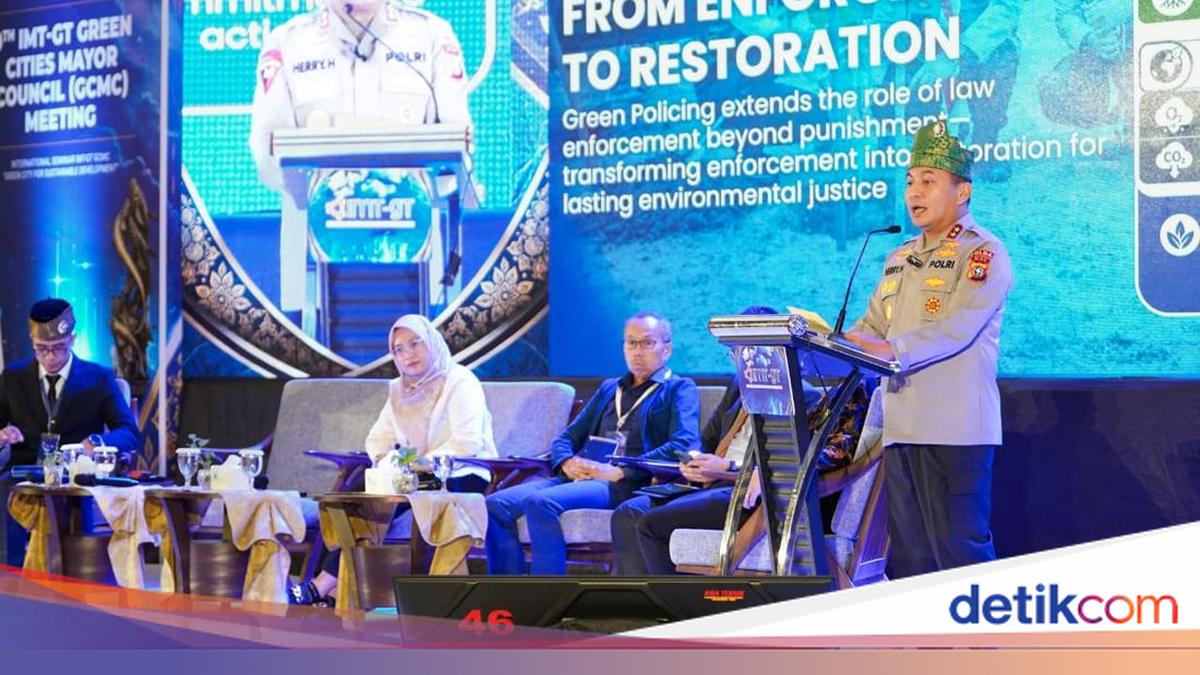
Riau Police Chief Inspector General Herry Heryawan was a speaker at the Green Cities Mayors Council (GCMC) seminar of the Indonesia-Malaysia-Thailand Growth Triangle (IMT-GT) 2026. At the forum, the Riau Police Chief presented the issues of ecological damage and Green Policing.
Speaking before regional heads and delegations from Indonesia, Malaysia and Thailand, Inspector General Herry Heryawan said environmental problems can no longer be seen purely as ecological issues. In his view, environmental damage can ultimately develop into social problems and even threats to public security.
The Police Chief began by noting that Riau Province possesses extraordinary natural wealth, from forests and peatlands that play an important role in global climate regulation, to rivers that serve as a source of livelihood for communities. At the same time, however, Riau also faces various environmental problems such as forest and land fires, illegal mining, illegal logging, encroachment on conservation areas and river pollution.
On that occasion, the two-star general put forward his concept of Green Policing, which emerged from his experience leading the Riau Regional Police since 2025. In response to these problems, the Riau Regional Police under his leadership carried out massive law enforcement. Yet along the way, he saw that law enforcement alone was not enough to break the cycle of environmental problems.
“Every year we still face relatively the same environmental problems. From there arises a simple question: why do the same problems keep occurring even though law enforcement continues to be carried out?” said Inspector General Herry Heryawan in Pekanbaru on Wednesday (5/8/2026).
According to him, environmental crime has a different character from conventional crime. Perpetrators can indeed be arrested and processed through the courts, but the ecological damage that has already occurred cannot automatically be restored through legal proceedings. When a river is polluted, for example, the impact does not stop at a legal violation. Children living along the river can lose their living space as well as their connection with nature inherited across generations.
“The law can stop perpetrators, but law enforcement alone cannot restore ecosystems. The law can provide certainty, but legal certainty alone does not automatically create sustainability,” he said.
Green Policing as the Answer
That awareness became one of the starting points for developing Green Policing in Riau. The police no longer ask only how to handle environmental crime, but have begun to look at how to prevent environmental damage from developing into a security threat.
This is because, in his view, environmental damage and public security are very closely linked. Damage to river catchment areas can increase flood risk, forest encroachment can trigger social conflict, while various forms of environmental degradation can give rise to new problems within communities.
“When the environment becomes weaker, security also becomes weaker,” he said.
That approach then led the Riau Regional Police to expand collaboration with regional governments, academics, civil society organisations, the private sector, schools, educational institutions and grassroots communities.
A graduate of the 1996 Police Academy class, he assessed that environmental problems are often not caused by an absence of working institutions, but rather by weak connectivity between institutions. For that reason, Green Policing was built as a space that brings these various forces together.
“For us, Green Policing is ultimately not merely a policing approach. Green Policing has become a platform for collaboration,” he said.
He cited the handling of illegal mining in Kuantan Singingi Regency as an example. After law enforcement operations were carried out, the police returned to the site to promote restoration through the installation of environmental protection signs, tree planting, community campaigns, strengthening environmental education and supporting the efforts of the regional government.
According to Herry, that experience reinforced the view that security in the future cannot be understood merely as a condition without crime.
“Security also means the presence of a healthy environment. That is why I believe Green Policing and Green Cities are very closely connected,” he said.
At the IMT-GT forum, Herry also stressed that green city development cannot be done by viewing a city as a stand-alone area.
A city’s survival depends on the forests in its upstream areas, rivers that keep flowing, trust between communities and the ability of various institutions to work together.
Therefore, the future of cities in the IMT-GT region, in his view, is determined not only by how fast development is carried out, but also by how strong the capacity is to maintain a balance between development, the environment and public security.
“Protecting the environment is not merely about protecting nature. Protecting the environment means protecting the future of our communities and the generations after us,” said the 1996 Police Academy graduate.
He then closed his remarks with a message that has long been one of the spirits of the Riau Regional Police’s Green Policing.
“If we protect nature, then nature will protect us,” the Police Chief concluded.
Source: jawawa.id (https://jawawa.id/newsitem/riau-police-chief-discusses-green-policing-and-ecological-damage-at-imt-gt-forum-1785909182)
Originally published by detikcom (https://news.detik.com/melindungi-tuah-marwah/d-8605116/kapolda-riau-bicara-soal-green-policing-dan-kerusakan-ekologis-di-forum-imt-gt), translated from Indonesian