
Riau Police and Johor Police Strengthen Cooperation on Malacca Strait Security
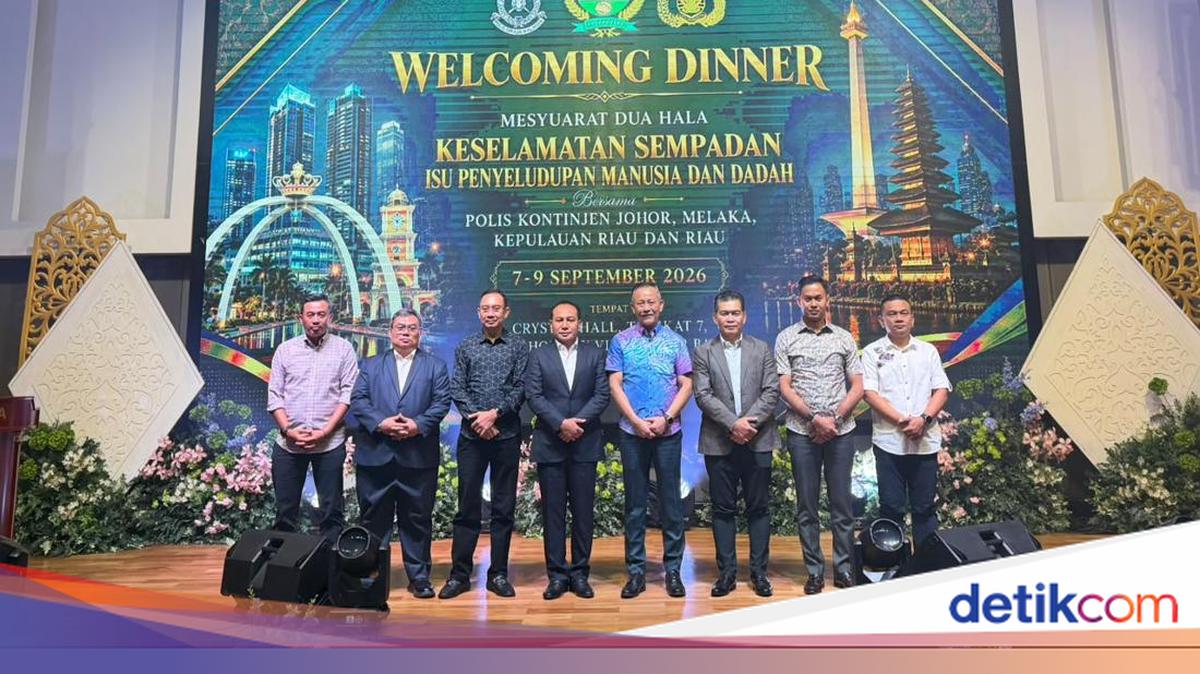
Riau Regional Police Chief Inspector General Herry Heryawan attended a strategic meeting with Johor Police officials in Johor, Malaysia. The meeting was held to strengthen cooperation in securing the Malacca Strait against transnational crime.
The bilateral meeting was also attended by Johor Police Chief CP Dato Ab Rahaman Bin Arsad, Melaka Police Chief DCP Datuk Wira Dzulkhairi Bin Mukhtar, Indonesian Consul General in Johor Bahru Sigit Suryantoro Widyanto, Deputy Regional Police Chief of Riau Islands Brigadier General Anom Wibowo, and senior officials of the PDRM and the Indonesian National Police.
Inspector General Herry Heryawan stressed that Riau’s geographical position, directly facing the Malacca Strait, makes the region highly strategic economically, yet vulnerable to cross-border crime.
“Criminal networks do not recognise jurisdictional boundaries and operate in an organised manner from upstream to downstream. Therefore, handling them unilaterally is not enough. Real Indonesia-Malaysia synergy is needed,” said Inspector General Herry on Tuesday (8/9/2026).
Three main issues were discussed at the meeting: people trafficking (TPPO), narcotics, and forest and land fires (karhutla).
Between 2022 and 2026, Riau Regional Police and its district units processed 98 people trafficking cases, rescued 732 victims of undocumented Indonesian migrant workers (PMI) for repatriation, and prosecuted 190 suspects. Riau Regional Police identified wage disparities as the main method used to recruit undocumented Indonesian migrant workers to Malaysia through unofficial ports known as ‘rat ports’.
This law enforcement effort is complemented by joint prevention efforts with the Task Force for the Prevention of Illegal PMI Placement from BP3MI Riau, cross-agency commitments with the Ministry for the Protection of Indonesian Migrant Workers, and massive education campaigns by Bhabinkamtibmas officers in coastal areas.
Narcotics ‘Rat Runs’ on the Riau Coast
In the narcotics eradication sector, Riau Province faces the challenge of 29 rat ports along its coastline, exploited by international networks. Drug supplies centred in or transiting through Malaysia frequently enter Riau via three main routes: land (via North Sumatra/Aceh), sea (the Malacca Strait), and air.
From January to September 2026, Riau Regional Police uncovered 2,053 narcotics cases and arrested 2,816 suspects, seizing 0.455 tonnes of evidence (236.8 kg of crystal methamphetamine and 276,309 ecstasy pills). Besides crystal methamphetamine and ecstasy, Riau Regional Police also seized various other narcotics, including heroin, ketamine, Happy Five, happy water, and etomidate.
As a grassroots prevention measure, Riau Regional Police has established 16 Drug-Free Villages and appointed 23 Anti-Narcotics Ambassadors.
Forest Fires and Transboundary Haze
The effects of the super El Niño phenomenon from January to August 2026 drove an increase in the area affected by forest and land fires in Riau to 17,525.80 hectares, with a peak of 306 hotspots at the end of August 2026. Riau Regional Police deployed 3,030 personnel and tactical equipment, including thermal drones, fire suppression drones, and 100 patrol ATVs.
In terms of law enforcement throughout 2026, police handled 45 police reports, detained 49 suspects, and secured 2,958.04 hectares of burnt land. Alongside law enforcement, Riau Regional Police and related agencies built mitigation infrastructure comprising 1,988 canal blocks, 1,390 retention basins, 19 boreholes, 313 watchtowers, and 514 fire warning signs.
Fire mitigation efforts were also reinforced through public outreach and education as well as social activities, including distributing 165,000 face masks and setting up health posts for affected residents. Data from the BMKG shows that wind patterns carry the potential for transboundary haze from Kalimantan towards Sarawak and Sabah (Malaysia), Brunei Darussalam, and the Philippines, further underscoring the need for communication between countries.
“This shows that environmental problems also require cross-border communication and coordination,” he added.
Green Policing Innovation
As a form of modern policing, Riau Regional Police has pioneered the Green Policing concept, combining Problem Oriented Policing and Community Policing. Through preventive, repressive and restorative approaches, between 2025 and 2026 Riau Regional Police rescued 3,423.54 hectares of land from environmental crime. In the same period, it destroyed 2,712 units of equipment used in illegal gold mining (PETI).
Law enforcement efforts were also reinforced through restoration and rehabilitation, with 246,791 trees planted, projected to absorb 5,429.4 tonnes of carbon. In addition, early detection is being carried out through the development of a digital Smart App Green Policing application and a Waste to Energy project in Pekanbaru.
To follow up on the existing maritime patrol cooperation (the Rendezvous between the Riau Regional Police Marine Directorate and the PDRM’s Region Two Marine Police Force in Johor Bahru), the Riau Regional Police Chief pushed for the application of an integrated Case Management cooperation mechanism, from early detection and information exchange to joint analysis and case evaluation.
At the meeting, the Riau Regional Police Chief promoted case management as an integrated cooperation pattern, beginning with information detection, information exchange, joint analysis, investigative coordination, action according to jurisdiction, the communication of outcomes, and joint evaluation.
“With this mechanism, cooperation does not stop at information exchange, but continues through to action and evaluation of cross-border cases,” he said.
To strengthen this cooperation, the Regional Police Chief proposed five main commitments. First, accelerating communication and information exchange, through direct communication channels or liaison officers, as well as rapid information sharing on perpetrators, networks, methods and cross-border movements.
“Second, integrating information to map criminal networks, methods and routes, including people trafficking and narcotics networks, transit points, vulnerable locations, transport patterns, and possible links between the two criminal networks,” he continued.
The Riau Regional Police Chief also encouraged professional, integrity-based case handling in accordance with jurisdiction, while maintaining the validity of information, the chain of custody, data confidentiality, and coordination mechanisms for cases with connections in both countries. To break the people trafficking chain, Riau Regional Police is pushing for strengthened community safety and protection, particularly for trafficking victims, through identification, rescue, recovery, repatriation, and prevention to ensure victims do not become targets of these networks again.
“Finally, strengthening case management through closer communication and joint evaluation via joint case management, case tracking, joint case reviews, and periodic evaluations of criminal networks’ methods and movement patterns,” he concluded.
Source: jawawa.id (https://jawawa.id/newsitem/riau-police-and-johor-police-strengthen-cooperation-on-malacca-strait-security-1788854014)
Originally published by detikcom (https://news.detik.com/melindungi-tuah-marwah/d-8653783/polda-riau-dan-kepolisian-johor-kerja-sama-perkuat-keamanan-selat-malaka), translated from Indonesian