
Riau Leads Indonesia's High-Integrity Forest Carbon Market
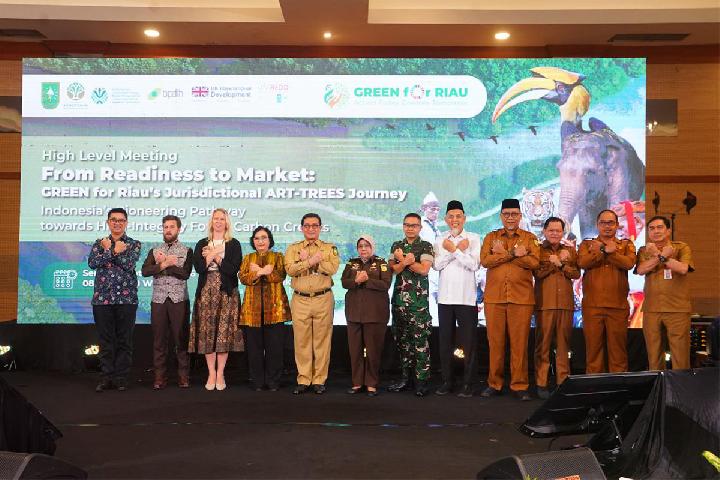
Riau Leads Indonesia’s High-Integrity Forest Carbon Market
Reporter
September 8, 2026 | 03:19 pm
TEMPO.CO, Jakarta - The Government of Riau on Tuesday, September 7, marked a major step in its GREEN for Riau Initiative, advancing its preparations to pursue implementation under the REDD+ Environmental Excellence Standard (TREES), administered by the Architecture for REDD+ Transactions (ART), at jurisdictional scale.
The Ministry of Forestry expressed its support for the Riau Provincial Government’s efforts to strengthen its readiness for jurisdictional REDD+. This support forms part of broader efforts to advance technical and institutional readiness, safeguards, and governance in line with national policy. Through this process, Riau becomes the first province in Indonesia to implement jurisdictional REDD+ aligned with ART-TREES, a high-integrity international standard, while also establishing a practical reference point for other provinces.
“This is a significant milestone for Riau,” said S.F. Hariyanto, Acting Governor of Riau. “Our ambition is to protect forests and peatlands while creating real opportunities for communities. By building one transparent provincial system, we aim to ensure that climate finance rewards measurable results, upholds strong safeguards and the people whose stewardship makes those results possible.”
Over 7–8 September, a connected series of engagements brings together provincial and national authorities, the United Nations, development partners, UK and Norwegian Embassy officials, communities, technical experts and potential buyers. These engagements combine high-level dialogue, technical consultations, a community site visit and a meeting with market participants.
Together, these activities examine the foundations needed to strengthen jurisdictional REDD+ and open access to various results-based finance and carbon market schemes, in line with national policy and applicable standard requirements. This includes developing a provincial-scale Forest Reference Emission Level (FREL) consistent with the national FREL and national MRV system, social and environmental safeguards, an equitable benefit-sharing mechanism, and clear rules for nesting projects and community-led action within one jurisdictional accounting framework.
A draft Operational Guidance Note for Riau’s jurisdictional REDD+ nesting and accounting framework will be presented and consulted on during these events.
“Riau’s efforts to strengthen its readiness for jurisdictional REDD+ are commendable. However, environmental and social integrity must be a foundation from the outset. This includes a reference level and MRV system consistent with the national framework, robust social and environmental safeguards, and clear benefit-sharing,” said Haruni Krisnawati, Expert Staff to the Minister for Climate Change, Ministry of Forestry. “Riau’s experience can offer an important lesson for other provinces developing credible jurisdictional REDD+ as they consider high-integrity pathways in Indonesia.”
This work is aligned with Indonesia’s National Action Plan on Gender Mainstreaming and Social Inclusion in Climate Change (RAN-GPI). “Women are not only recipients of climate impacts, but also agents and leaders of change. Green development must ensure that women and vulnerable groups are engaged, heard, protected, and able to benefit,” said Arifatul Choiri Fauzi, Minister of Women’s Empowerment and Child Protection of the Republic of Indonesia.
Riau contains extensive forests and about 4.9 million hectares of peatland, making the province important to Indonesia’s climate and land-use goals. The emerging framework aims to align with Indonesia’s FOLU Net Sink 2030 ambition and the development of Carbon Economic Value in the forestry sector. Nesting arrangements are needed to maintain consistency in accounting while reducing the risk of overlapping claims among programmes operating at different scales.
This readiness milestone comes during Sumatra’s dry season, when the risk of forest and peatland fires and associated haze is particularly high. These seasonal risks underscore why protecting standing forests and peatlands—and shifting from emergency response toward sustained prevention, restoring water governance, rewetting degraded peatland ecosystems and improved land and water management—is central to reducing Riau’s long-term fire and emissions risks.
“Protecting these forests is about far more than carbon; it is about water, public health, and long-term resilience for the people of Riau,” said Gita Sabharwal, United Nations Resident Coordinator in Indonesia. “That is why Riau’s approach matters: it shows how climate ambition, forest protection, community well-being, and investment can reinforce one another, while helping Indonesia set a global standard for high-integrity jurisdictional forest action.”
The GREEN for Riau Initiative is supported by the UN-REDD Programme through the United Nations Environment Programme (UNEP) and the Food and Agriculture Organization (FAO), with funding from the United Kingdom’s Foreign, Commonwealth & Development Office (FCDO). The initiative has supported technical dialogue, institutional coordination and early analytical work on reference levels, safeguards and nesting, with the aim of translating international integrity requirements and Indonesian policy into an operational provincial approach.
“This marks a major milestone for Riau and other ART-TREES pilot provinces. It demonstrates how climate ambition can be translated into results,” said Peter Rajadiston, Minister-Counsellor (Development) at the British Embassy Jakarta.
“The UK is proud to support Indonesia and Riau to advance sustainable development and deliver our shared priorities under the UK-Indonesia Strategic Partnership on Climate, Energy and Nature. Riau has the opportunity to demonstrate how robust peatland emissions accounting and effective nesting can align private sector projects within a credible jurisdictional framework. This is essential for ensuring integrity, boosting investor confidence, supporting premium pricing for high-quality credits, and attracting long-term private investment into forests and local communities,” he added.
Riau’s pathway remains subject to completion and validation of technical requirements, stakeholder consultation, and the applicable ART-TREES registration, validation and verification processes.
Read: Jokowi Calls for ‘UN 2.0’ at Penang Peace Dialogue
Click here to get the latest news updates from Tempo on Google News