
Riau Islands Economy Grows 7.02 Per Cent, Bank Indonesia Highlights Need for Inclusive Benefits
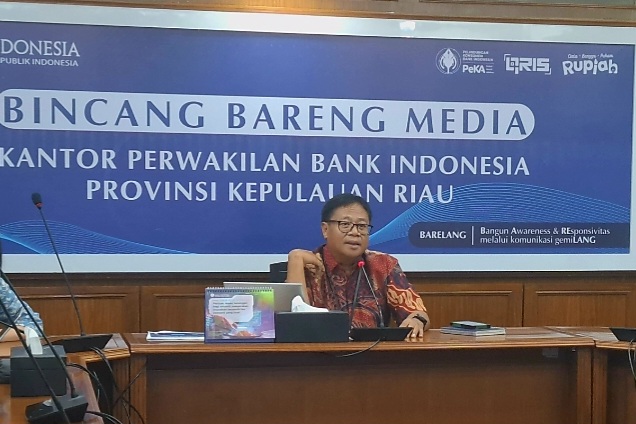
BATAM – The economy of the Riau Islands (Kepri) has advanced rapidly throughout the first half of 2026. However, amid the flood of investment and industrial expansion, the next challenge is no longer merely sustaining growth, but ensuring its impact is increasingly felt by the wider population.
The Riau Islands economy grew 6.99 per cent year-on-year in the second quarter of 2026. Cumulatively, economic growth in the first semester of 2026 reached 7.02 per cent, far above the national economic growth rate of around 5.45 per cent.
This performance was also underpinned by Batam, which recorded higher growth. In the second quarter of 2026, Batam’s economy grew 7.28 per cent year-on-year.
The achievement places Kepri among the provinces with the highest economic growth in Sumatra and serves as a positive signal for the region’s economic prospects through to the end of 2026.
Head of Bank Indonesia’s Riau Islands Provincial Office, Rony Widijarto, said the latest economic data provides one of the bases for Bank Indonesia to view Kepri’s growth prospects more positively.
According to Rony, investment is one of the main engines driving the high growth. In the second quarter of 2026, investment growth was recorded at around 24 per cent, a sharp increase compared to the previous period.
The surge has significantly boosted investment’s contribution to Kepri’s economic growth. In the first quarter the contribution was around 3.62 per cent, but in the second quarter of 2026 it leapt to 10.62 per cent.
“This investment growth is expected to generate a multiplier effect as investments, particularly in the industrial sector, enter the operational stage,” Rony said during a media discussion (Bincang Bareng Media) held in the Raja Ali Haji Room at Bank Indonesia’s Kepri Provincial Office on Tuesday (15/9/2026).
Industry Remains the Main Engine
Behind the high investment growth, the manufacturing sector remains the main pillar of the Kepri economy. Processing industry activity has continued to grow steadily and makes a dominant contribution to the region’s economic structure.
The mining sector has also held relatively firm, helping to support the high economic growth through the second quarter of 2026.
The strength of industrial activity is also reflected in banking financing. Bank credit by project location in Kepri grew around 36 per cent in July 2026, far higher than national credit growth of around 13 per cent.
The credit growth was primarily driven by corporate lending, which increased by around 66 per cent.
Financing has flowed not only directly into industry, but also into supporting sectors such as warehousing and transport, electricity, gas and water supply, and various activities related to the processing industry.
According to Rony, the high credit disbursement indicates that industrial expansion in Batam and Kepri is still under way, even as the global economy faces various challenges.
However, the surge in investment and strong industrial expansion raises the next question: how much is this growth able to create a multiplier effect for the people of Kepri?
High Growth Is Not Enough
According to Bank Indonesia, high economic growth does not automatically mean its benefits are felt evenly across all levels of society.
Therefore, the next challenge is ensuring that Kepri’s growth becomes more inclusive. The multiplier effect from the industrial sector needs to be strengthened so that it does not stop at increased investment and production, but also boosts the participation of Kepri residents in economic activity.
One indicator under close attention is employment. Economic growth needs to be accompanied by increased job opportunities, both in the formal and informal sectors. That way, economic success is reflected not only in gross regional domestic product (GRDP) figures, but also felt through rising incomes and public welfare.
Rony believes strengthening sectors outside big industry is important to broaden the impact of economic growth.
In this context, micro, small and medium enterprises (MSMEs) are one of the strategic sectors.
“How can we start with things we can monitor in terms of development progress? One of them is through MSMEs,” he said.
Strengthening MSMEs is considered capable of creating a wider multiplier effect, especially through the creative economy and tourism sectors.
Nevertheless, Kepri’s MSMEs still face a number of classic problems, ranging from weak institutional and corporatisation capacity, business capabilities that need improvement, and access to financing.
QRIS as a Gateway to the Digital Economy
Amid efforts to strengthen MSMEs, payment digitalisation is one of the instruments continuously promoted by Bank Indonesia.
The number of businesses using digital payment channels in Kepri continues to rise. As of July 2026, the number of QRIS merchants reached around 680.77 thousand.
The majority of these merchants come from the micro and small business sectors. Micro-enterprises account for around 72 per cent, while small enterprises account for around 19.8 per cent.
In terms of transactions, QRIS usage in Kepri also continues to record high growth.
As of July 2026, QRIS transaction value had reached around Rp9.94 trillion. QRIS transaction growth in Kepri also remains at a high level compared to the national figure.
Bank Indonesia continues to encourage wider QRIS adoption, including through the zero per cent Merchant Discount Rate (MDR) policy for micro-enterprises on transactions up to Rp500 thousand, as well as expanded conveniences for other merchant categories in accordance with prevailing regulations.
For Bank Indonesia, payment digitalisation is not merely about changing how people transact. More broadly, digitalisation forms part of efforts to widen economic access for small business players.
In this way, the growth in investment and industry that currently serves as Kepri’s main economic engine is expected to create a longer chain of benefits: from job creation, the growth of MSME suppliers and industrial supporters, increased economic transactions, to the development of the creative economy and tourism sectors.
Strengthening MSMEs, expanding payment digitalisation, improving employment opportunities, and creating a multiplier effect from industrial investment are the next tasks so that Kepri’s already high economic growth can develop into growth that is more even, inclusive, and sustainable.
This message also forms part of the agenda of Gebyar Melayu Pesisir (GMP) 2026, which promotes the development of MSMEs, the creative economy and tourism as part of efforts to broaden the sources of Kepri’s economic growth amid the strong dominance of the industrial sector.
Source: jawawa.id (https://jawawa.id/newsitem/riau-islands-economy-grows-7-02-per-cent-bank-indonesia-highlights-need-for-inclusive-benefits-1789494621)
Originally published by batamstraits.com (https://batamstraits.com/2026/09/15/ekonomi-kepri-tumbuh-702-persen-bank-indonesia-soroti-pemerataan-manfaatnya/), translated from Indonesian