
RI Deputy FM Discusses Two-State Solution and the Fate of BoP
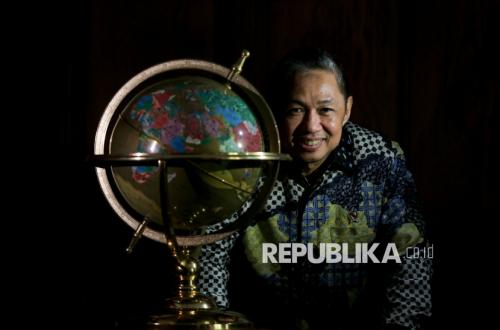
Deputy Foreign Minister Anis Matta, who oversees Islamic World affairs, has little free time. Escalations in the Gulf region and increasing Israeli aggression keep him constantly engaged, with numerous meetings to be held with representatives of Muslim-majority countries.
Amidst his busy schedule, Anis Matta met with Republika at his office in the Constitution Building, Ministry of Foreign Affairs complex, on Monday (8/6/2026). The seasoned politician, who now also leads the Gelora Party, spoke fluently about the regional situation and its broad impact.
Regarding the Global Sumud Flotilla 2.0, Matta explained, “This is the second one. Since last year, we have established a protocol at the Foreign Ministry, led by the Directorate for the Protection of Indonesian Citizens.”
He stressed that the decision of individual activists to participate comes first. “The state’s duty here is to protect its citizens. In the case of the Flotilla, we have a technical constraint because we do not have diplomatic relations with Israel. Therefore, citizen protection is carried out in the outer ring of Israel,” he stated.
This outer ring involves all Indonesian embassies along the activists’ routes being on standby before departure. For the current journey, coordination has been most intensive with the governments of Turkey, Egypt, and Jordan, while Indonesia’s Embassy in Rome covers Cyprus.
Matta receives hour-by-hour reports and views the Flotilla as a sign. “This is a sign that the narrative of the Palestinian struggle has left Palestine. It has become owned by humanity, by the citizens of the earth. The issue of Palestinian independence is fought for by people of conscience from all over the world.”
He elaborated that the Palestinian struggle narrative has passed through three stages. The first was the Arab-Israeli conflict narrative, an attempt to localise the issue after Israel’s establishment in 1948, just three years after Indonesia’s independence when Palestinians experienced the Nakba.
From the 1950s through the 1980s, he noted, “The narrative was simply, ‘This is a conflict between Arabs and Israelis.’” Although Indonesia did not have to be directly involved, it fought for the cause in the context of unliberated nations, especially following the Asia-Africa Conference in Bandung in 1955.