
Reviving the Soul Amidst the Machines: The Silent Crisis in the Modern Workspace
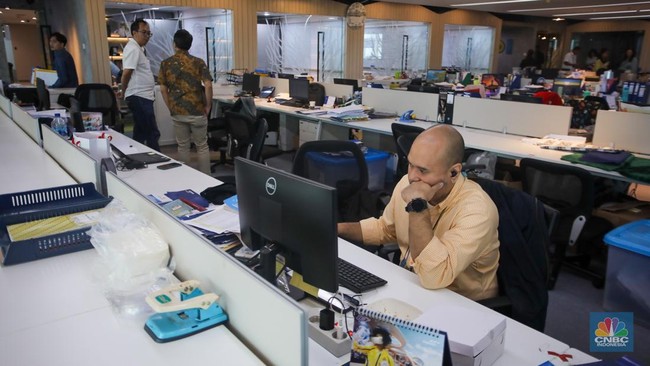
The integration of Artificial General Intelligence (AGI) and Autonomous Agentic Artificial Intelligence (AAAI) architecture has permeated almost all modern corporate supply chains. In offices, restaurants, and co-working spaces, AI dashboards can now present unprecedented quantitative performance.
Five-year market risk analyses may be completed in milliseconds, financial decision-making automation runs without mechanical friction, and operational efficiency projections pierce exponential graphs. Statistically and quantitatively, the business civilisation of the 21st century may be at the golden peak of its materialism. However, if the lens of observation shifts from algorithmic monitors to the eyes of the professionals executing those decisions, a haunting sight emerges.
Behind neatly arranged formal attire lies massive existential exhaustion. This burnout can no longer be cured merely by superficial wellness facilities, a third cup of coffee, or short weekend holidays aimed at ‘healing’. The phenomena of ‘quiet quitting’, mass burnout, and swelling employee disengagement raise a question for us all: has extreme technical efficiency birthed the quietest humanitarian crisis in organisational history?
The question is, why is this happening? The problem may be ontological in nature. Conventional Human Resource Management (HRM), inherited from the industrial engineering rationality of the 19th century, views corporations as complex giant machines, with the humans within them merely as interchangeable components. Humans are measured, assessed, and valued solely based on quantitative outputs, procedural compliance with Standard Operating Procedures (SOP), and rigid physical or digital presence. When this mechanistic paradigm is forced amidst the wave of AGI disruption, humans experience an unprecedented level of alienation.
Workers treated like mechanical data processors are existentially pushed to the brink as they struggle to compete with the speed and accuracy of machines. This disconnect between how we manage work and the fundamental essence of human existence demands a new framework of thought, namely ‘Conscious Human Resources’.
From ‘Having’ to ‘Being’ in HR Governance
The paradigm shift offered in this treatise is rooted in Erich Fromm’s critical thinking regarding the two modes of human existence: ‘To Have’ and ‘To Be’. Conventional HRM operates entirely within the ‘having’ paradigm. In this mode, companies are busy ‘possessing’ employees’ working hours, controlling physical movements through direct or algorithmic surveillance, and extracting as much output as possible to satisfy the compass of shareholder primacy. Humans are reduced to mere costs to be suppressed or measurable assets to be utilised to their maximum extent.
Conversely, the ‘being’ paradigm places humans as conscious subjects—whole individuals possessing inseparable emotional, mental, spiritual, and social dimensions. The workplace is no longer viewed as a prison of transactional routines, but as a living ecosystem that nurtures life and fosters the highest human potential.
The construction of Conscious Human Resources is built upon the integration of three main pillars: Content Awareness (awareness of self-potential), which involves a deep understanding of an individual’s internal architecture, including innate talents, mindset, cognitive capacity, and emotional dynamics; Context (sensitivity to context and modern developments), which involves sharp sensitivity to the dynamics of the external ecosystem, including the acceleration of AGI, global geopolitical shifts, and sustainability demands; and Connectivity Awareness (awareness of interconnectedness), the realisation that no organisational element stands in isolation. Individual well-being, team harmony, corporate financial health, and the ecological sustainability of the earth are tightly interwoven in a single web of life.
The philosophical foundation of Conscious Human Resources is further strengthened when paired with the thoughts of the classical ethics philosopher Ibn Miskawayh in his work, Tahdzib al-Akhlaq. Miskawayh asserts that the pinnacle of human existence is the achievement of moral goodness and the perfection of the soul. Work effectiveness is not the result of extrinsic coercion, but the fruit of spiritual clarity. Miskawayh enriches the three practical foundations of Conscious Human Resources through:
Self-awareness through self-monitoring (muraqabat al-nafs) and introspection (muhasabah), enabling workers to respond to work challenges calmly and rationally without being dictated by ego fluctuations.
Empathy, by understanding that humans are social beings (madaniyyun bi al-thab’i). Compassion in the workplace strengthens emotional bonds and creates a psychologically safe space.
Integrity, where there is absolute alignment between inner intention and public action, reflecting justice and virtue.
The Ontology of Conscious HR in the Modern Era
To understand the culmination of the current workplace crisis, we must trace the history of how human work has been defined. As expressed by James Suzman in Work: A Deep History of How We Spend Our Time, ancient hunter-gatherer societies, such as the Ju/’hoansi tribe, spent only 15 to 17 hours per week to meet their subsistence needs, enjoying the rest of their time for social and cultural activities.
The obsession with long working hours and material accumulation was born with the Agricultural Revolution and exacerbated by the Industrial Revolution, which separated work from pure biological needs, transforming it into an individual social status.
Source: jawawa.id (https://jawawa.id/newsitem/reviving-the-soul-amidst-the-machines-the-silent-crisis-in-the-modern-workspace-1788490638)
Originally published by CNBC Indonesia (https://www.cnbcindonesia.com/opini/20260904081041-14-764867/membangkitkan-ruh-di-tengah-mesin-krisis-sunyi-di-ruang-kerja-modern), translated from Indonesian