
Reviving the 'Gold' of Tombo Coffee, Growing the Economy and Protecting the Environment
Long before coffee became part of today’s lifestyle trends, Tombo Village in Bandar District, Batang Regency, Central Java, was already familiar with the commodity.
Since the Dutch colonial era, Tombo has been known for its coffee wealth, which was once marketed to international markets. Coffee became one of the community’s agricultural strengths and part of the village’s identity passed down from generation to generation.
However, Tombo coffee’s journey has not always been in its golden age.
Increasingly tight market competition and various challenges in commodity management caused coffee to be gradually displaced by other crops, including rubber and tea. Over time, Tombo coffee’s glory was no longer as strong as before.
Now, the spirit to strengthen Tombo’s ‘gold’ potential is beginning to grow. The community, including the village’s younger generation, is starting to see coffee not only as a legacy of the past but as an economic opportunity that still has a future. At the same time, coffee development is also seen as able to go hand in hand with efforts to maintain environmental functions, particularly in the watershed area.
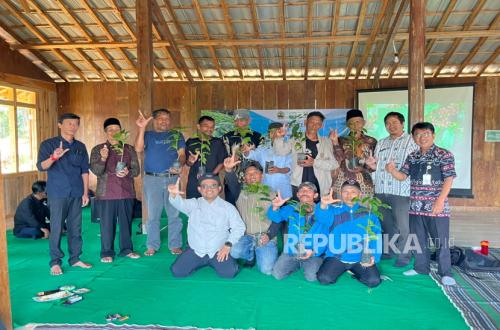
This spirit was realised through a Technical Guidance session on Arabica Coffee Cultivation for Tombo Village farmers at Pondok Sidawung on Tuesday (11/8/2026). The activity is part of the DAS Lestari programme, which encourages community economic development alongside sustainable environmental management.
Farmers received practical knowledge on Arabica coffee cultivation, from planting techniques to pest and disease management. Burohim and Anang from Surjo Coffee Farmers attended as speakers to share experience and knowledge that can be directly applied on farmers’ land.
Enthusiasm was visible throughout the activity. Participants raised various questions, especially about pests and plant diseases, which are among the challenges in maintaining coffee growth and productivity. For the farmers, this knowledge is not merely training material. What they learned will be taken back to their gardens and become a foundation for caring for their plants so they can grow well.
One participant, Tarmujo, a coffee farmer in Tombo, said the training provided a clearer understanding of the stages of coffee cultivation.
“For today’s training, from planting to knowledge and handling of pests and diseases, it is quite clear. Going forward I will apply and understand it in managing coffee plants,” he said.
Tombo Village Head Mustajab sees the farmers’ enthusiasm as important capital for strengthening coffee development in his village.
“Alhamdulillah, farmers are very enthusiastic about participating in this activity. Many questions were raised, and hopefully the knowledge gained can support the success of Arabica coffee development in Tombo Village. We hope that from the initial stage to implementation it can run well and have an impact on improving the community’s economy,” he said.
The cultivation strengthening was then followed by seedling support. A total of 5,400 Arabica coffee seedlings have been prepared to support planting on farmers’ land.
Based on a survey conducted by the Forestry Service Branch Region IV of the Central Java Environment and Forestry Service (CDK IV) of 27 plots of land, the seedlings are planned to be distributed to 13 farmers for planting ahead of the rainy season.
Interestingly, the development is not carried out by opening new forest areas. All planting locations are on farmers’ own land and are not in forest areas. Thus, coffee development is carried out without forest clearing or encroachment.
Instead, the coffee plants being developed belong to the MPTS (Multi-Purpose Tree Species) group, namely plants that not only provide economic benefits through their production but also have ecological functions. The presence of these plants is expected to help maintain soil conditions, reduce erosion risk, and support surrounding environmental functions.
With this approach, coffee development in Tombo is directed at bringing together two interests that are equally important for the community: increasing the economic value of land while maintaining its ecological function.
The process is carried out collaboratively involving the Tombo Village Government, the Forest Village Community Institution (LMDH), CDK Region IV, and PT Bhimasena Power Indonesia (BPI).
For BPI, the success of a community empowerment programme is not enough with merely providing seedlings. Farmers’ knowledge and skills need to be strengthened so that the community can manage the potential independently and sustainably.
General Manager of Stakeholder Relations at PT Bhimasena Power Indonesia, Aryamir H. Sulasmoro, said strengthening community capacity is an important part of programme sustainability.
“Support for the community is not only in the form of providing seedlings, but also how farmers’ knowledge and skills can continue to develop. Through this activity, we hope farmers have sufficient foundation to develop Arabica coffee while managing land sustainably,” he said.
As a follow-up to the technical guidance, farmers will also receive mentoring to ensure the planting and seedling maintenance process is carried out according to the techniques and knowledge provided during the training.
Thus, the development process does not stop when the training activity ends. Knowledge will be passed on to the gardens, seedlings will be planted and cared for, while the mentoring process is expected to help farmers face challenges as the plants grow.
The journey to restore Tombo coffee’s glory certainly does not happen overnight.
Time is needed for seedlings to grow, for farmers to care for them, and for the results to provide economic benefits.
However, these small steps carry a great hope: that the coffee that was once Tombo’s strength can once again take a role in community life.
Not by repeating the past, but by building a more sustainable future.
Because for the people of Tombo, coffee ‘gold’ is not only about the harvested fruit. It is about economic value growing in farmers’ hands, knowledge passed on to the next generation, and land that remains preserved for future life.
Source: jawawa.id (https://jawawa.id/newsitem/reviving-the-gold-of-tombo-coffee-growing-the-economy-and-protecting-the-environment-1787716336)
Originally published by Republika (https://rejogja.republika.co.id/berita/tkcvq2291/menghidupkan-kembali-emas-kopi-tombo-menumbuhkan-ekonomi-dan-menjaga-lingkungan), translated from Indonesian