
Revitalising 836 Special Schools: Education Ministry to Deliver Safe Schools and Strengthen Inclusive Education
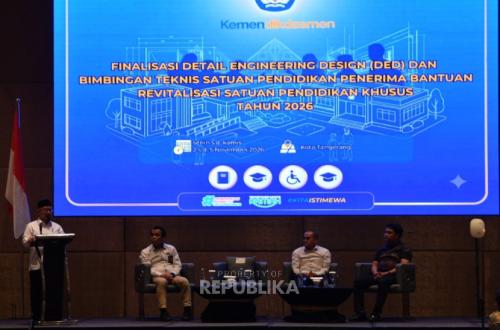
JAKARTA — The Ministry of Primary and Secondary Education is strengthening its 2026 revitalisation programme for 836 special schools, prioritising building safety, accessibility and learning facilities suited to the needs of pupils with disabilities. At a technical design finalisation and training event in Tangerang, Banten, the ministry called for each school to draw up a revitalisation plan that not only improves its physical condition but also supports learning, assistance and pupils’ development of independence.
In his remarks, Minister of Primary and Secondary Education Abdul Mu’ti said every child was entitled to a proper education, including children with disabilities. School buildings and facilities therefore needed to be adapted to pupils’ needs.
“Revitalisation is not an end in itself, but a means of providing representative school buildings and excellent education,” Mu’ti said when opening the event in Tangerang on Monday (2 November).
Director General of Secondary and Special Education Tatang Muttaqin said that substantial needs remained in improving educational facilities. According to the Education Data Centre (Dapodik) figures he cited, more than 900,000 classrooms were in moderate or severe disrepair and required attention.
Some schools also still needed new classrooms. “Behind these figures are millions of children waiting for safe, comfortable and suitable learning spaces, including children with special needs at special schools,” Tatang said.
The Special School Education Unit Revitalisation Programme is part of President Prabowo Subianto’s Quick Best Results Programme (PHTC) and the implementation of the fourth Asta Cita priority. Grants are paid directly into school accounts and managed through a self-managed mechanism. This makes schools responsible for carrying out the work and enables them to involve local communities and use locally sourced building materials.
Tatang urged school principals to use the grants in line with their needs and approved plans. He also told them not to respond to requests that would divert the funds from their intended purpose. The programme is monitored with the involvement of the Attorney General’s Office and the Ministry of Finance, including to ensure compliance with tax rules.
The facilities required vary from one special school to another. Rhadeya Phawitra, acting head of SLBN Surade, said her school needed a multipurpose room, a school health unit room and a skills room. The ageing building and damaged roof affected the comfort of learning activities. Unstable electrical wiring was also a concern because it could disrupt the use of electronic equipment, including interactive flat panels, known locally as Papan Interaktif Digital (IFP/PID).
Building access also affects pupils’ ability to take part in school activities. For pupils with motor impairments, difficult routes can restrict their movement. Accessible facilities allow wheelchair users to join activities outside the classroom and interact with their classmates more independently.
Rina Hadiastuti, head of SKH Melati Ceria Sampit in East Kotawaringin Regency, Central Kalimantan, also highlighted the need for dedicated rooms. She said her school needed speech therapy and occupational therapy rooms. Until now, these services had been provided in a house belonging to a pupil’s parent, which the school was allowed to use. The location was some distance away, and the room had no partitions to separate activities.
Rina described an occasion when two teachers were teaching two autistic pupils in the same room. At the same time, one teacher was giving the instruction “close” while the other was saying “open”. The conflicting instructions confused the pupils. She said a quieter, better-organised dedicated space was needed so that each child could receive support suited to their needs.
The technical design finalisation and training were held in two rounds. The first took place from 29 October to 1 November 2026, and the second from 2 to 5 November 2026. The second round was attended by 315 participants: 133 school principals, 133 planning staff, and 49 committee members and facilitators.
Tatang stressed that the success of the revitalisation programme would not be measured solely by whether construction or building repairs were completed. The facilities provided must genuinely meet pupils’ needs. “For children with special needs, a suitable school is more than just a facility. It is a place where they can feel safe, valued and accepted, and have an equal opportunity to develop,” he said.
With plans tailored to each school’s circumstances, the revitalisation programme is expected to deliver facilities that can be used effectively. Therapy rooms, accessible routes, skills rooms and safe buildings are all important elements of the educational services needed by pupils at special schools.
Source: jawawa.id (https://jawawa.id/newsitem/revitalising-836-special-schools-education-ministry-to-deliver-safe-schools-and-strengthen-inclusive-education-1793854317)
Originally published by Republika (https://news.republika.co.id/berita/to0gn2430/revitalisasi-836-slb-kemendikdasmen-hadirkan-sekolah-yang-aman-dan-perkuat-pendidikan-inklusif), translated from Indonesian