
Revisiting the Traces of Nusantara Science is Key to Building a Scientific Culture and National Confidence
Indonesia has a long history as a space for the birth and development of knowledge that has shaped global science. The nation’s rich biodiversity, local community experiences, and the involvement of Indonesians in research since the past demonstrate that Indonesia is not merely an object of research but also an important part of global knowledge production. However, many of these knowledge traces have not been adequately documented, preserved, or disseminated. Therefore, Indonesia’s current challenge is not only to produce new knowledge but also to re-examine, maintain, and develop the knowledge that has long grown within its society.
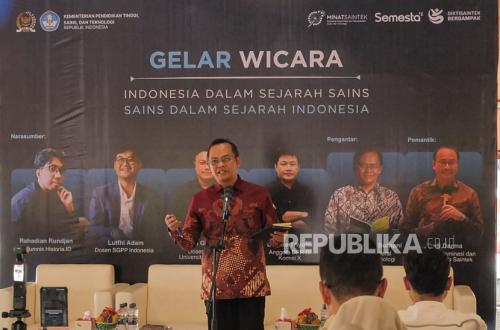
Speaking at a talk show titled ‘Indonesia in the History of Science, Science in the History of Indonesia’ at the Multatuli Museum in Lebak, Banten, Director General of Science and Technology at the Ministry of Higher Education, Science, and Technology, Ahmad Najib Burhani, stated that science is not foreign to Indonesia. He noted that traditions of knowledge developed in the Nusantara through empirical experience in shipping, agriculture, medicine, astronomy, maritime technology, and environmental management. ‘Science is part of the long journey of Nusantara civilisation that needs to be continuously developed to answer future challenges,’ Najib said on Friday (7/8/2026). He added that revisiting this history is important for building a scientific culture and national confidence, stressing that science must be present in daily life and become a basis for decision-making.
Member of Commission X of the House of Representatives, Bonnie Triyana, emphasised the need to view the history of science with greater openness to diverse sources of knowledge. He argued that local knowledge should not be pitted against modern science but should be elevated, critically studied, and elaborated upon within scientific development. Bonnie put forward the idea of the pluriversality of knowledge, an acknowledgment that knowledge can grow from various experiences, cultures, and societal contexts. This approach does not reject scientific rationality but prevents science from adopting a single worldview that might ignore long-lived community knowledge.
Director of Dissemination and Utilisation of Science and Technology, Yudi Darma, explained that the challenge of strengthening scientific culture is not just about public trust in science, but also public engagement in scientific activities and conversations. A 2025 National Survey on Perception and Interest in Science and Technology, conducted with the Indonesian Survey Institute (LSI) involving 1,203 respondents, showed that 87.9 percent of the public trust science and 81.1 percent trust scientists and researchers. However, this trust is not yet matched by participation, with 88.2 percent of the public not involved in science and technology activities and 74.3 percent admitting they never discuss science and technology. Yudi stated that this shows a need for more spaces for the public to discuss and interact with the scientific process.
During the discussion session, panellists illustrated Indonesia’s long-standing role in scientific development. Luthfi Adam, a lecturer at SGPP Indonesia, cited the Bogor Botanical Gardens in the 19th century as a major centre for tropical botanical research, highlighting the significant but often unrecorded contributions of local staff in specimen collection and knowledge production. Budi Gustaman, a history lecturer at Padjadjaran University, pointed out that scientific knowledge can be found in community practices like reading seasons and animal behaviour, which can be re-examined through scientific approaches. Historia ID columnist Rahadian Rundjan reminded the audience that Nusantara waters have been a crucial space for global scientific expeditions since the 18th and 19th centuries. Through this talk show, the ministry encouraged that the history of science should not remain a past archive but be rediscovered, maintained, and disseminated to form the foundation of a scientific culture and strengthen Indonesia’s contribution to global knowledge.
Source: jawawa.id (https://jawawa.id/newsitem/revisiting-the-traces-of-nusantara-science-is-key-to-building-a-scientific-culture-and-national-confidence-1786459917)
Originally published by Republika (https://rejogja.republika.co.id/berita/tjlw7b291/baca-kembali-jejak-sains-nusantara-penting-untuk-bangun-budaya-sains-dan-kepercayaan-diri-bangsa), translated from Indonesian