
Revision of Election Law Deemed Necessary to Regulate Small Party Coalitions to Reduce Wasted Votes
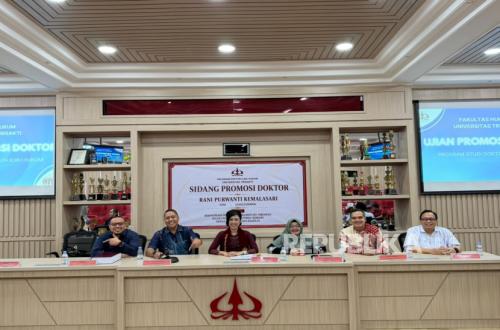
The discourse on revising the Election Law ahead of the 2029 General Election has reignited debate over the parliamentary threshold. Amidst these discussions, academics see the need for a new formulation capable of maintaining the stability of the political system without sacrificing voters’ rights to representation. One proposal emerged from Rani Purwanti Kemalasari during a doctoral promotion hearing at the Faculty of Law, Trisakti University. Through her dissertation, Rani offers a coalition mechanism for political parties that do not meet the parliamentary threshold, so that voters’ votes can still be converted into seats in the DPR. According to Rani, the implementation of the parliamentary threshold has had the important goal of simplifying the party system, strengthening the presidential system, and increasing the effectiveness of parliament’s work. However, the policy has also given rise to the phenomenon of wasted votes. “Conceptually, the parliamentary threshold has a strategic function to support government stability, strengthen the presidential system, and increase the effectiveness of parliament’s work,” Rani said. She considers the issue of wasted votes to potentially diminish the meaning of popular sovereignty, as not all voters’ votes obtain political representation in parliament. This condition is also seen as being out of step with the principle of a proportional electoral system. Rani explained that the urgency for regulatory change has strengthened following Constitutional Court Decision Number 116/PUU-XXI/2023. The Court declared the 4 per cent parliamentary threshold constitutional for the 2029 Election and beyond, but requested lawmakers formulate a new arrangement before the next election is held. As a comparison, Rani examined practices in the Philippines, Poland, and Turkey. These countries maintain a parliamentary threshold for political stability but provide space for small parties through electoral coalition mechanisms. “The Philippines, Poland, and Turkey demonstrate that simplifying the party system does not have to sacrifice political representation. Coalition mechanisms can minimise wasted votes while maintaining the stability of the political system,” she said. Based on her research, Rani proposes that the 4 per cent parliamentary threshold be maintained in the revision of the Election Law. However, political parties that do not meet the threshold would be given the opportunity to form a coalition with other parties so their accumulated vote tally can reach 4 per cent nationally. In her proposal, the formation of a coalition must be made in writing and registered with the General Elections Commission (KPU) no later than seven days before polling day. She believes this scheme could be a middle way between the need to maintain government effectiveness and the protection of citizens’ political rights. “Small parties that do not reach the threshold can still combine their political strength so that voters’ votes are not simply lost and still have the chance to be converted into political representation,” she said. Rani hopes the new formulation can be considered in the revision of the Election Law. Besides reducing the number of wasted votes, the coalition mechanism is also considered to have the potential to strengthen the constitutional resilience of election regulations. She also encouraged the government and the DPR not to focus on eliminating the parliamentary threshold, but rather to perfect its regulation through a clear pre-election coalition mechanism. On the other hand, the KPU needs to prepare transparent and accountable technical rules so that the scheme can be implemented effectively ahead of the 2029 Election.