
Revealed! This is the Plan for Continuing IKN Development in 2027
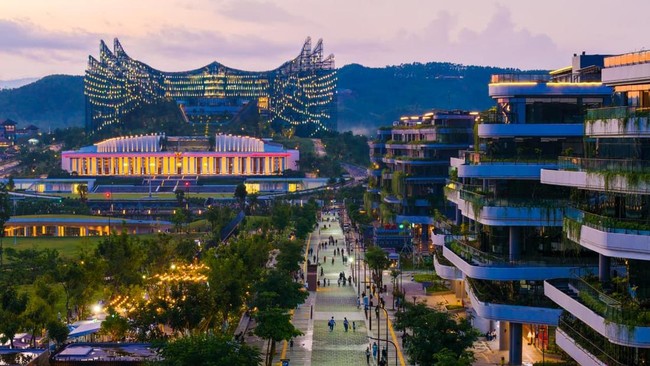
Jakarta, CNBC Indonesia - The administration of President Prabowo Subianto has included plans for the continuation of the Nusantara Capital (IKN) project development as part of the 2027 Government Work Plan (RKP).
In the initial draft of the 2027 RKP prepared by the Ministry of National Development Planning (PPN)/Bappenas, IKN is confirmed to function as a catalyst for regional growth, enhancing connectivity, promoting population distribution, and opening new economic opportunities outside Java.
“Continuing the development of the government ecosystem in IKN supported by integration with surrounding regional development,” as stated in the 2027 RKP document, Friday (8/5/2026).
Based on the 2027 RKP, IKN development is also planned to involve investments from State-Owned Enterprises (BUMNs) amounting to Rp80 billion.
Additionally, it is established as an important part of the development of the “Nusantara Economic Superhub” in line with the mandate of the 2025-2029 National Medium-Term Development Plan (RPJMN) and efforts to strengthen Kalimantan’s role as a strategic hub in reducing disparities.
“Acceleration of economic diversification is needed through the development of downstream industries based on natural resources, strengthening connectivity between strategic areas, including corridors supporting the Nusantara Capital (IKN),” as stated in the 2027 RKP document.
In its implementation, the continuation of the IKN development process in 2027, as planned, includes accelerating the completion of building construction in the Core Government Centre Area (KIPP), which encompasses the legislative and judicial office complexes, as well as state vertical housing to support the next phase of civil servant (ASN) relocation.
Furthermore, strengthening internal and external connectivity of IKN will be achieved through the completion of road developments in areas 1B, 1C, and WP-2, as well as optimising supporting roads for KIPP 1A to ensure smooth logistics and regional accessibility.
Expansion of basic environmental infrastructure provision in the IKN Area (KIKN) will also be carried out through the construction of drinking water pipeline networks and macro drainage systems (retention ponds) for mitigating urban flood risks.
In line with national regional development priorities, the development of Kalimantan Island, the location of IKN, will receive special attention in 2027, driven through five main focuses.
First, integrating city planning with surrounding areas within the framework of metropolitan regional development, including developing mass transportation systems and managing urban areas in an integrated manner, as well as continuing the development of the government ecosystem in IKN supported by integration with surrounding regional development.
Second, accelerating the equitable distribution of basic services, particularly in remote areas, to narrow disparities in human resource quality between regions, while optimising transmigration areas as new economic growth centres based on sustainable agriculture.
Third, developing connectivity networks and transportation hubs to open market access and reduce logistics costs, connecting cross-regional areas to create a superhub, and including connections between islands and the mainland.
Fourth, accelerating economic diversification to reduce vulnerability to global price fluctuations and promote broader formal job creation through downstreaming of flagship commodities, by preparing industrial zones and special economic zones for superhub development, as well as developing food production centres or food barn areas to expand the non-extractive economic base, while realising food sovereignty and accelerating welfare equity in rural areas.
Fifth, strengthening investment in human capital through improving access and quality of vocational education, reducing stunting, and enhancing basic health services.
In the 2027 RKP, the government considers the success of implementing the direction, strategy, and focus of regional development inseparable from good local governance through cross-authority collaboration (central-regional), sectors, and stakeholders, particularly the Nusantara Capital Authority (OIKN).
OIKN needs to build a framework of close cooperation with surrounding local governments, primarily East Kalimantan Province and partner districts/cities, including Samarinda City, Balikpapan City, North Penajam Paser Regency, and Kutai Kartanegara Regency, in synchronising spatial planning, division of public service authorities, management of social and environmental impacts, and synchronisation of industrial zone developments as the Nusantara Economic Superhub.