
Revealed: The Reasons Behind IHSG's 1% Surge
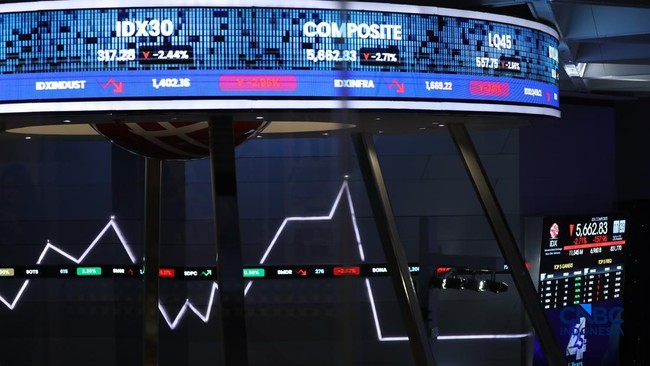
The Jakarta Composite Index (JCI) surged in trading on Wednesday (12/8/2026), after a sharp correction the previous day. Based on data from the Indonesia Stock Exchange (IDX), at 12.00 WIB the JCI stood at 6,330.56, appreciating 1.00% from the previous close.
By the lunch break, transaction value reached Rp 7.92 trillion with trading volume of 19.43 billion shares across 1.18 million transactions. A total of 449 stocks rose, 171 fell, and 170 remained unchanged.
The most actively traded issuers this morning included CUAN, TPIA, DSSA, PTRO and BMRI.
Throughout today’s trading, the JCI moved in a range from 6,272 (+0.08%) to a high of 6,339 (+1.15%).
The majority of trading sectors strengthened, with the highest gains recorded by the utilities, technology and basic materials sectors. Meanwhile, the healthcare and industrial sectors contracted today.
Specifically, conglomerate issuers recorded a united surge ahead of the MSCI announcement, particularly shares belonging to the Barito Group owned by Indonesia’s richest person, Prajogo Pangestu. Four Prajogo shares were the main drivers of the JCI’s performance today: BREN, BRPT, CUAN and PTRO.
Other issuers that also supported the index’s positive movement included DCII, ISAT, BRMS, DSSA, VKTR and BBCA.
Indonesia’s financial market on Wednesday (12/8/2026) faces two important agendas: the release of United States inflation data and the MSCI August 2026 Index Review announcement.
Inflation data will determine the direction of the US dollar, US Treasury yields, the rupiah and global stock markets. Meanwhile, the MSCI review results are of particular interest to domestic investors because they can affect the weighting of Indonesian shares and foreign flows.
The main agenda on Wednesday evening is the release of US inflation for July. Annual inflation is expected to ease to 3.4% from 3.5% in June.
However, on a monthly basis, consumer prices are expected to rise again by 0.1% after falling 0.4% in June. The previous month’s decline was largely influenced by weaker energy prices.
Core inflation, which excludes food and energy prices, is expected to fall to 2.5% annually from 2.6%. On a monthly basis, core inflation is projected to rise 0.2% after remaining unchanged in June.
The market will pay greater attention to core inflation because this indicator reflects more fundamental price pressures. Its components include housing costs, healthcare services, transportation and various other services.
Beyond the headline figure, investors need to watch the movement of services and housing prices. Persistent pressure on these two components could indicate that the disinflation process is not yet proceeding evenly.
Lower-than-expected inflation could increase the likelihood of a Federal Reserve rate cut and pressure the US dollar and US Treasury yields. Conversely, a higher figure could prompt the Fed to maintain tight monetary policy for longer.
In addition to US inflation, domestic investors will scrutinise the MSCI August 2026 Index Review announcement scheduled for Wednesday (12/8/2026), equivalent to early Thursday (13/8/2026) WIB.
Changes from the review will take effect from 1 September 2026 but will enter a transition period from the announcement date.
However, this rebalancing is not proceeding normally for Indonesian shares. MSCI is still maintaining a freeze on a number of index changes due to concerns about transparency of share ownership structures, accuracy of free float calculations, and suspected coordinated trading activity.
In the August review, MSCI will not add Indonesian shares to the MSCI Investable Market Indexes. Increases in the Foreign Inclusion Factor (FIF) and the number of shares counted in the index also remain frozen.
In addition, there will be no upgrades for Indonesian shares based on market capitalisation size, including moves from the Small Cap index to Standard.
Nevertheless, MSCI can still remove shares that fall within the High Shareholding Concentration framework. The index provider can also adjust free float estimates based on disclosure data for shareholders with ownership above 1%.
This means the opportunity for adding new shares and increasing weightings remains closed. Conversely, reductions in weightings or removal of certain shares can still occur. This condition could restrain sentiment towards the JCI because it opens the risk of foreign fund outflows without providing balanced inflow opportunities.
MSCI acknowledged the reforms announced by the Financial Services Authority (OJK), the Indonesia Stock Exchange and the Indonesian Central Securities Depository (KSEI). These measures include improving disclosure of shareholders above 1%, more detailed investor classification, implementation of the High Shareholding Concentration framework, and plans to raise the minimum free float requirement to 15%.
However, MSCI wants to see consistent implementation that delivers tangible impact on transparency and ease of investment. Therefore, November will be an important deadline for the Indonesian stock market.
If by November Indonesia’s progress is deemed insufficient, MSCI may consider various options, including initiating consultation on a possible reclassification of Indonesia from Emerging Market to Frontier Market.
Indonesia will not automatically be downgraded to Frontier Market in November. MSCI has only stated that reclassification consultation could begin if the improvements made have not shown adequate results. Nevertheless, this risk remains important because it could affect global fund exposure to Indonesian shares.