
Revealed: The Reason IHSG Surged Over 1%
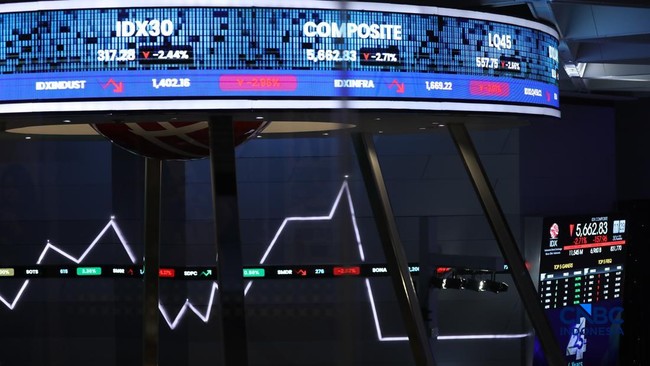
Jakarta, CNBC Indonesia - The Composite Stock Price Index (IHSG) soared in trading on Thursday (30/7/2026), amidst a wait-and-see attitude from market participants responding to a series of important global economic agendas this week. Based on data from the Indonesia Stock Exchange (IDX) up to 10:10 WIB, the IHSG was at 6,158.56, up 1.1% from the previous closing of 6,091.38. This morning, the IHSG moved in the range of 6,106 to 6,168. Transaction value was recorded at around Rp 4.38 trillion with trading volume reaching 9.82 billion shares in 608 thousand transactions. A total of 471 stocks strengthened, 152 stocks weakened, while 153 stocks were stagnant, indicating that selling pressure began to halt at the start of today’s session. The most actively traded stocks today included TPIA, BBCA, BBRI, BUMI and BMRI. Almost all trading sectors strengthened, with weakening only recorded in the utility and health sectors. The raw materials, consumer and financial sectors were recorded as strengthening the most sharply today. Specifically, blue-chip issuers were recorded as the main drivers of the IHSG’s performance. Shares of Bank Central Asia (BBCA), Telkom Indonesia (TLKM), Bank Mandiri (BMRI), Amman Mineral (AMMN) and Bank Negara Indonesia (BBNI) were the main supporters of the IHSG’s performance this morning. Today’s significant strengthening occurred after the IHSG was in the red for 6 consecutive trading days. The IHSG’s strengthening also occurred in response to Asian stock exchanges starting to recover, after the South Korean (KOSPI) and Japanese (Nikkei 225) benchmark stock indices previously plunged due to a sell-off in technology stocks. Indonesian and global financial markets are actually facing heavy pressure due to a combination of negative geopolitical sentiment, and the shift in aggressive central bank policy direction. The conflict in the Middle East escalated sharply after a US gas tanker was hit by a drone in Egypt, followed by mutual missile attacks between Iran, the US military, and Saudi Arabia. This situation has triggered serious concerns about global energy supply disruptions. As a direct impact of the heating up war, crude oil prices soared significantly—Brent oil flew 7.9% to US$ 90.74 per barrel and WTI soared 6.56% to US$ 84.46 per barrel—risking triggering a new wave of inflation. From the United States, The Fed decided to hold interest rates in the range of 3.50-3.75%, but was accompanied by a strong hawkish signal and the widest dissent among officials since 2016. The market is also awaiting the release of PCE inflation data and US second-quarter economic growth which is projected to remain strong, reinforcing the likelihood that high interest rates will persist for longer. Meanwhile, the European region is also in focus with the Bank of England (BoE) meeting and the release of Eurozone GDP and inflation data. The technicality of this tight global interest rate policy reinforces risk-off sentiment in international markets. Amidst these external pressures, the domestic scene is coloured by the opening of the GIIAS 2026 automotive exhibition at ICE BSD. This event is expected to boost transactions, manufacturing activity, and support household consumption and domestic economic growth in the second half of 2026. Asia-Pacific stock exchanges opened variably on Thursday (30/7/2026), as investors scrutinised The Fed’s interest rate decision and the mixed financial reports of giant US technology issuers. Japan’s Nikkei 225 index weakened 0.25%, Topix fell 0.59%, Kosdaq corrected 0.73%, and Australia’s S&P/ASX 200 fell 0.26%, while South Korea’s Kospi actually strengthened 0.89% after plunging the previous day. Market sentiment was also overshadowed by a surge in the yield on US 30-year government bonds which rose 10 basis points to above the 5.2% level—the highest since 2007—a reaction to The Fed’s decision to hold rates with a hawkish tone. The performance of US technology issuers showed contrasting results due to different artificial intelligence (AI) investment strategies. Meta Platforms shares plunged 7% after releasing a revenue projection weaker than expectations and being burdened by high AI investment costs, while Microsoft soared 8% driven by strong growth in its Azure cloud computing business. This difference reflects how the efficiency of AI investment is now a major determinant of investor confidence in technology company profitability. Going forward, the focus of global market participants is on a number of important US macroeconomic data releases, including weekly jobless claims, the preliminary estimate of second-quarter real GDP, and June PCE inflation data which is projected to grow 3.7% annually. In addition, the continuation of the financial reporting season is still awaited with the release of performance from Bristol-Myers Squibb, Amazon, Apple, and Coinbase.