
Revealed! How Trenggono Was Appointed as Minister by Prabowo
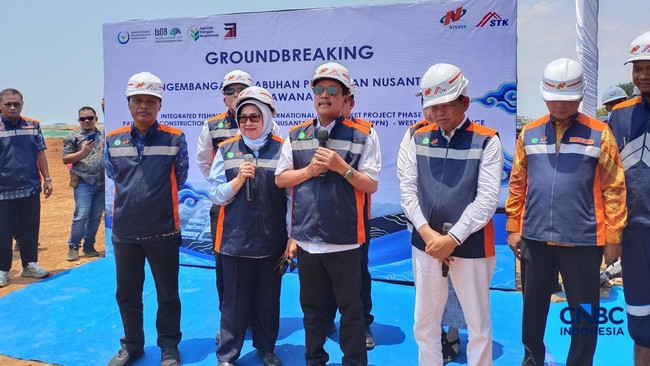
The Minister of Marine Affairs and Fisheries, Sakti Wahdu Trenggono, has revealed the story of his entry into the government and how he eventually earned the trust to serve as Minister. The story began when he served as the Deputy Minister of Defence, assisting Prabowo Subianto, who was the Minister of Defence at the time.
Trenggono admitted that he initially felt nervous during his early days as a government official. He recounted his journey into the Ministry of Marine Affairs and Fisheries during the groundbreaking ceremony for the development of the Kejawanan Nusantara Fishing Port (PPN) in Cirebon, West Java, on Thursday (17/9/2026).
“I have been a minister for five years. When I entered as a minister in early 2021, I was still learning. It was like being in school. I was nervous on both sides,” Trenggono said in his speech.
Before becoming the Minister of Marine Affairs and Fisheries, Trenggono served as the Deputy Minister of Defence from 2019 to 2020, working alongside Prabowo. He was subsequently inaugurated as the Minister of Marine Affairs and Fisheries on 23 December 2020.
Trenggono revealed that his transition to becoming a Minister occurred because he was encouraged by Prabowo, who was then the Minister of Defence. “I felt pushed… pushed by Mr Prabowo. He said, ‘You should be a minister, don’t just be my deputy, become the Minister of Marine Affairs and Fisheries’. Oh, heavens. That is what happened,” he recounted.
After assuming his role, Trengundgo began travelling across various regions of Indonesia to personally observe the conditions of fishing villages and fishing ports. However, his first experiences were quite shocking.
“I travelled across Indonesia, and what I saw were fishing villages and settlements. Then I saw the port infrastructure. Once that was done, I thought, ‘Oh dear, why does it smell like this? Why would I want to be the Minister of Marine Affairs and Fisheries?’” he shared.
This experience led Trenggono to compare the condition of Indonesian fishing ports with several countries he had visited. He travelled to Japan, Australia, and various European nations to observe the management of fishing villages and ports.
“I travelled the world; I went to Japan, Australia, and Europe. The fishing villages were excellent. The ports were also great. There were no ports that were smelly, slum-like, or anything of the sort,” said Trenggono.
Based on these observations, Trenggono began contemplating how to transform the face of Indonesian fishing ports to be more modern, clean, and productive. “This is a reform. We are implementing fundamental changes; we are improving them. Certainly, if the ports are good, the product quality will also be good,” Trenggeno stated following the groundbreaking event.
One such effort is currently being realised through the development of the Kejawanan PPN. The project, funded via a loan from the Islamic Development Bank (IsDB), is valued at approximately Rp459 billion.
The development of Kejawanan PPN aims to increase port capacity. The vessel capacity is projected to rise from 241 units to 500 units. Fish production is also targeted to surge from 5,600 tonnes to 32,000 tonnes per year.
Furthermore, labour absorption is projected to increase from around 2,900 people to 8,000 people, while non-tax state revenue is targeted to rise from Rp15 billion to Rp53 billion.
Trenggono stated that the transformation of the port is not solely aimed at increasing fisheries production. The government also intends to integrate port functions with the tourism sector.
“The dream is a modern, beautiful, and clean fishing port that is odourless, and truly combined with the tourism and thematic sectors according to the local characteristics,” he concluded.