
Revealed: Government Outlines the Benefits of the Free Nutritious Meals Programme
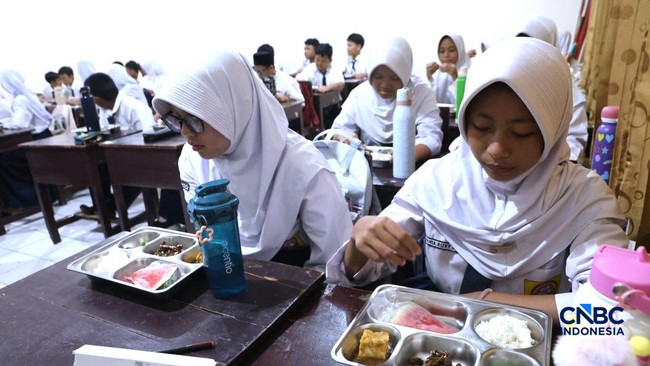
Jakarta, CNBC Indonesia – The government’s efforts to promote the Free Nutritious Meals (MBG) programme are intended not only to improve people’s nutritional intake, but also to create economic opportunities for local businesses.
By involving micro, small and medium-sized enterprises (MSMEs), cooperatives, village-owned enterprises (BUMDes), farmers and livestock breeders in the food supply chain, the programme could expand markets for local products and stimulate regional economic activity.
National Nutrition Agency (BGN) data as at 9 October 2026 show that 63,608 suppliers are involved in MBG across 37 provinces. Of these, 52,689, or 82.83 per cent, are MSMEs. The rest comprise 9,388 suppliers from cooperatives, 1,105 from BUMDes and 426 from Merah Putih Village Cooperatives.
BGN head Sudaryono said the programme was also designed to deliver economic benefits to local businesses and food producers.
“The programme has an impact on the local economy by empowering MSMEs, farmers and livestock breeders. The main requirement is that all food ingredients must be appropriate and meet food-safety standards,” Sudaryono said, as quoted on Tuesday (27 October).
The extensive involvement of MSMEs in the MBG supply chain points to opportunities for community-based businesses to take part in a nationwide programme.
Demand for ingredients for nutritious meals creates a market for suppliers, from product provision to the distribution of food to Nutrition Fulfilment Service Units (SPPGs).
During President Prabowo Subianto’s first two years in office, MBG has become one of the programmes linking efforts to improve human capital with the economic empowerment of communities.
Its economic benefits could widen further if the programme’s needs are met through sustainable partnerships with local producers and businesses.
MBG strengthens supply chains and opens markets for local businesses
The programme involves a range of participants across the food ecosystem. Farmers and livestock breeders can supply food, cooperatives can bring together members’ products, and MSMEs and BUMDes can take part in supplying or distributing food requirements.
Under this model, SPPGs are key points connecting the programme’s needs with suppliers. Procurement from local producers could create markets for businesses near service areas while ensuring steady demand.
Sudaryono also stressed the importance of prioritising food sourced locally so that communities benefit from the programme’s economic impact. He made the remarks in response to a proposal from state logistics company Bulog to supply premium rice for MBG.
“We view Bulog’s proposal positively. However, we want to make clear that the MBG programme will continue to prioritise food sourced from the local area. We want local farmers, traders and MSMEs to share in the economic activity generated by the programme,” Sudaryono said.
BGN welcomed Bulog’s proposal as support for meeting MBG’s rice requirements. The supply could provide an alternative when local stocks are insufficient, while food sourced locally would remain the priority. This principle is consistent with efforts to strengthen local producers’ role in the programme’s supply chain.
One example of how this is being implemented is the procurement of eggs for MBG in East Java. According to BGN materials, SPPGs in the province are required to buy eggs from local livestock breeders three times a week.
The reference price is about Rp24,000 per kilogram at the farm-gate level, with estimated purchases equivalent to 8–10 per cent of East Java’s total egg production. The arrangement is intended to open up a market for breeders and boost regional economic activity.
Strengthening local supply chains also gives cooperatives scope to enhance their members’ economic role. By consolidating products from farmers and livestock breeders, cooperatives can widen market access and build more organised business relationships with programme operators.
However, the economic benefits will depend on how procurement works in practice, including local suppliers’ participation, continuity of demand, product quality, fair prices and timely payments to suppliers.
More than one million staff and volunteers involved
In addition to creating opportunities for suppliers, MBG’s implementation involves a large workforce. BGN data through September 2026 record 1,027,998 staff and volunteers active in the programme, comprising 86,120 SPPG staff and 941,878 volunteers.
The figure illustrates the scale of operational activity required to support the programme across the country. However, the number of staff and volunteers should be interpreted according to the categories recorded by BGN, as not all of them are formal employees or paid workers.
In terms of service reach, BGN data as at 9 October 2026 record 26,385 SPPGs under the second interim determination letter for beneficiary families (KPM), with 433,571 beneficiary groups and a total of 57,491,334 beneficiaries.
Meanwhile, data through September 2026 record budget realisation of Rp149.79 trillion and coverage of 53,906,576 beneficiaries. The two beneficiary figures relate to different reporting periods.
The programme’s extensive reach indicates the scale of food demand that must be met consistently. In terms of economic empowerment, that demand offers local producers and suppliers an opportunity to participate, provided they can meet standards for quality, food safety, pricing and continuity of supply.
Going forward, stronger partnerships with MSMEs, farmers, livestock breeders, cooperatives and BUMDes will be important to expanding the programme’s economic benefits.
Evaluation should also cover changes in MSME turnover, farmers’ and livestock breeders’ income, the continuity of procurement contracts, and the distribution of business opportunities across regions.
MBG therefore has the potential to bring together two development goals: improving people’s nutrition and strengthening local economic activity.
As the government marks two years of its work, the programme’s success will be reflected not only in the breadth of its services, but also in efforts to build a supply chain that enables community businesses to grow alongside it.
Source: jawawa.id (https://jawawa.id/newsitem/revealed-government-outlines-the-benefits-of-the-free-nutritious-meals-programme-1793083901)
Originally published by CNBC Indonesia (https://www.cnbcindonesia.com/news/20261027130217-4-779837/terungkap-pemerintah-beberkan-sederet-manfaat-program-mbg), translated from Indonesian