
Revealed: China's 24-Hour Surveillance Tactics to Spy on Global Citizens
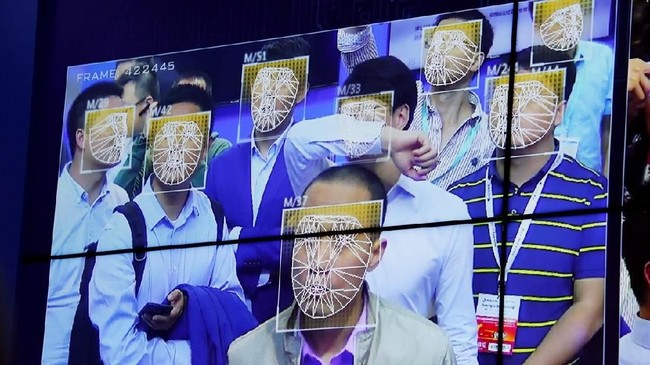
Jakarta, CNBC Indonesia - A startling discovery has revealed the extent to which the Chinese authorities carry out surveillance of foreign nationals. The movements of tourists, journalists and foreign students were monitored in real time, down to details of transactions and train seat numbers.
The scandal came to light by accident when Marc Hofer (46), a cyber security researcher and journalist from Amsterdam serving as a correspondent in China, was carrying out a routine scan early this year. Hofer discovered an open site called the “Dynamic Control Platform for Overseas Personnel”.
This Chinese-built platform had a futuristic appearance reminiscent of a scene from the sci-fi film Minority Report, and was designed specifically to track the whereabouts of foreign nationals in Zhangjiakou, the host city of the 2022 Winter Olympics and a popular ski destination in China.
Ironically, the sophisticated system containing sensitive data could be accessed by the public. The login credentials were filled in automatically when the site’s page was opened.
While browsing the dashboard, Hofer was shocked to find a photo of himself along with his passport number and a telephone number he had previously used in China.
“Anyone who entered data there had access to the real data,” said Hofer, quoted by The New York Times on Monday (3/8/2026).
The monitoring dashboard contained nearly 12,000 data entries. The categories tracked were highly specific, ranging from:
300+ foreign journalists
International students (predominantly from India and Pakistan)
Members of the “Five Eyes” alliance (the United States, the United Kingdom, Canada, Australia and New Zealand)
Nationals from “key countries” (Iran, Egypt, Israel, Pakistan, Sudan, Morocco)
Residents from Hong Kong and Taiwan
Lists of fugitives and “key persons” (a Chinese euphemism for activists or threats to stability)
Beyond static data such as names and passport numbers, the system integrated facial recognition with medical histories, gas payment transactions, medical record numbers, and even airline and railway seat numbers.
The fallout of “surveillance sprawl” and the police vendor project
According to an investigation by The New York Times, the platform was connected to Origin Dynamic, a Beijing-based company providing robotics technology and surveillance systems for the Chinese police. The company is known to be partly owned by the Yancheng Municipal Government in Jiangsu Province.
Origin Dynamic even filed a patent in 2023 for a “non-Chinese citizen information interface” whose design was identical to the Zhangjiakou platform.
Greg Walton, a senior investigator at the SecDev Group, assessed the leak as a consequence of the rampant surveillance sprawl in China. The excessive involvement of private vendors, contractors and police agencies has itself created new security gaps.
“Every time there is a new platform, there are more points where sensitive personal data can be misconfigured, copied or exposed,” Walton explained.
Religious discrimination to the tracking of social relationships
The system not only tracked location but also deeply categorised personal identity. Profiles of foreign students at Hebei North University, for instance, included religious data and marital status, and even mapped friendship networks.
If three foreign nationals were caught on camera walking together in a public area, the AI system would automatically draw a relationship network connecting the three of them.
Maya Wang, a human rights expert at Human Rights Watch, stressed that this level of data integration had never been seen before in any other country.
“It illustrates how China completely lacks privacy protection laws or safeguards against arbitrary action by the authorities,” Wang asserted.
Since Hofer’s findings emerged and were downloaded in January, the platform was finally taken completely offline by the Chinese authorities in May. At the time of writing, both Origin Dynamic and the Zhangjiakou police declined to comment.